Introduction
You want a pair of glasses that say something — without saying a word. But luxury eyewear is full of brands charging premium prices for average quality. Cartier glasses stand apart because they are not just eyewear. They are precision-crafted objects made from platinum, titanium, and 18k gold, shaped by artisans who have been perfecting the same techniques for over 50 years. This guide covers everything you need — styles, prices, materials, authenticity checks, and smart buying tips — so you spend your money right the first time.
What Makes Cartier Glasses Different From Other Luxury Eyewear?
Cartier glasses occupy a category of their own in the luxury eyewear market. Most designer eyewear brands license their names to third-party manufacturers. Cartier does not. Every frame collection goes through Cartier’s own design studios in Paris before production begins, and finishing is handled by specialized ateliers with direct oversight from the maison.
The difference shows up in the details. Hinges on Cartier optical frames use screws so fine they require jeweler-grade tools to adjust. Temple arms are weighted and balanced so the glasses sit evenly without nose pad pressure. These are not cosmetic touches — they reflect a manufacturing philosophy borrowed directly from Cartier’s fine jewelry tradition.
Cartier registered its first eyewear design in 1983. Since then, the brand has built a catalog of frames that routinely appear on heads of state, collectors, and style icons across generations. The longevity of specific designs — particularly the Santos and Panthere lines — confirms that these glasses are built to last decades, not seasons.
How Many Cartier Glasses Collections Are There?
Cartier organizes its eyewear into distinct collections, each with its own design DNA. Understanding the collections helps you find the right fit for your face shape, style, and budget.
Santos de Cartier The Santos is the flagship eyewear line, inspired by Cartier’s legendary Santos watch. Square or rectangular frames with visible screws on the front plate are the defining features. The Santos works equally well as an optical frame and as a sunglasses silhouette. Materials range from brushed titanium to gold-plated steel.
Panthère de Cartier The Panthere collection leans feminine and fluid. Rounded shapes, subtle cat-eye lifts, and smooth edges define this line. It is the most jewelry-like of all Cartier glasses collections, often featuring pavé diamond or sapphire accents along the temple.
C de Cartier The C de Cartier line takes its signature element — the interlocking double-C motif — and makes it the focal point of the frame design. The double-C appears at the hinge or temple junction. These frames are bold, immediately recognizable, and popular with buyers who want visible brand identity.
Signature C de Cartier A refined variation of the C line, offering slimmer profiles and more understated finishes for buyers who want the Cartier name without the logo-forward aesthetic.
Première de Cartier Inspired by the Place Vendôme in Paris, this collection features architectural shapes with geometric precision. The Première reads as both modern and classic, making it a strong choice for professional settings.
Trinity de Cartier Drawing from the iconic Trinity ring — three interlocked bands in white, yellow, and rose gold — this collection translates the same tricolor concept into eyewear temples and frames.
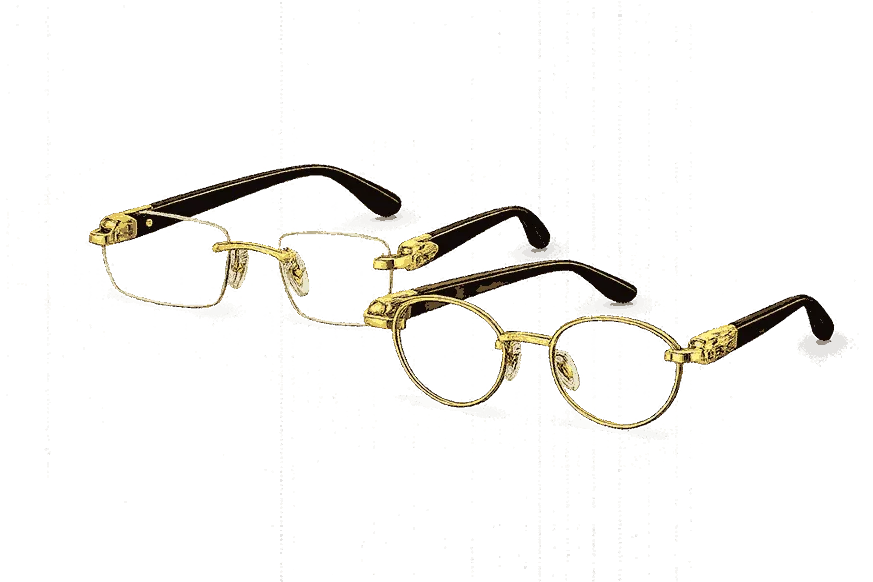
Frameless and Semi-Rimless Lines Cartier also produces rimless optical glasses with wire-thin titanium bridges and minimal nose pieces. These frames are among the lightest the brand makes, often under 15 grams total.
What Materials Are Used in Cartier Glasses Frames?
The material composition of Cartier glasses is one of the clearest indicators of their value and durability. Cartier uses materials that most eyewear brands reserve for jewelry.
Platinum: Used in limited-edition and high-jewelry eyewear pieces. Platinum frames are exceptionally dense, hypoallergenic, and tarnish-resistant. They are the rarest Cartier glasses material.
18k Gold: Yellow, white, and rose gold appear across multiple collections. Gold frames are either solid or used as plating over a titanium base. Solid gold frames are custom order only.
Titanium: The primary structural material for many Cartier optical and sunglasses frames. Titanium offers a strength-to-weight ratio that no steel alloy matches, and it is fully hypoallergenic.
Gold-Plated Steel: Used in accessible-tier Cartier frames. The plating is thick by industry standards — Cartier specifies a minimum micron count above what most luxury competitors use.
Buffalo Horn and Acetate: Select collections use ethically sourced buffalo horn or premium Italian acetate for temples and fronts. These materials add warmth and texture contrast to metal frames.
Lens Materials: Cartier uses Carl Zeiss Vision and its own optical laboratory for prescription lenses. Sunglass lenses are available in mineral glass, CR-39, and polycarbonate, depending on the collection.
How Much Do Cartier Glasses Cost? Full Price Breakdown
Cartier glasses pricing reflects both the material content and the manufacturing process. The range is wide, giving buyers at different budget levels genuine entry points.
| Collection | Frame Type | Price Range (USD) |
| C de Cartier | Sunglasses | $650 – $950 |
| Santos de Cartier | Optical / Sun | $800 – $1,400 |
| Panthere de Cartier | Optical / Sun | $900 – $2,200 |
| Première de Cartier | Optical | $1,100 – $1,800 |
| Trinity de Cartier | Optical / Sun | $1,200 – $2,500 |
| Rimless Titanium | Optical | $1,500 – $3,500 |
| Diamond / Gemstone Editions | Optical / Sun | $4,000 – $25,000+ |
| High Jewelry Eyewear | Special Order | $30,000+ |
Prices above are for frames only before prescription lenses. Adding Cartier-branded Carl Zeiss lenses typically adds $300 to $700 depending on the lens type and prescription complexity.
Pre-owned Cartier glasses from reputable dealers sell at 30–60% below retail while retaining most of the material value, particularly for gold and platinum pieces.
Where Can You Buy Authentic Cartier Glasses?
Buying authentic Cartier glasses requires using verified channels. Fakes exist across every price tier, including high-quality counterfeits sold at 60–70% of retail price on secondary markets.
Authorized Sources:
- Cartier boutiques (flagship and regional stores globally)
- Cartier’s official website (cartier.com) with region-specific stores
- Authorized opticians and luxury eyewear retailers listed on Cartier’s dealer locator
- Sunglass Hut boutiques that carry Cartier as a licensed authorized dealer in select markets
Pre-Owned Verified Sources:
- TheRealReal (authentication team trained on luxury accessories)
- Vestiaire Collective (peer authentication with optional expert review)
- Established gray-market dealers who specialize in luxury eyewear with provenance documentation
Avoid purchasing Cartier glasses through general marketplaces like eBay without seller verification, unverified Instagram sellers, and any source that cannot provide original Cartier packaging, documentation, and a serial number.
How to Authenticate Cartier Glasses: 7 Checks That Matter
Authenticating Cartier glasses is non-negotiable if you are buying outside an authorized retailer. Here are the physical checks that separate genuine pieces from copies.
- Serial number engraving: Every authentic pair carries a laser-engraved serial number on the inside of one temple arm. The engraving is crisp, evenly spaced, and readable without magnification.
- Screw quality: The screws on genuine Cartier glasses frames are flush with the surface and have a precise Phillips or flathead slot. Counterfeits often show uneven screw heads or slight misalignment.
- Hinge movement: Authentic Cartier hinges open and close with smooth, consistent resistance. There is no wobble at the hinge point, even after repeated cycling.
- Logo placement: The Cartier wordmark appears in a specific position, typeface, and size on every frame. The font is always the same — a slightly condensed serif — and never appears stamped or printed.
- Nose pad construction: On metal frames, nose pads are attached via small adjustable arms made from the same metal as the frame body. Plastic pads glued to the frame are a red flag.
- Packaging: Authentic Cartier glasses come with a red lacquered case, a polishing cloth with the Cartier logo woven in, and a certificate of authenticity booklet with a matching serial number.
- Weight and finish: Hold genuine and counterfeit frames side by side whenever possible. Gold-plated Cartier frames have a warmth and depth to the finish that plated steel frames with thin plating cannot replicate.
Cartier Glasses vs. Other Luxury Eyewear Brands: Honest Comparison
Buyers considering Cartier glasses often compare the brand to other high-end eyewear houses. Here is an honest side-by-side look.
| Brand | Manufacturing Control | Metal Tier | Starting Price | Resale Value |
| Cartier | In-house / Atelier | Platinum, 18k Gold, Titanium | $650 | High |
| Oliver Peoples | Third-party (Safilo) | Acetate, Titanium | $350 | Moderate |
| Lindberg | Own factory (Denmark) | Titanium, Gold | $500 | High |
| Barton Perreira | Third-party | Acetate, Steel | $380 | Low |
| Dior Eyewear | Licensed (Marcolin) | Acetate, Steel | $420 | Moderate |
| Cartier vs. Dita | Dita owns some production | Titanium, Gold-fill | $600 | High |
Cartier glasses hold their value better than most luxury eyewear because the brand’s fine jewelry reputation anchors perception across categories. Lindberg offers comparable engineering at a lower price point but without the same cultural recognition or resale market depth.
Are Cartier Glasses Good for Everyday Wear?
Yes — with a few practical considerations. Cartier glasses are built for durability, but certain finishes and materials require more care than standard eyewear.
What works well daily:
- Titanium frames handle humidity, sweat, and impact without degrading
- Mineral glass lenses scratch far less than polycarbonate
- The wide range of sizes means most face shapes find a comfortable fit
- Prescription compatibility covers most common corrections including high-index lenses
What to watch:
- Gold-plated steel frames can show wear at high-contact points like nose pads and temples over years of daily use — re-plating is available through Cartier service centers
- Buffalo horn frames should not be exposed to prolonged moisture or extreme heat
- Rimless Cartier optical frames are more fragile at the lens mounting points than full-frame designs — they work better for moderate-use environments
Cartier offers a global repair and maintenance service. Frames can be returned to any Cartier boutique for cleaning, adjustment, re-plating, and hinge repair. This after-sale support significantly extends the practical life of the glasses.
What Cartier Sunglasses Offer Beyond Style
Cartier sunglasses are not cosmetic accessories with a luxury price tag. The optical performance of each sunglass lens meets real visual standards.
UV Protection: All Cartier sunglass lenses provide UV400 protection, blocking 100% of UVA and UVB radiation. This meets the standard required by optometrists for protective eyewear.
Polarization: Select models in the Santos and Panthere collections offer polarized lens options. Polarized mineral glass lenses are available as an upgrade across most frames.
Lens Tint Options: Cartier uses internal lens tints rather than surface coatings in many of their mineral glass options. Internal tints do not chip or peel and maintain optical clarity at the edges of the lens.
Prescription Sunglasses: All Cartier sunglass frames are compatible with prescription lens insertion. Cartier’s optical service converts sunglasses to prescription sunglasses while maintaining the original frame finish and temple design.
Photochromic Options: Transitions-compatible lenses are available for most Cartier optical frames, including the rimless titanium lines.
How to Care for Cartier Glasses the Right Way
Proper care extends both the appearance and the functional life of Cartier glasses significantly.
Daily habits that protect your frames:
- Use both hands to put on and remove glasses — single-hand removal bends temples gradually over time
- Store in the original red lacquered Cartier case or a hard-shell alternative when not wearing
- Clean lenses with the included microfiber cloth or a clean cotton cloth — avoid paper towels, which scratch lens coatings
- Rinse with lukewarm water before wiping — dry wiping grinds fine particles into the lens surface
What to avoid:
- Ultrasonic cleaning machines can loosen stones in gem-set frames and damage coatings on mineral glass lenses
- Ammonia-based lens cleaners strip anti-reflective coatings
- Leaving frames in a hot car causes acetate warping and can deform gold-plated temples
Professional care schedule:
Visit a Cartier boutique or authorized service center once a year for professional cleaning, alignment, and inspection. The service is complimentary with proof of purchase at Cartier boutiques globally.
Cartier Glasses for Men vs. Women: Key Differences
Cartier does not heavily gender-code its eyewear, but certain collections lean toward specific face shapes and aesthetic preferences that align broadly with gendered marketing.
Cartier glasses marketed toward men:
- Santos de Cartier: angular, structured, medium-to-large fit
- Signature C: clean geometric lines, narrow bridge
- Rimless titanium: minimal profile, professional settings
Cartier glasses marketed toward women:
- Panthere de Cartier: rounded silhouettes, gem accents, smaller face fit
- Première de Cartier: elegant architectural shape
- Trinity: tricolor gold detail, medium fit
Many buyers choose across these lines based on fit and face shape rather than gender designation. Cartier boutique staff are trained to recommend based on face measurement and bridge width rather than assumed gender preference. The brand’s online try-on tool uses augmented reality and works with any face.
6 Frequently Asked Questions About Cartier Glasses
Q: Are Cartier glasses actually made of gold? A: Some are. Entry-level frames use gold-plated steel with thick plating. Mid-tier frames use gold-plated titanium. Select limited edition and special-order pieces use solid 18k gold. The product listing always specifies the exact material composition.
Q: How long do Cartier glasses last? A: With normal care and annual maintenance, Cartier titanium and gold frames last 20 to 30 years. The brand’s repair service keeps older frames functional indefinitely. Several Cartier frames from the 1990s remain in production and in active daily use.
Q: Can I get prescription lenses in Cartier frames? A: Yes. All Cartier optical frames accept prescription lenses. Cartier’s own optical service uses Carl Zeiss Vision lenses. Many authorized opticians also cut prescriptions for Cartier frames. High-index lenses work with rimless and semi-rimless designs.
Q: Do Cartier glasses hold their resale value? A: Better than most luxury eyewear. Gold and platinum pieces hold value closest to original retail. Titanium and steel frames typically resell at 40–60% of retail depending on condition and whether original packaging is present. Limited editions from specific years have sold above retail at auction.
Q: What is the difference between Cartier glasses and Cartier sunglasses? A: Cartier glasses refers to optical frames designed to hold prescription lenses. Cartier sunglasses come with pre-installed tinted lenses and UV protection. Many frame designs exist in both categories. The core frame construction is identical — the difference is the lens type and whether the nose pads and bridge accommodate prescription fitting.
Q: How do I know if my Cartier glasses are fake? A: Check the serial number engraving on the temple interior, the quality and flush fit of the screws, the movement of the hinge, and the depth and warmth of the metal finish. Genuine Cartier packaging includes a red lacquered case, a woven-logo cloth, and a documentation booklet with a matching serial. If a seller cannot provide original packaging and documentation, request professional authentication before purchase.
Final Thoughts: Should You Invest in Cartier Glasses?
Cartier glasses are not the right choice for everyone — and that is exactly the point. If you want designer branding on a mass-produced frame, there are cheaper ways to get it. But if you want eyewear built from the same philosophy that produces some of the world’s finest jewelry, made to last decades and serviceable for life, Cartier glasses deliver in a way that almost no other brand can match.
The entry price is real. But so is the return. Frames that last 20 years at $1,200 cost less per year than trendy frames replaced every two seasons at $400. Add genuine optical performance, a global service network, and a resale market that actually exists, and the value calculation changes.
Start at a Cartier boutique. Try the Santos or the Panthere. Ask the staff to walk you through the material options in your budget range. The tactile experience of holding a genuine Cartier frame for the first time tells you more than any article can.
Primary Sources:
- Cartier Official Eyewear Collection — cartier.com/en-us/eyewear
- Carl Zeiss Vision Lens Technology Overview — zeiss.com/vision-care
- The Vision Council — Luxury Eyewear Market Report — thevisioncouncil.org
- GIA (Gemological Institute of America) — Precious Metal Standards — gia.edu
- Safilo Group Annual Report (Luxury Eyewear Manufacturing Benchmarks) — safilo.com/investors