Introduction
Staring at your ceiling fan wondering why your room feels stuffy despite the blades spinning? You’re paying for cooling or heating that’s working against you. The frustration ends here. Your ceiling fan has a simple switch that changes everything—cutting energy bills up to 40% while keeping every season comfortable. This complete guide reveals exactly how to use ceiling fan direction to transform your home’s climate control.
Why Ceiling Fan Direction Actually Matters for Your Comfort
Your ceiling fan isn’t just decoration that moves air randomly. The direction those blades spin determines whether you feel cooler in summer or warmer in winter.
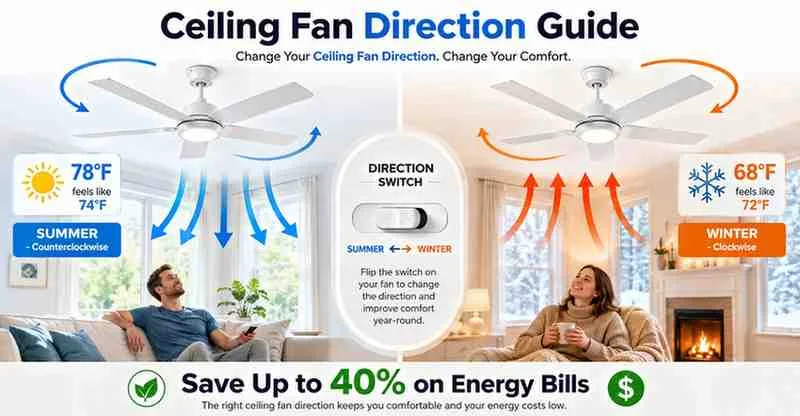
Physics plays the starring role here. When blades rotate counterclockwise, they push air straight down, creating that pleasant breeze across your skin. This wind-chill effect makes you feel 4-8 degrees cooler without changing the actual temperature.
Reverse the spin to clockwise, and the blades pull air upward. Warm air trapped near your ceiling gets redistributed throughout the room. You’ll notice the difference immediately—especially in rooms with high ceilings where heat naturally rises.
Most homeowners never touch that direction switch. They’re missing out on year-round benefits that cost nothing extra.
Ceiling Fan Direction for Summer: Maximize Your Cooling Power
Summer demands maximum cooling efficiency.When you glance up at your ceiling fan, set it to spin counterclockwise.
Here’s what happens:
- Blades angled to push air downward
- Creates direct breeze on your skin
- Evaporates moisture from your body
- Produces instant cooling sensation
Run your fan on medium to high speed during hot months. The stronger airflow amplifies the cooling effect.
According to the U.S. Department of Energy, proper fan direction lets you raise your thermostat by 4°F without sacrificing comfort. That translates to 30% savings on air conditioning costs during peak summer months.
Summer ceiling fan direction checklist:
- Counterclockwise rotation (viewed from below)
- Medium to high speed settings
- Use alongside AC, not as replacement
- Turn off when leaving the room (fans cool people, not rooms)
Ceiling Fan Direction for Winter: Keep Warm Air Where You Need It
Cold months require a different strategy. Switch your ceiling fan to clockwise rotation when temperatures drop.
Winter heating creates a frustrating problem. Furnaces warm the air, which immediately floats to your ceiling. You’re heating the top portion of your room while sitting in the cooler lower section.
Clockwise fan rotation solves this waste. The blades gently pull air upward and push it along the ceiling. This redirects trapped warm air down the walls and back into your living space.
In the winter, run your fan at its lowest speed. . You want gentle redistribution, not a chilling breeze.
Winter benefits:
- Even temperature distribution floor to ceiling
- Lower thermostat settings maintain comfort
- Reduced furnace runtime
- Energy savings up to 15% on heating bills
The National Renewable Energy Laboratory confirms that proper winter fan use reduces heating costs significantly in homes with ceilings 8 feet or higher.
Winter ceiling fan direction settings:
- Clockwise rotation (viewed from below)
- Low speed only
- Best for rooms with vaulted or high ceilings
- Combine with programmable thermostat for maximum savings
Finding and Using Your Ceiling Fan Direction Switch
Although manufacturers conceal it in different places, every contemporary ceiling fan has a direction switch.
Common switch locations:
- Motor housing near the blades
- Remote control as a button or setting
- Wall switch panel
- Smartphone app for smart fans
The physical switch sits on the fan motor itself. Usually, it is a little toggle switch or slider. You’ll find it between the light fixture and blade attachments.
Steps to change fan direction:
- Turn off the fan completely (wait for blades to stop)
- Use a stepladder to safely reach the motor housing
- Locate the small switch on the motor body
- Slide or flip the switch to opposite position
- Turn fan back on and verify new rotation direction
Some switches are stiff from years without use. Apply firm, steady pressure rather than forcing it.
Remote-controlled fans often feature a dedicated reverse button. Check your user manual or look for a circular arrow symbol on the remote.
Smart ceiling fans with Wi-Fi connectivity let you change direction through mobile apps. These systems often include seasonal scheduling features.
Ceiling Fan Direction Myth: Separating Facts from Fiction
Misinformation about ceiling fan direction spreads faster than the breeze itself. Let’s eliminate the most common myths.
“Fan direction does not matter—they all cool the same way” is the first myth.
False. Direction fundamentally changes how air circulates. Counterclockwise creates direct cooling breeze. Clockwise redistributes ambient air without strong downdraft. The physics differ completely.
Myth #2: “Running fans in winter wastes energy”
Wrong when used correctly. Clockwise rotation on low speed redistributes existing warm air. This reduces furnace cycles, actually saving energy. Running counterclockwise in winter would indeed waste energy by creating unwanted cooling.
Myth #3: “Higher speed always means better results”
Not true for winter operation. High-speed clockwise rotation creates uncomfortable drafts and disrupts the gentle air redistribution you need. Summer benefits from higher speeds; winter requires low settings.
Myth #4: “Fans lower room temperature”
Fans don’t reduce actual temperature. They create perceived cooling through air movement across skin. Leave the room, and the temperature remains unchanged. This matters for energy efficiency—turn off fans in empty rooms.
“The switch position is universal across all fans” is the fifth myth.
Switch positions vary by manufacturer. Some use up for summer, others use down. Always test after switching to verify the actual blade rotation, not just switch position.
Seasonal Transition: When to Switch Your Ceiling Fan Direction
Timing your fan direction changes maximizes year-round comfort and savings.
Spring transition (March-April):
Switch to counterclockwise as temperatures consistently reach 70°F or higher. Start on low speed and increase as weather warms.
Fall transition (September-October):
Change to clockwise when you begin using heat regularly. Wait until overnight temperatures drop below 60°F consistently.
Transitional weather strategy:
Those comfortable spring and fall days need flexibility. When you’re running neither AC nor heat, use counterclockwise on low speed for gentle air circulation.
Create smartphone reminders twice yearly to check and adjust fan direction. Many people forget this simple task that delivers immediate comfort improvements.
Energy Savings: Real Numbers Behind Ceiling Fan Direction
Proper ceiling fan direction directly impacts your utility bills. The savings add up significantly over time.
Summer savings breakdown:
- Raising thermostat 4°F with proper fan use: 30% AC cost reduction
- Average home saves $50-80 monthly during peak summer
- Annual summer savings: $300-500
Winter savings calculation:
- Proper clockwise circulation: 10-15% heating cost reduction
- Average home saves $30-60 monthly during heating season
- Annual winter savings: $180-360
Combined annual impact: $480-860 in reduced energy costs from simply using your existing ceiling fans correctly.
According to Energy Star, homes with ceiling fans in main living areas achieve the highest returns. Bedrooms, living rooms, and kitchens benefit most from directional optimization.
Additional efficiency tips:
- Clean fan blades monthly (dust reduces efficiency by 20%)
- Tighten blade screws to eliminate wobble
- Replace fans older than 15 years with Energy Star models
- Use fans with LED light fixtures for additional savings
Room-by-Room Ceiling Fan Direction Strategy
Different rooms require customized approaches to fan direction and speed.
Bedroom optimization:
Summer nights need counterclockwise rotation on medium speed for sleeping comfort. Winter calls for clockwise on low—or off entirely if heating vents provide adequate warmth. Position fans at least 18 inches from the ceiling for optimal airflow.
Living room setup:
Large gathering spaces benefit most from proper direction year-round. Summer: counterclockwise on high during occupied hours. Winter: clockwise on low continuously when heating. Rooms with cathedral ceilings see dramatic improvement with winter clockwise rotation.
Kitchen ceiling fans:
Counterclockwise rotation helps remove cooking heat in summer. Winter clockwise circulation prevents heat from rising and staying near the ceiling. Run on medium speed while cooking regardless of season.
Bathroom fans:
Moisture removal takes priority over temperature. Counterclockwise year-round removes humidity effectively. Combine with exhaust ventilation for best results.
Home office considerations:
Counterclockwise on low speed provides gentle cooling without creating paper-disturbing drafts. Winter clockwise keeps workspace comfortable without disrupting computer equipment.
Ceiling Fan Direction and HVAC System Coordination
Your ceiling fans and HVAC system should work together, not compete.
Summer coordination:
Set thermostat 4-5 degrees higher than normal comfort level. Run ceiling fans counterclockwise to compensate with wind-chill cooling. Your AC runs less frequently while maintaining comfort.
Winter pairing:
Lower thermostat 2-3 degrees below standard setting. Clockwise fan circulation on low redistributes furnace-heated air. Heating system cycles less often.
Zoning strategy:
Use fans to create comfort zones without adjusting whole-house temperature. Occupied rooms get appropriate fan direction and speed. Empty rooms need fans turned off.
Smart thermostat integration:
Modern systems can trigger fan operation based on temperature differentials between ceiling and floor. Program seasonal direction changes into your smart home routines.
The combination of proper fan direction and optimized HVAC settings delivers superior results compared to either system alone.
Troubleshooting Common Ceiling Fan Direction Problems
Even simple systems sometimes malfunction. Here’s how to fix common issues.
Problem: Switch won’t move
Years of settled position make switches stiff. Spray contact cleaner around the switch base. Wait five minutes, then gently work the switch back and forth until it moves freely.
Problem: Fan wobbles after changing direction
Blade balance shifted during operation. Tighten all blade screws. Use a balancing kit (small weights that attach to blades) if wobble persists.
Problem: No noticeable airflow in either direction
Blades may be installed at wrong angle. Check manufacturer specifications for proper blade pitch (12-15 degrees is standard). Clean extremely dusty blades that block airflow.
Problem: Remote won’t change direction
Replace remote batteries first. Re-pair remote with receiver following manual instructions. Some remotes lack direction control—check for physical switch on motor housing.
Problem: Fan runs but doesn’t reverse
Internal directional mechanism may have failed. Fan replacement or expert repair are needed for this. Most fans over 10 years old aren’t worth repairing.
When to call professionals:
- Electrical issues or sparking
- Motor making grinding noises
- Fan hanging loosely from ceiling
- Persistent problems after basic troubleshooting
Upgrading to Smart Ceiling Fans: Direction Control Made Simple
Modern technology eliminates the hassle of manual direction changes.
Smart fan capabilities:
- Voice control through Alexa, Google Home, or Siri
- Seasonal scheduling in mobile apps
- Automatic direction switching based on temperature
- Integration with whole-home automation systems
Top features to consider:
- Wi-Fi connectivity (no separate hub required)
- DC motors (70% more efficient than AC motors)
- Automatic direction reversal
- Temperature-triggered operation
- Occupancy sensors
Popular smart ceiling fan brands include Hunter, Modern Forms, and Big Ass Fans. Installation typically matches traditional fans with added wire for smart module.
Retrofit options:
Convert existing fans with smart switches or fan controllers. These devices replace wall switches and add scheduling, speed control, and remote operation. Direction still requires manual switch adjustment on the fan itself.
Cost-benefit analysis:
Standard models cost between $80 and $200, while smart fans cost between $200 and $600. Energy savings and convenience typically recover the difference within 3-5 years.
Ceiling Fan Safety and Maintenance for Optimal Performance
Proper maintenance keeps fans running efficiently in both directions.
Monthly maintenance tasks:
- Wipe blades with microfiber cloth
- Check for loose screws or connections
- Listen for unusual noises
- Verify stable mounting
Quarterly deep cleaning:
- Remove light fixtures and blade assemblies
- Wash blades with mild soap solution
- Clean motor housing exterior
- Vacuum ceiling area around fan
Annual inspection checklist:
- Test direction switch functionality
- Lubricate motor bearings if accessible
- Inspect electrical connections
- Measure wobble (should be less than 1/8 inch)
- Check ceiling mounting security
Safety considerations:
Minimum 7 feet clearance from floor to blade tips prevents accidents. Install fans rated for room size—undersized fans run inefficiently regardless of direction. Use outdoor-rated fans only in covered exterior spaces.
Blade tip speed shouldn’t exceed 1,000 feet per minute. Calculate by multiplying blade length (in feet) by RPM, then by 2π. Excessive speed creates dangerous conditions.
Frequently Asked Questions
Which direction should a ceiling fan go in summer?
Counterclockwise when viewed from below. This pushes air directly downward, creating a cooling breeze across your skin. Run on medium to high speed for maximum cooling effect.
What direction for ceiling fans in winter?
Clockwise rotation on low speed pulls air up and redistributes warm air from the ceiling back down the walls. This gentle circulation prevents heat from collecting overhead.
Where is the ceiling fan direction switch located?
Most switches sit on the motor housing between the blades and light fixture. Some models include direction control on remotes or wall switches. Check your fan’s sides near where blades attach.
Does ceiling fan direction really make a difference?
Absolutely. Proper summer direction creates cooling breeze that lets you raise thermostats 4°F while maintaining comfort. Winter direction redistributes trapped warm air, reducing heating costs by 10-15%.
Can I damage my ceiling fan by switching direction?
No. The direction switch is designed for regular seasonal changes. Always turn the fan off completely before flipping the switch to prevent motor stress.
How often should I change my ceiling fan direction?
Twice yearly—spring (switch to counterclockwise for cooling) and fall (switch to clockwise for heating). Set calendar reminders for early April and late September.
Take Control of Your Home Comfort Today
Your ceiling fan direction switch represents one of the simplest, most effective tools for year-round comfort and energy savings. The few minutes spent adjusting direction twice yearly return hundreds of dollars in reduced utility costs.
Check the current rotation of each fan as you go through your house. Make the seasonal adjustment based on today’s weather. Feel the immediate difference in comfort.
Share this guide with family members so everyone understands how to optimize fans throughout the year. Small changes in daily habits create substantial long-term benefits.
What room will you adjust first? Start with your most-used space and experience the transformation proper ceiling fan direction delivers.