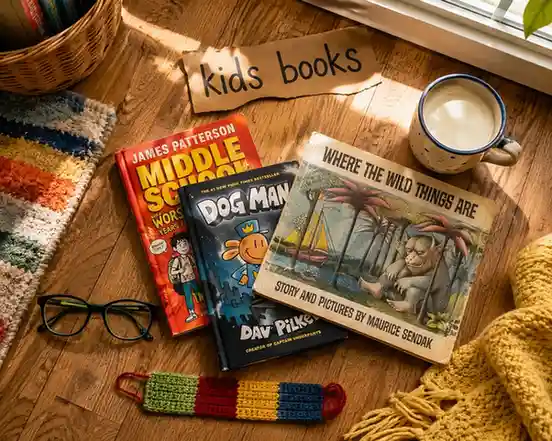
Parents often struggle to find kids books that truly engage. Screens steal attention, and reading becomes a chore. But the right story can turn a reluctant reader into a bookworm. This guide handpicks the most exciting kids books—from timeless classics to popular new hits and page-turning James Patterson adventures—so your child discovers the magic of reading.
What Makes a Kids Book Truly Great?
A great kids book grabs attention on page one and never lets go. Relatable characters, a propulsive plot, and language that sings are non‑negotiables. The best titles also layer in emotional truth and a sense of wonder that sticks long after the last page.
As a parent and children’s book club organizer, I watch one truth play out again and again: a single gripping story can flip a child’s entire relationship with books. The American Academy of Pediatrics confirms that reading aloud builds the neural pathways for language and empathy. When the book is impossible to put down, that benefit multiplies.
Look for these hallmarks in any kids book you bring home:
- A main character who faces real dilemmas
- Illustrations or descriptions that spark curiosity
- A voice that respects the child’s intelligence
- A satisfying ending that feels earned
Which Classic Kids Books Still Captivate Young Readers?
Classic kids books endure because they speak to universal feelings—adventure, loneliness, friendship, the thrill of being brave. Generations of children have worn out these pages, and they still fly off library shelves today.
Here are timeless starters every child deserves to meet:
| Classic Kids Book | Author | Age Range | Why It Endures |
| Where the Wild Things Are | Maurice Sendak | 3–6 | Raw emotion and wild imagination in under 350 words |
| Charlotte’s Web | E.B. White | 6–9 | Gentle handling of friendship and loss |
| The Tale of Peter Rabbit | Beatrix Potter | 2–5 | Mischief meets consequences in a cozy garden world |
| Anne of Green Gables | L.M. Montgomery | 9+ | An irrepressible orphan who reframes every setback |
| The Snowy Day | Ezra Jack Keats | 2–5 | Quiet joy and a milestone in diverse representation |
The Library of Congress lists many of these as “Books That Shaped America.” Classic kids books become part of a family’s shared language, and rereading them at different ages unlocks new layers.
Which Children’s Books Are Currently the Most Popular?
Popular kids books blend high‑interest topics with breakneck pacing. Kids pass them between backpacks, and library hold lists stretch for weeks. These are the titles that turn “reading time” into “just one more chapter, please.”
| Popular Kids Book | Author | Genre | Why Kids Devour It |
| Dog Man series | Dav Pilkey | Graphic novel / Humor | Irreverent, fast, and full of heart |
| The Wild Robot | Peter Brown | Sci‑fi / Survival | A robot stranded on an island learns to belong |
| Diary of a Wimpy Kid | Jeff Kinney | Realistic fiction | Relatable middle‑school chaos in a handwritten format |
| Front Desk | Kelly Yang | Contemporary | A brave immigrant story rooted in real‑life experiences |
| Amina’s Voice | Hena Khan | Contemporary | Friendship and identity resonate with upper‑elementary readers |
The Scholastic Kids & Family Reading Report shows that 77% of kids say their favorite books are the ones they choose themselves. Popular kids books win because they feel like a choice, not an assignment.
Why Are James Patterson Kids Books So Addictive?
James Patterson kids books hook even the most reluctant readers. Short chapters end with mini‑cliffhangers that make stopping feel impossible. The vocabulary stays accessible without ever talking down to the child, and every series puts action first.
Patterson’s ReadKiddoRead initiative reinforces what his books prove: kids read more when stories feel like play. His catalog for young readers spans multiple age brackets and interests.
| James Patterson Kids Series | Age Range | Key Themes |
| Middle School | 8–12 | Humor, resilience, navigating school life |
| I Funny | 9–13 | Comedy, disability representation, chasing dreams |
| Treasure Hunters | 9–13 | Global adventure, sibling teamwork |
| Jacky Ha-Ha | 9–13 | Overcoming stuttering, pranks with heart |
| Max Einstein | 9–13 | STEM, problem‑solving, female empowerment |
| Ali Cross (Alex Cross’s son) | 10–14 | Mystery, justice, family loyalty |
The rapid‑fire style of James Patterson kids books builds reading stamina. Kids finish a chapter without realizing it, then immediately start the next. That momentum often carries over to other kids books as confidence grows.
How Do You Choose the Perfect Kids Books by Age?
Matching a kids book to a child’s developmental stage keeps frustration low and interest high. The table below pairs typical milestones with book types that hit the sweet spot.
| Age Group | Developmental Needs | Best Kids Books Formats | Examples |
| 0–2 | Sensory exploration, bonding | Board books, touch‑and‑feel, nursery rhymes | Brown Bear, Brown Bear |
| 3–5 | Language explosion, imagination | Picture books with rich art and rhythm | The Gruffalo, Last Stop on Market Street |
| 6–8 | Decoding words, building stamina | Early readers, illustrated chapter books | Mercy Watson, Zoey and Sassafras |
| 9–12 | Identity, peer relationships | Middle‑grade novels, graphic novels, series | Percy Jackson, New Kid |
| 13+ | Abstract thinking, independence | YA crossover, nonfiction, deep fantasy | The Hate U Give, Scythe |
A child’s interest always outweighs a rigid age label. If a five‑year‑old listens to a chapter book with rapt attention, keep going. The goal is to associate kids books with pleasure, not pressure.
Picture Books vs. Chapter Books: When Should Kids Switch?
Picture books build visual literacy and deepen comprehension through art. Chapter books stretch attention and fluency. There is no fixed switch date. Many eight‑year‑olds still treasure picture books long after they start reading chapter books independently.
Keep both formats in heavy rotation. Picture books introduce sophisticated themes in a condensed, safe space. Chapter books reward persistence. A daily reading diet that mixes the two often produces the strongest reader.
How Can Diverse Kids Books Broaden a Child’s World?
Diverse kids books normalize difference and dismantle stereotypes before they take root. Stories featuring characters of varied races, cultures, family structures, and abilities build empathy muscle and mirror the real world.
Children who see ethnic diversity in books exhibit greater social-emotional competency, according to the Journal of Developmental & Behavioral Pediatrics. Even a handful of carefully chosen titles can shift a child’s worldview.
Try these starting points:
- Eyes That Kiss in the Corners (Joanna Ho) – self‑love and Asian identity
- Julian Is a Mermaid (Jessica Love) – gender expression and unconditional acceptance
- Sulwe (Lupita Nyong’o) – colorism and inner radiance
- El Deafo (Cece Bell) – deafness as a superpower in graphic memoir form
Place diverse kids books face‑out on shelves. Just the covers prompt inquiries that lead to the most insightful discussions.
What Are the Best Ways to Build a Home Library on a Budget?
A powerful kids book collection does not demand a big budget. Library sales, secondhand shops, and book swaps fill shelves for pennies. Many public libraries also offer digital borrowing through Libby or Hoopla, giving instant access to thousands of kids books on a tablet.
Use these frugal strategies:
- Hit library book sales on bag‑day for fill‑a‑bag pricing
- Join a local “buy nothing” group and request kids books
- Rotate books with neighbors in a monthly swap
- Subscribe to Dolly Parton’s Imagination Library if available in your area
- Keep a wish list so friends and relatives know exactly which kids books to gift
A child cares about the story, not the price tag. Ten treasured books read over and over beat a hundred that sit untouched.
How to Turn Reading into a Daily Habit That Sticks
Habit‑stacking makes reading automatic. Attach story time to an existing routine—right after breakfast, as part of bedtime, or in the car on the way to practice. Consistency matters more than duration; even ten minutes of kids books a day adds up to 60 hours a year.
Try these practical hooks:
- Keep a “next read” basket visible in the living room
- Let the child choose the book, even if it’s a comic or a re‑read
- Read aloud with expression—voices, pauses, and all
- Model reading yourself; kids imitate what they see
- Track books on a simple chart and celebrate milestones with a new kids book
The American Academy of Pediatrics recommends daily reading from infancy. When the habit feels like a treat, not a task, it sticks for life.
Frequently Asked Questions About Kids Books
What age should I start reading kids books to my child?
Start at birth. Even newborns absorb the rhythm of language and the warmth of your voice. Board books with high‑contrast images work well in the first months.
How do I pick kids books that match my child’s interests?
Follow their passions. If they love dinosaurs, build a stack of fiction and nonfiction dino books. Let them lead at the library and notice which covers they grab first.
Are James Patterson kids books appropriate for young readers?
Yes. Patterson’s middle‑grade novels target ages 8–12 with age‑appropriate action, humor, and relatable school situations. The Middle School and I Funny series keep content light and uplifting. Always skim a few pages first to match the individual child.
What are the must‑read classic kids books for early readers?
Frog and Toad collections by Arnold Lobel, Little Bear by Else Holmelund Minarik, and The Cat in the Hat by Dr. Seuss build confidence with controlled vocabulary and warm storytelling.
Where can I find free or cheap kids books?
Public libraries remain the top source. Add Little Free Library stops, thrift stores, and digital platforms like Epic! for unlimited access. Dolly Parton’s Imagination Library mails free books monthly to eligible families.
How many kids books should a child read per month?
There is no magic number. The Scholastic Kids & Family Reading Report found that children who read 5–7 days a week show the highest reading proficiency. Aim for daily engagement, whether one picture book or several chapters.
A well‑chosen kids book can reshape a child’s whole trajectory. Take a classic off the shelf, request a popular new release, or start a James Patterson series tonight. Visit your library, fill a basket, and make reading the most anticipated part of the day. Which kids book will you hand your child next? Share your family’s favorite in the comments, and let’s build a community where every child grows up loving to read.