Your baby spikes a fever or cries from obvious pain. You reach for infant Tylenol, syringe in hand, and your mind races — how much is actually safe? Giving too little brings no relief; giving too much can damage a tiny liver. This guide hands you a clear infant Tylenol dose chart, weight‑based calculations, and the safety rules pediatricians want every parent to follow. You’ll know exactly when to give it, how to measure it, and what never to do. Relax, you’re about to gain real confidence.
What Is Infant Tylenol?
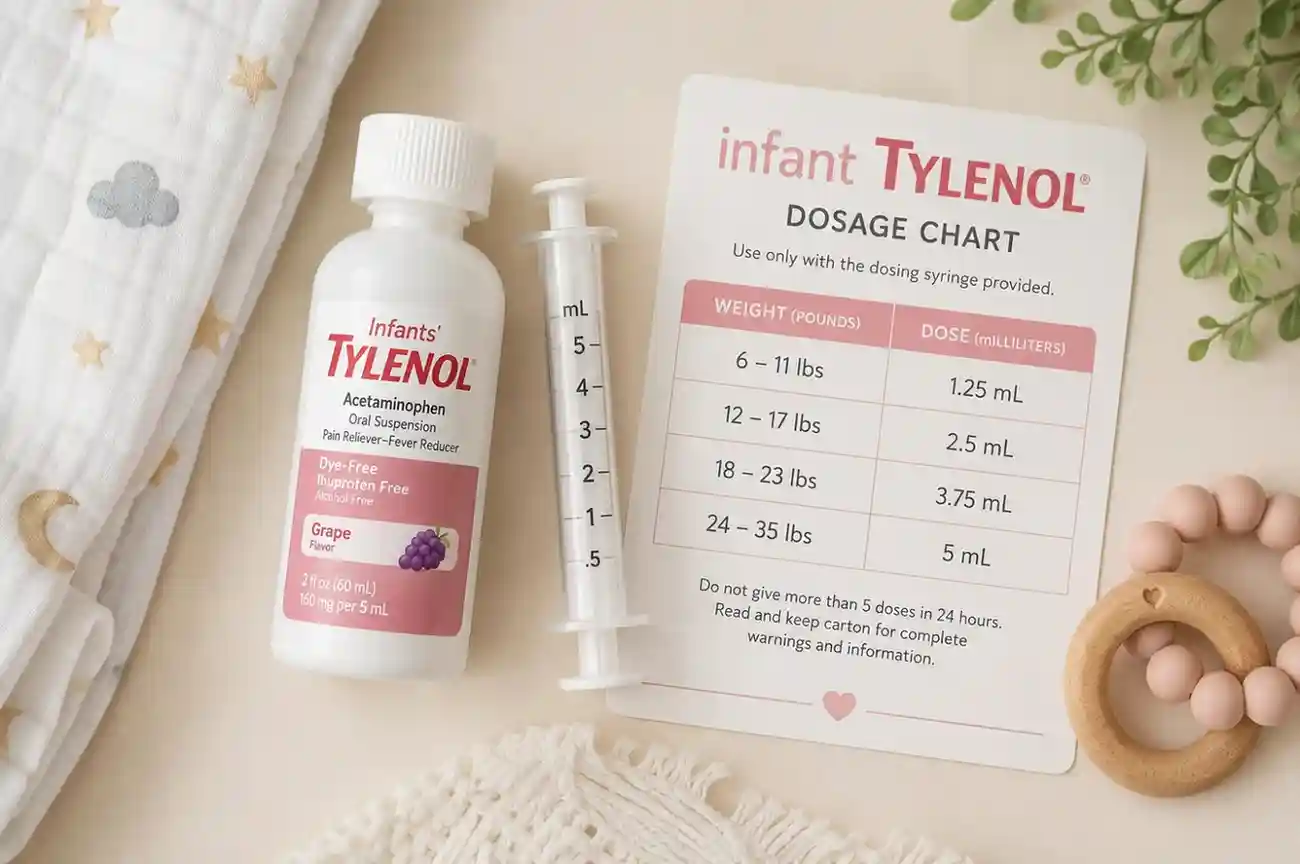
Infant Tylenol is an over‑the‑counter liquid pain reliever and fever reducer designed for babies and young children. Its active ingredient, acetaminophen, eases discomfort from teething, earaches, sore muscles, and reduces fever after vaccinations or illness. Unlike ibuprofen, infant Tylenol is gentle on the stomach and can be given to babies as young as 2 months old under a doctor’s direction. The product comes with a specific oral syringe to help parents measure the infant Tylenol dose accurately — never use a kitchen spoon.
How Infant Tylenol Works to Reduce Fever and Pain
Acetaminophen blocks pain signals in the brain and acts on the body’s temperature‑regulating center to lower a fever. Once you give the correct infant Tylenol dose, it typically begins working within 30 to 45 minutes. The effect lasts four to six hours, helping your baby rest comfortably while the body fights off an infection. Because it processes through the liver, staying within the recommended infant Tylenol dosing limits is non‑negotiable.
Infant Tylenol Dose: How Much Is Safe?
Safety rests entirely on your baby’s weight, not their age. The standard medicine concentration is 160 milligrams per 5 milliliters (160 mg/5 mL). Doctors calculate an infant Tylenol dose at 10–15 mg per kilogram of body weight, given every 4 to 6 hours. You must never exceed five doses in a 24‑hour period. If you don’t know your infant’s current weight, weigh them before giving any medicine. When in doubt, call your pediatrician.
Infant Tylenol Dosage Chart by Weight
This infant Tylenol chart uses the 160 mg/5 mL oral suspension. Match your baby’s weight first, then read the corresponding dose in milliliters. Under 2 months? Do not use unless a doctor explicitly prescribes it.
| Weight (lbs) | Weight (kg) | Infant Tylenol Dose (mg) | Liquid to Give (mL) |
| 6 – 11 | 2.7 – 5.0 | 40 mg | 1.25 mL |
| 12 – 17 | 5.5 – 7.7 | 80 mg | 2.5 mL |
| 18 – 23 | 8.2 – 10.5 | 120 mg | 3.75 mL |
| 24 – 35 | 10.9 – 15.9 | 160 mg | 5 mL |
Always use the weight‑based infant Tylenol dose above. If your child weighs more than 35 pounds, you’re likely moving into children’s Tylenol territory — check packaging or ask a pharmacist.
Infant Tylenol Dose by Age: Why Weight Matters More
Age brackets on boxes are loose estimates, not safety guarantees. A 6‑month‑old can weigh anywhere from 13 to 20 pounds — two different infant Tylenol dose levels. Never guess by age. Grab a digital baby scale and reference the infant Tylenol chart above. Pediatric dosing guidelines from the American Academy of Pediatrics stress weight over age every time.
How to Read the Infant Tylenol Syringe and Measure Correctly
The box includes a dosing syringe marked in milliliters. Check these steps:
- Shake the bottle well before each use.
- Insert the syringe tip and turn the bottle upside down.
- Pull back the plunger until the black ring aligns exactly with your required infant Tylenol dose.
- Remove the syringe, place it gently inside your baby’s cheek, and push the plunger slowly so they swallow without choking.
- Never squirt it forcefully at the back of the throat.
When to Give Infant Tylenol to Your Baby
Use infant Tylenol only for genuine discomfort or fever over 100.4°F (38°C) — measured rectally in infants. Common situations include:
- Post‑vaccination fussiness and low‑grade fever.
- Teething pain that disrupts feeding or sleep, when teething gels fail.
- Ear infection pain until your doctor sees the baby.
- General aches and fever from mild viral illnesses.
Do not give infant Tylenol for a simple sleep aid or “just in case.” Always address the underlying cause with your pediatrician.
Infant Tylenol vs Children’s Tylenol: Key Differences
Infant Tylenol and children’s Tylenol in the 160 mg/5 mL concentration are often the same medicine — the infant version simply includes a syringe, while the children’s version comes with a cup. Never swap syringes between products. A children’s formulation might also come in different strengths (like 160 mg per chewable tablet), so always verify the concentration before calculating any infant Tylenol dose.
Maximum Dose and Safety Precautions
- Five doses in 24 hours is the absolute ceiling.
- Space each infant Tylenol dose at least 4 hours apart.
- Read all ingredient labels. Acetaminophen hides in many multi‑symptom cold medicines. Doubling up can cause severe liver injury.
- If you accidentally give too much, go straight to the emergency room — even if your baby seems fine.
- Keep a written log of times and exact amounts for every dose.
Signs of Acetaminophen Overdose in Infants
Early signs can be silent, then escalate quickly. Watch for nausea, vomiting, extreme sleepiness, sweating, or yellowish skin/eyes within the first 24 hours. Days later, liver failure symptoms appear. More than 11,000 accidental acetaminophen overdoses in children under 6 are reported yearly in the U.S. (source: FDA). Never treat more than the infant Tylenol dose on the chart unless a doctor directs otherwise.
Storing Infant Tylenol Safely and Checking Expiration
Keep the bottle tightly closed, away from light and heat. Never store it in a diaper bag for days in a hot car — extreme temperatures degrade the medicine. Check the expiration date every time you reach for it. Expired infant Tylenol loses potency and poses a risk of bacterial contamination. As soon as you finish the bottle, safely discard the syringe or wash it according to package directions.
Alternatives to Infant Tylenol and When to Call the Doctor
For babies older than 6 months, ibuprofen (Motrin/Advil) may be an option, but only after a pediatrician approves it. Never alternate infant Tylenol and ibuprofen without a doctor’s explicit instruction. Non‑medicine comforts include lukewarm sponge baths for fever, extra breastfeeding or formula for hydration, and a calm, cool room. Contact your doctor immediately if:
- Your baby is under 3 months with a fever of 100.4°F or higher.
- Fever persists beyond 3 days.
- Your infant shows signs of dehydration, stiff neck, or unusual rash.
- Pain worsens despite the correct infant Tylenol dose.
Frequently Asked Questions
Can I give infant Tylenol on an empty stomach?
Yes. Infant Tylenol is gentle on the stomach and does not require food. It absorbs well with or without meals, reducing the risk of irritation.
What if my baby spits up right after the infant Tylenol dose?
Wait 15 to 20 minutes. If you see the full dose in the spit‑up and your baby didn’t swallow any, you can re‑give the same amount once.To prevent an unintentional overdose, skip the re-dose and wait until the next planned time if you are unsure. How long does infant Tylenol take to work?
Most babies show a drop in fever or reduced pain cues within 30 to 45 minutes. The peak effect usually occurs around 1 to 2 hours after giving the infant Tylenol dose.
Can I use infant Tylenol for teething every night?
No. Using infant Tylenol nightly for teething overloads the liver and masks other problems. Reserve it for nights when teething pain clearly disrupts sleep despite teething rings and gum massage. Speak with your doctor about safer long‑term comfort measures.
Is the infant Tylenol dose the same for premature babies?
Premature infants or those with low birth weight may need adjusted doses. Only a neonatologist or pediatrician can determine the safe amount. Never use standard infant Tylenol charts for preemies without medical guidance.
Does infant Tylenol expire?
Yes. Check the expiration date printed on the box and bottle. Using expired infant Tylenol weakens its fever‑fighting ability and can introduce harmful bacteria if the preservatives degrade.
You now have a reliable infant Tylenol dose chart and the safety steps to act without second‑guessing. Bookmark this page so you can pull up the exact weight‑based infant Tylenol dose in the middle of the night. Always double‑check your baby’s weight, stay below five doses in 24 hours, and place a direct call to your pediatrician when anything feels off. Trust the chart, trust your instincts, and give your little one the comfort they need — safely.
This guide was written by Linda Morrison, RN, BSN, a pediatric nurse with over 12 years of hands‑on newborn and infant care experience. All medical information aligns with current recommendations from the American Academy of Pediatrics, the U.S. Food and Drug Administration, and the Centers for Disease Control and Prevention.