You leave for work every morning. Your home alone house runs itself — pipes pressurize, appliances cycle, water heats and cools. But here is the problem: hard water works silently against every system while you are away. Scale builds inside your pipes, hot water heater, and dishwasher. The damage stacks up fast. A water softener system for home use stops that damage before it starts — and this guide shows you exactly how.
What Is Hard Water and Why Does It Destroy a Home Alone House?
Hard water carries dissolved calcium and magnesium minerals picked up from underground rock and soil. When that water heats up or evaporates inside your home alone house, those minerals drop out of solution and stick to every surface they touch.
The U.S. Geological Survey reports that 85% of American homes receive hard water through their municipal or well supply. That means the majority of homeowners are fighting an invisible problem every single day.
Here is what hard water does to an unprotected home alone house over time:
- Coats the inside of pipes with mineral scale, narrowing water flow
- Forces your water heater to work harder, cutting efficiency by up to 29%
- Leaves white chalky deposits on faucets, showerheads, and tiles
- Shortens the lifespan of washing machines and dishwashers
- Creates soap scum that is harder to clean and requires more detergent
The fix is not complicated. The right water softener system for home use removes those minerals before they ever reach your appliances.
How Does a Water Softener System for Home Actually Work?
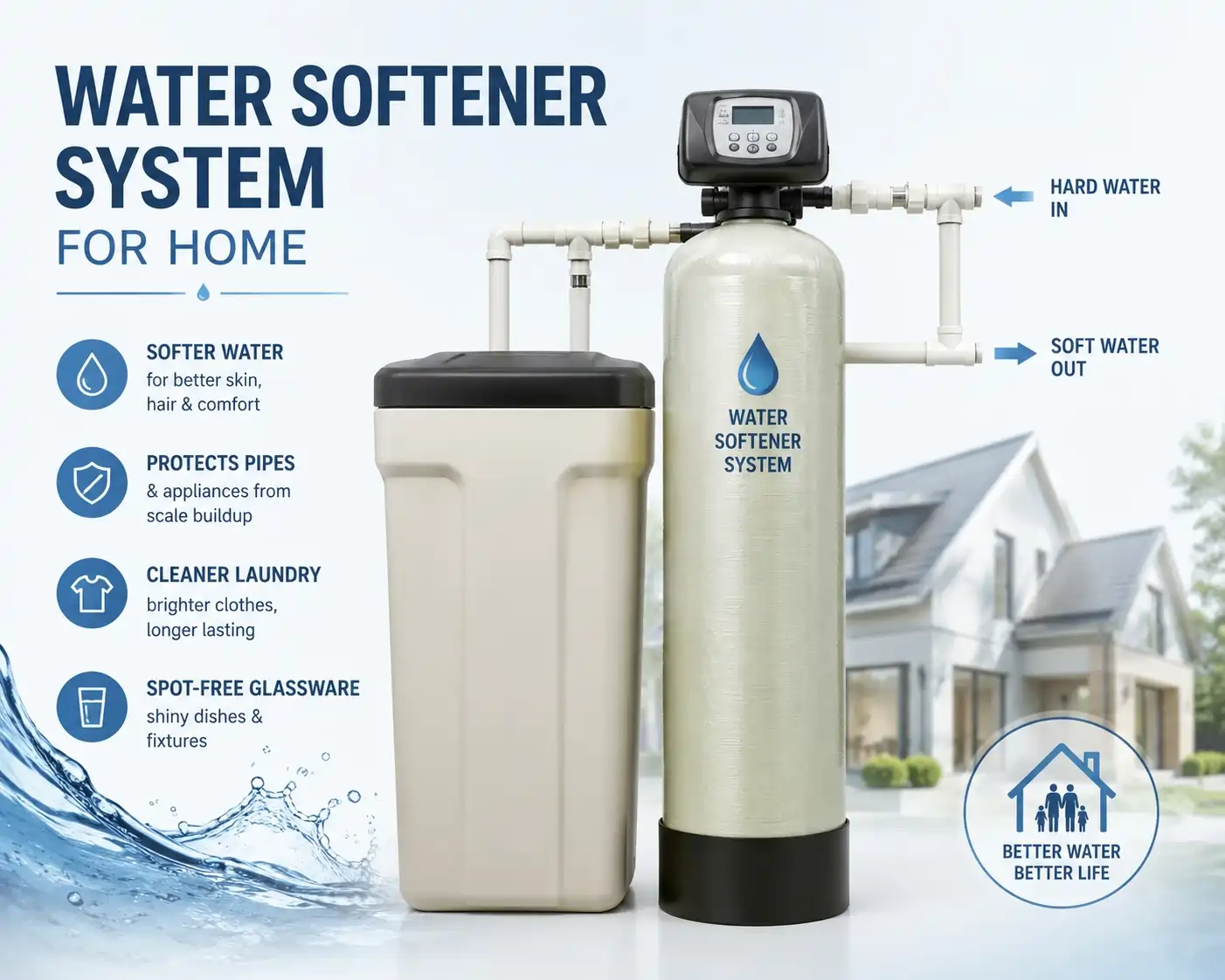
A water softener system for home operates on a process called ion exchange. Hard water enters a mineral tank filled with resin beads. Those beads carry a negative charge and attract the positively charged calcium and magnesium ions. The minerals stick to the resin, and soft water flows out to the rest of your home alone house.
Over time, the resin beads fill up with minerals and need to be cleaned. The system runs a regeneration cycle where a salt-and-water brine solution flushes the beads, strips the minerals away, and carries them down the drain. The beads recharge and the cycle starts again.
The entire process happens automatically, which makes it a perfect fit for a home alone house where no one monitors the system daily.
What Are the Main Types of Water Softener Systems for Home Use?
Choosing the right system means matching the technology to your home’s specific water hardness and household size.
Salt-Based Ion Exchange Softeners These are the most effective and widely used systems. They completely remove calcium and magnesium from the water supply. Best for homes with hardness above 7 grains per gallon (GPG).
Salt-Free Water Conditioners These systems do not remove minerals — they change the mineral structure so scale cannot stick to surfaces. They work well in moderately hard water areas and require no salt or electricity.
Softeners with Two Tanks One of the two resin tanks is always in use because they alternate. Perfect for a large home alone house with high daily water usage and no tolerance for downtime.
Magnetic Water Conditioners These clamp onto pipes and use magnetic fields to alter mineral behavior. They require no installation, no salt, and no electricity, but research on their effectiveness is mixed. It works best as a complement rather than the main remedy.
| System Type | Removes Minerals | Needs Salt | Best For |
| Salt-Based Ion Exchange | Yes | Yes | High hardness, whole home |
| Salt-Free Conditioner | No (alters structure) | No | Moderate hardness, eco-focus |
| Dual-Tank Softener | Yes | Yes | Large homes, high usage |
| Magnetic Conditioner | Partially | No | Low budget, supplemental use |
| Reverse Osmosis | Yes (point of use) | No | Drinking water only |
Reverse Osmosis Systems These remove minerals along with other contaminants at the point of use, typically under the kitchen sink. They do not treat whole-house water but pair well with a full home softener.
How Hard Is Your Water? Understanding Grains Per Gallon
Before you buy any water softener system for home use, test your water. You need a number, not a guess.
Water hardness is measured in grains per gallon (GPG) or parts per million (PPM).
| Hardness Level | GPG Range | PPM Range | What It Means |
| Soft | 0–1 | 0–17 | No treatment needed |
| Slightly Hard | 1–3.5 | 17–60 | Minor deposits over time |
| Moderately Hard | 3.5–7 | 60–120 | Visible scale, soap issues |
| Hard | 7–10.5 | 120–180 | Appliance damage begins |
| Very Hard | 10.5+ | 180+ | Urgent treatment needed |
You can test your water three ways:
- Buy a home test kit from a hardware store (under $20)
- Send a sample to a certified water testing lab for detailed results
- Speak with your local water provider; the majority release yearly reports on water quality.
Knowing your exact hardness level helps you size your home alone house water softener correctly and avoid buying more capacity than you need.
What Size Water Softener Does a Home Alone House Need?
Sizing a water softener system for home use comes down to two numbers: your daily water usage and your water hardness in GPG.
The Formula: People in home × Gallons per person per day (average: 75) × Water hardness (GPG) = Daily grain demand
Example: A family of 4, water hardness of 10 GPG 4 × 75 × 10 = 3,000 grains per day
Most softeners regenerate every 3–7 days. Multiply your daily demand by your preferred regeneration interval.
3,000 × 7 = 21,000 grains minimum capacity needed
A 24,000-grain softener fits this home alone house comfortably. Always size slightly above your calculated need to extend resin life and reduce regeneration frequency.
| Home Size | Avg. Daily Use | Recommended Capacity |
| 1–2 people | 150 GPD | 16,000–24,000 grains |
| 3–4 people | 300 GPD | 24,000–32,000 grains |
| 5–6 people | 450 GPD | 32,000–48,000 grains |
| 7+ people | 600+ GPD | 48,000+ grains |
Where Should You Install a Water Softener in a Home Alone House?
Placement determines how well the system protects your home. Install the softener on the main water supply line coming into the home alone house, after the pressure tank (if you have a well) but before the water heater.
This position treats all the water entering the house — every faucet, shower, toilet, appliance, and pipe benefits from softened water.
Key installation requirements:
- A drain connection nearby for the regeneration brine discharge
- An electrical outlet within reach (for timed or demand-initiated systems)
- A bypass valve so water flows during maintenance or repairs
- At least 10 feet of distance from any water heater for heat protection
- A level surface on a floor that can handle the system’s full weight when loaded with salt and water
Many homeowners in a home alone house choose the garage, utility room, or basement for installation. These locations keep the system out of living spaces while staying accessible for salt refills and occasional maintenance checks.
How to Install a Water Softener System for Home Use (Step-by-Step Overview)
This is a mid-level DIY project. If you are comfortable with basic plumbing and can follow instructions, you can complete this in a few hours.
Step 1: Shut off the main water supply Locate your main shutoff valve and turn it off completely. To relieve any residual pressure in the lines, open a faucet.
Step 2: Cut into the supply line Use a pipe cutter to cut the main supply line where you plan to install the bypass valve. Keep the cut clean and square.
Step 3: Install the bypass valve Connect the bypass valve to the cut line using the fittings that come with your unit. The bypass lets you isolate the softener without cutting water to the whole house.
Step 4: Connect the inlet and outlet Follow the directional markings on your softener head. Inlet connects to the supply coming in from the street or well. Outlet goes toward your water heater and the rest of the home alone house.
Step 5: Connect the drain line Run the drain hose from the control head to a floor drain or utility sink. Do not submerge the end of the drain line — this creates backflow risk.
Step 6: Connect the brine tank overflow hose Run this separate line to the same drain. Keep it elevated slightly above the floor drain entrance.
Step 7: Add salt to the brine tank Fill the brine tank about two-thirds full with the correct salt type for your model (pellet, crystal, or block salt).
Step 8: Start the system Turn the bypass valve to the service position, slowly open the main water supply, and run a manual regeneration cycle to flush the resin and prime the system.
Step 9: Set the control head Program the current time, your water hardness level, and your preferred regeneration schedule. Most systems offer demand-initiated regeneration, which regenerates based on actual water use rather than a fixed timer.
Always check local plumbing codes before installation.In certain localities, connecting any gadget to the main supply line requires a licensed plumber.
What Kind of Salt Does a Home Alone House Water Softener Need?
Salt is the fuel that keeps your water softener system for home use running. Choosing the right type matters for both performance and maintenance.
Solar Salt Crystals Made by evaporating saltwater in large shallow ponds using sunlight. Affordable, widely available, and effective for most softeners. Minor risk of mushing in the brine tank under humid conditions.
Evaporated Salt Pellets The purest form of softener salt — 99.99% sodium chloride. More expensive than crystals but produces fewer residues in the brine tank. Best choice for a home alone house with minimal maintenance intervals.
Potassium Chloride Pellets A sodium-free alternative for homeowners watching sodium intake or concerned about the environmental impact of salt discharge. About 25–30% less efficient than sodium chloride and significantly more expensive.
Block Salt Solid blocks designed for specific softener models. Not compatible with all units, so check your manual before using.
Tips for managing salt in a home alone house:
- Check the salt level monthly and refill when the tank is one-third full
- Break up salt bridges (hard crusty formations above the water line) with a broom handle every few months
- Use a single salt type consistently — mixing types can cause buildup
- Keep the brine tank lid on to prevent debris and moisture contamination
What Maintenance Does a Water Softener System for Home Require?
One of the least maintenance-intensive appliances in a single-family home is a water softening system. Still, a few simple tasks keep it running at peak performance for 15–25 years.
Monthly:
- Check salt level and refill as needed
- Check for mushing or salt bridges in the brine tank.
- Listen for unusual sounds during regeneration cycles
Every 3–6 Months:
- Clean the brine tank if sediment accumulates
- Check the resin bed for iron fouling (if your water contains iron)
- Use a resin cleaner product if water has high iron or manganese content
Annually:
- Inspect all connection fittings for mineral buildup or slow leaks
- Test your water hardness to confirm the softener is performing correctly
- Clean or replace the injector/venturi assembly if regeneration efficiency drops
Every 5–10 Years:
- Consider replacing the resin bed if softening performance drops significantly despite clean brine tank and correct salt levels
- Inspect control valve seals and replace if leaks develop
The Water Quality Association recommends annual water testing for all homes using a softener to verify the system is dialed in correctly and the water quality meets health and appliance safety standards.
Can a Water Softener System Protect Plumbing in a Home Alone House?
Yes — and this is one of the strongest arguments for installing one. Pipes in a home alone house face the worst conditions because problems go unnoticed longer. Scale can build for weeks between visits if no one is there to check.
Hard water scale narrows pipes over time the same way plaque narrows arteries. A pipe that once carried 1-inch of water flow can shrink to a half-inch opening after years of unchecked scale buildup. Water pressure drops, appliances work harder, and eventually pipes fail.
A properly sized water softener system for home use prevents scale from forming in the first place. And according to research published by the Battelle Memorial Institute, softened water keeps water heaters operating at their rated efficiency rating throughout their lifespan — hard water can cut that efficiency by up to 29% within a few years.
That efficiency loss directly translates to higher energy bills every single month in your home alone house.
How Much Does a Water Softener System for Home Cost?
Cost breaks down into three categories: equipment, installation, and ongoing operation.
Equipment Cost:
| System Type | Price Range |
| Basic Salt-Based Softener | $400–$800 |
| Mid-Range Softener (demand-initiated) | $800–$1,500 |
| Premium Whole-Home System | $1,500–$3,000 |
| Salt-Free Conditioner | $500–$2,000 |
| Dual-Tank Softener | $1,500–$3,500 |
Installation Cost: DIY installation costs nothing beyond tools and supplies (typically $50–$150 in fittings and connectors). Professional installation ranges from $200–$500 depending on your location and plumbing complexity.
Annual Operating Cost: Salt: $50–$150 per year depending on water hardness and household size Electricity: $30–$80 per year (minimal draw from the control head) Resin cleaner (optional): $20–$40 per year
What You Save: The American Water Works Association estimates that softened water reduces detergent and cleaning product use by 50–75%. Combined with energy savings on your water heater and extended appliance lifespan, most homeowners recover their investment within 2–4 years.
Is a Water Softener System for Home Use Safe for Drinking Water?
This is one of the most common questions homeowners ask, and the answer depends on your household needs.
Salt-based softeners replace calcium and magnesium with sodium. The amount of sodium added is proportional to the water’s original hardness. For most households with moderate hardness, the sodium increase is minor — often less than 20 mg per liter, which falls well within safe drinking levels set by the World Health Organization.
However, for people on sodium-restricted diets, the extra sodium in softened water may be a concern. Three practical solutions work well:
- Install a reverse osmosis filter under the kitchen sink to treat drinking and cooking water separately
- Leave one cold kitchen tap on a bypass line to provide untreated water for drinking
- Switch from sodium chloride to potassium chloride in the softener
The home alone house benefits from whole-home protection while drinking water remains appropriate for everyone in the household.
6 Frequently Asked Questions About Home Alone House Water Softeners
Q: How do I know if my home alone house actually needs a water softener? A: Test your water. If hardness is above 3.5 GPG, you will see noticeable deposits on fixtures, reduced soap lather, and shortened appliance lifespans. Above 7 GPG, a water softener system for home use is strongly recommended to prevent serious plumbing and appliance damage.
Q: Can I leave my water softener running when my home alone house is vacant for weeks? A: Yes. Most modern softeners run on demand-based regeneration — they only cycle when water is used. For extended absences, put the system in bypass mode, which stops water from flowing through the resin and conserves salt until you return.
Q: What happens if I run out of salt in my water softener? A: Without salt, the resin beads exhaust and the system passes hard water through untreated. No immediate damage to the softener occurs, but your pipes and appliances resume hard water exposure. Refill salt as soon as possible and run a manual regeneration cycle to recharge the resin.
Q: How long does a water softener system for home use last? A: A quality salt-based water softener lasts 15–25 years with proper maintenance. The resin bed may need replacement after 10–15 years. Control heads and valves are the most common points of failure and are typically replaceable without buying a whole new unit.
Q: Does a water softener remove iron from well water in a home alone house? A: Standard softeners remove low levels of ferrous (clear water) iron — up to about 2–5 PPM depending on the system. For higher iron levels, you need an iron filter installed upstream of the softener. Test your well water specifically for iron content before choosing a system.
Q: Will a water softener system lower my home’s water pressure? A: A properly sized and maintained softener has minimal effect on pressure — typically less than 1–2 PSI loss. A clogged or fouled resin bed can cause pressure drop. If you experience significant pressure loss, backwash the resin or call a technician.
Protect Your Home Alone House Before Problems Start
Your home alone house handles more on its own than you realize. Pipes carry water under pressure around the clock. Appliances run through cycle after cycle without your supervision. Hard water attacks all of it silently, daily, and without warning.
A water softener system for home use is not a luxury for large houses — it is a practical investment that pays back in lower energy bills, fewer plumbing repairs, and appliances that actually last as long as the manufacturer promised.
Start with a water hardness test. Match the system size to your household’s real daily demand. Install it on the main supply line so every part of your home alone house gets protected. Then set the regeneration schedule and let it run.
The best home protection strategy is the one that works while you are not watching. A well-chosen water softener does exactly that.
Sources referenced in this article: 1. U.S. Geological Survey — Water Hardness Distribution in the United States 2. Battelle Memorial Institute — Water Heater Efficiency and Water Hardness Study 3. Water Quality Association — Consumer Water Treatment Guidelines 4. American Water Works Association — Household Water Use and Treatment Research 5. World Health Organization — Sodium in Drinking Water Health Guidelines
About This Guide: Written by a home improvement content strategist with hands-on experience researching water treatment systems, plumbing maintenance, and whole-home protection strategies. All recommendations reflect current water treatment standards and independent research.