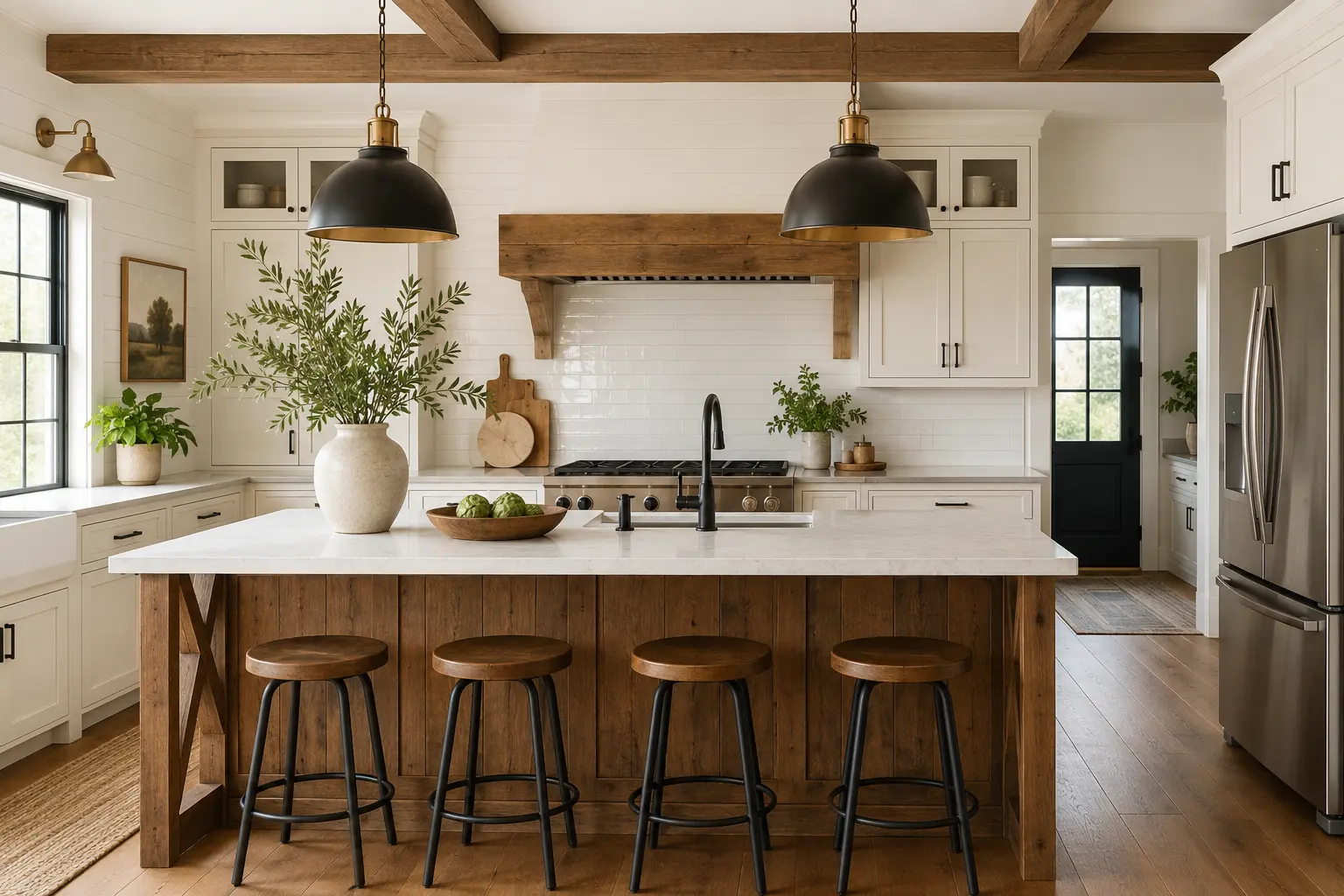
Is Your Kitchen Missing That Perfect Mix of Warm and Modern?
Every morning when you enter your kitchen, something seems strange. . It is either too cold and sterile, or too cluttered and old-fashioned. You want warmth without the chaos, and style without sacrificing function. The modern farmhouse kitchen solves exactly that problem. It brings together natural materials, clean lines, and lived-in comfort in one space that actually works for real families.
What Is a Modern Farmhouse Kitchen?
A modern farmhouse kitchen is a design style that combines the warmth of traditional farmhouse aesthetics with the clean structure of contemporary design. Think white or muted cabinetry, natural wood accents, apron-front sinks, open shelving, and plenty of natural light — all working together without feeling overdone.
This style grew from the broader farmhouse interior movement, popularized widely by designers like Joanna Gaines and the Magnolia brand. But it has evolved far beyond shiplap and mason jars. Today’s version feels intentional, layered, and deeply personal.
The core idea is simple: a space that feels handcrafted and inviting, but functions as efficiently as any high-end contemporary kitchen.
Why Modern Farmhouse Kitchens Are Still Dominating in 2026
Interior design trends come and go fast. Yet the modern farmhouse kitchen has held its ground for over a decade. Why?
Because it solves a real problem people have with their homes. The majority of homeowners choose a cozy kitchen over one that feels like a showroom floor. They want materials that look good even after heavy daily use. They want a space where kids can do homework at the island and guests can linger without feeling out of place.
According to the National Kitchen and Bath Association (NKBA), natural materials and warm neutrals remain among the top requested elements in kitchen remodels through 2024 and into 2025. The data supports what designers have been seeing firsthand: people are choosing comfort and character over cold minimalism.
The modern farmhouse kitchen delivers both beauty and practicality. That combination is always fashionable.
The Core Design Elements of a Modern Farmhouse Kitchen
Getting this look right starts with understanding its foundational components. You do not need every single element. But combining the right ones creates that signature feel.
Key elements include:
- Shaker-style cabinetry — flat-center panels with clean frame edges
- Apron-front (farmhouse) sink — typically porcelain or fireclay
- Beam ceilings, butcher block worktops, and floating shelves are examples of natural wood embellishments.
- Warm greens, whites, creams, and gentle grays are examples of muted or neutral color schemes.
- Matte black or brushed brass hardware — small details with big impact
- Subway tile or beadboard backsplash — classic textures that ground the space
- Open shelving — both practical and decorative
- Pendant lighting — industrial or lantern-style fixtures above the island
- Vintage or antique touches — repurposed furniture, woven baskets, ceramic canisters
- Combinations of stone, wood, metal, and linen
Each element adds a layer. Together they create a kitchen that feels both curated and naturally lived-in.
How to Plan Your Modern Farmhouse Kitchen Layout
Layout comes before aesthetics. A beautiful kitchen that functions poorly is a frustrating kitchen. Start with your workflow.
The three most popular layouts for a modern farmhouse kitchen:
1. L-Shaped Layout
Works well in mid-sized kitchens. Creates a natural flow between cooking, prep, and storage zones. Easy to add an island for additional workspace.
2. Galley Layout
Two parallel walls of cabinetry and counter space. Efficient for single cooks. A rustic modern farmhouse kitchen can shine here with contrast cabinetry — one wall painted dark, one kept white.
3. Open-Plan Layout with Island
The most popular choice. The island becomes the heart of the space. It provides seating, prep space, and storage. Works especially well when the kitchen opens into a living or dining area.
Whatever layout you choose, the kitchen work triangle — the path between your sink, stove, and refrigerator — should flow without obstruction. Keep that triangle under 26 feet total to maintain efficiency.
Choosing the Right Color Palette for a Modern Farmhouse Kitchen
Your kitchen’s emotional tone is determined by its color scheme. If you do it correctly, all other decisions become simpler.
White and cream: The classic starting point. Pure white feels crisper. Warm white or cream feels cozier. Benjamin Moore’s White Dove and Sherwin-Williams’ Alabaster are two trusted choices designers rely on frequently.
Soft sage green: One of the strongest trends in modern farmhouse kitchen ideas for 2025. It adds color without being aggressive. Pairs beautifully with unlacquered brass hardware and white marble countertops.
Warm gray and greige: More versatile than cool gray. Works with both warm wood tones and cool stone surfaces.
Deep navy or forest green: Used strategically on an island or lower cabinets only. Creates contrast and grounds the space without overwhelming it.
Charcoal and black accents: Never a base color here, but critical as an accent through hardware, light fixtures, or window frames.
Avoid matching everything to the same shade. Contrast is what makes a modern farmhouse kitchen feel designed rather than decorated.
Cabinet Styles and Finishes That Define the Look
Cabinets cover more visual surface in your kitchen than anything else. They matter more than most homeowners initially realize.
Shaker cabinets are the gold standard for this style. Their simple, recessed panel design works in traditional and contemporary spaces equally well. They are timeless without being boring.
Beadboard inserts on cabinet doors add texture and a true farmhouse nod. Use them on upper cabinets or glass-front doors for variety.
Two-tone cabinetry is one of the most impactful modern farmhouse kitchen ideas you can apply right now. Paint your lowers in a moody color — deep blue, hunter green, or even black — while keeping uppers white or cream. The result feels intentional and sophisticated.
Open shelving as a partial cabinet replacement adds airiness.Additionally, it compels you to maintain organization. . Style open shelves with a mix of functional items (everyday dishes, glasses) and decorative ones (plants, ceramics, vintage finds).
For finishes, matte paint holds up better in kitchens than high-gloss. It hides fingerprints, resists glare, and looks more authentic to the farmhouse spirit.
Countertop and Backsplash Options for a Rustic Modern Farmhouse Kitchen
The surface materials in a rustic modern farmhouse kitchen do a lot of heavy lifting. They add texture, warmth, and character simultaneously.
Top countertop choices:
| Material | Look | Durability | Maintenance |
| Quartz | Clean, consistent | Very high | Low |
| Marble | Luxurious, veined | Moderate | High |
| Butcher Block | Warm, natural | Good with care | Medium |
| Concrete | Industrial edge | High | Medium |
| Granite | Natural variation | Very high | Low |
Butcher block on the island with quartz or marble on perimeter counters is a favorite farmhouse combination. It breaks up the monotony of a single material and adds warmth. Backsplash options:
- Subway tile: A farmhouse staple. Classic 3×6 inch white tile with gray grout. Simple and always appropriate.
- Shiplap or beadboard: Used behind open shelving. Adds texture without pattern.
- Zellige tile: Handmade Moroccan tile with organic variation. Brings artisanal quality to the modern farmhouse kitchen.
- Brick veneer: Real warmth and texture. Works especially well behind a range or oven.
- Vertical stacked tile: A modern twist on the traditional subway format. Feels fresh and current.
Pick a backsplash that ties your countertop to your cabinetry. It is the connective tissue of the kitchen’s visual story.
Fixtures, Hardware, and Lighting That Complete the Farmhouse Feel
Small decisions in a kitchen create big visual impact. Hardware, fixtures, and lighting are where personality lives.
Sink choices:
The farmhouse apron-front sink is non-negotiable for many homeowners pursuing this style. Fireclay sinks (like those from Kohler or ROHL) offer a durable, slightly textured surface that only improves with age. White porcelain is the most traditional choice. Matte black fireclay feels more modern.
Hardware:
- Matte black pulls and knobs for a clean, graphic contrast on white cabinets
- Unlacquered or satin brass for warmth on greens and creams
- Wrought iron bin pulls for a more rustic approach
- Mix metals intentionally — brushed nickel fixtures with matte black hardware can work if the combination is consistent
Lighting:
Lighting does three jobs in a modern farmhouse kitchen: task, ambient, and decorative.
- Pendant lights over the island — Wire cage pendants, schoolhouse globes, and lantern-style fixtures all work well
- Under-cabinet lighting — Adds functional brightness and warmth at the counter level
- Recessed lighting — Provides even ambient light across the full kitchen
- Statement chandelier — In larger kitchens or open-plan spaces, a vintage or industrial-style chandelier creates a strong focal point
According to lighting design standards from the Illuminating Engineering Society (IES), kitchens need between 30 and 50 footcandles for task areas and 5 to 10 footcandles for ambient zones. Layer your sources accordingly.
Modern Farmhouse Kitchen Island Ideas
The island is often the star of a modern farmhouse kitchen. It serves as prep station, dining space, social hub, and storage center all at once.
Design approaches for your island:
Contrasting color: Paint the island a strong shade while keeping the surrounding cabinets white. This is the single most effective way to add depth and interest.
Different material top: Use butcher block on the island when the rest of your counters are quartz or marble. The material shift signals that the island plays a different role.
Furniture-style legs: Instead of fully enclosed base cabinets, use turned or tapered furniture legs on the island end panels. This lifts the island visually and reinforces the farmhouse feel.
Built-in seating overhang: Allow 12 to 15 inches of overhang on the seating side for comfortable bar stool clearance. Standard counter height islands (36 inches) pair with counter-height stools. Kitchen islands at 42 inches need bar-height seating.
Integrated storage features: Pull-out trash, deep drawers for pots, wine rack ends, and a prep sink all increase your island’s daily function.
A well-designed island can turn a basic modern farmhouse kitchen into a gathering place that your family actually uses.
Flooring Options That Ground the Modern Farmhouse Kitchen
Your floor connects every design element above it. Choose wrong, and even great cabinets and countertops look disconnected.
Best flooring choices:
Wide-plank hardwood: The most authentic farmhouse choice. Oak, hickory, and pine in widths of 5 inches or more feel genuinely warm. Whitewashed or wire-brushed finishes add texture without looking aged.
Engineered hardwood: Better performance than solid wood in kitchens with moisture fluctuations. Looks identical to solid hardwood. A practical choice for busy families.
Porcelain wood-look tile: Virtually maintenance-free. Works in any climate. Modern manufacturing makes these tiles nearly indistinguishable from real wood at a glance.
Black and white encaustic cement tile: Reserved for smaller kitchens or mudroom-adjacent spaces. Adds dramatic pattern that can anchor a simple cabinet scheme.
Terracotta tile: Warm, earthy, and completely on-trend for rustic modern farmhouse kitchen spaces. Sealing is essential to prevent staining.
Avoid overly polished or glossy floor surfaces. Matte and satin finishes are more authentic to the farmhouse spirit and also more practical for daily life.
Decorating and Styling Your Modern Farmhouse Kitchen
Design gets a kitchen 80% of the way there. Styling finishes the job. Here’s where you take ownership of your kitchen. Styling layers to consider:
- Greenery and plants: A simple potted herb garden on the windowsill adds life and practicality. A large fiddle-leaf fig or eucalyptus stems in a ceramic jug bring nature inside.
- Vintage or collected pieces: One or two well-chosen antique pieces — an old wooden bread board, a ceramic butter dish, a hand-thrown bowl — add authentic character that no amount of new furniture can replicate.
- Textiles: Linen dish towels, a striped runner rug, and a simple cotton curtain soften hard surfaces. They also add warmth and acoustic comfort.
- Functional displays: A beautiful cutting board leaning against the backsplash. A wooden bowl of seasonal fruit. An open cookbook on a stand. These objects have two purposes: they are decorative and functional. Baskets and woven elements: Woven baskets on open shelves or hanging from hooks add organic texture that balances harder materials like stone and metal.
The goal is intentional simplicity. Every item should earn its place. If it does not add function or beauty, it does not belong on the counter.
Modern Farmhouse Kitchen Ideas on Different Budgets
This style does not require a full renovation. . Smart choices at every price point can create the look you want.
Under $2,000 (Refresh and Style):
- Paint existing cabinets white or cream
- Swap out hardware with matte black or brass pulls
- Add a shiplap or peel-and-stick subway tile backsplash
- Install a simple pendant light over your table or island area
- Style open areas with ceramics, plants, and linen textiles
$2,000 – $10,000 (Targeted Upgrades):
- Replace upper cabinets with open shelving
- Install a new farmhouse apron-front sink
- Add butcher block to one countertop section
- Replace lighting throughout with cohesive farmhouse fixtures
- Add a kitchen island (freestanding furniture piece works well)
$10,000 – $50,000+ (Full Remodel):
- Full cabinet replacement with shaker-style doors
- New countertops in quartz, marble, or butcher block
- Full backsplash installation
- New hardwood or engineered wood flooring
- Custom island with contrasting finish
- Professional lighting plan with layered sources
According to Remodeling Magazine’s annual Cost vs. Value Report, a mid-range kitchen remodel returns approximately 67–80% of its cost at resale. The modern farmhouse kitchen style consistently performs well in real estate markets because of its broad appeal.
Detailed Comparison Table: Modern vs. Rustic Modern Farmhouse Kitchen
| Feature | Modern Farmhouse Kitchen | Rustic Modern Farmhouse Kitchen |
| Cabinet Style | Shaker, clean lines | Shaker with distressed or aged finish |
| Color Palette | White, soft neutrals | Warm wood tones, deeper earthen hues |
| Hardware | Matte black or brass | Wrought iron, antique bronze |
| Flooring | Light wide-plank hardwood | Reclaimed wood, terracotta |
| Countertops | Quartz, marble | Butcher block, concrete |
| Backsplash | Subway tile, zellige | Brick veneer, rough stone |
| Lighting | Schoolhouse globe, wire cage | Wrought iron chandelier, Edison bulbs |
| Overall Feel | Clean, airy, organized | Warm, textured, storied |
| Accent Materials | Linen, ceramic, polished stone | Raw wood, aged metal, handmade pottery |
| Best For | New builds, modern homes | Older homes, character-filled spaces |
Common Mistakes People Make With Farmhouse Kitchen Design
Knowing what works is valuable. Knowing what to avoid is equally important.
1. Over-matching everything:
Buying a “farmhouse kitchen set” where every item matches kills the authentic feel. Real farmhouse style looks collected over time.
2. Too much shiplap:
One shiplap wall or ceiling accent works beautifully. Shiplap on every surface turns your kitchen into a theme park.
3. Ignoring function for form:
Open shelving looks great until you realize you hate dusting dishes. Be honest about your lifestyle before committing.
4. Wrong scale on fixtures:
Pendant lights that are too small above a large island look out of proportion. As a rule, pendant diameter in inches should roughly equal your island width in feet.
5. Skipping the warm layer:
A kitchen with only white cabinets, white counters, and white tile reads sterile, not farmhouse. Always include at least one warm wood element.
6. Ignoring the floor:
Many homeowners spend their full budget on upper elements and underestimate flooring. The floor ties everything together. It deserves equal consideration.
FAQs About Modern Farmhouse Kitchen Design
1. What makes a kitchen a modern farmhouse kitchen?
A modern farmhouse kitchen combines natural materials, neutral colors, and simple cabinet styles with functional, lived-in warmth. Key features include shaker cabinets, an apron-front sink, open shelving, wood accents, and matte hardware. It differs from traditional farmhouse design by leaning toward cleaner lines and more intentional styling rather than a heavily rustic or antique-heavy approach.
Supporting detail: The balance between simplicity and warmth is what separates this style from both cold modern design and overly decorated traditional farmhouse. The modern version keeps surfaces cleaner and uses fewer ornate details while still maintaining cozy, natural character.
2. What colors work best in a modern farmhouse kitchen?
White, cream, warm gray, soft sage green, and deep navy are the strongest performers. White cabinets with warm wood accents remain the most classic combination. For 2025, soft sage or olive green lower cabinets paired with cream or white uppers is the most popular modern farmhouse kitchen idea trending among interior designers.
Supporting detail: Avoid cool-toned grays or stark whites without warm undertones. They clash with the natural wood and organic materials that make this style work. Before committing, always examine paint samples in your actual kitchen.
3. Is a modern farmhouse kitchen timeless or trendy?
It is closer to timeless than trendy. For many centuries, the fundamental components of high-quality kitchen design have included natural wood, muted hues, high-quality materials, and straightforward cabinet shapes. The specific styling details shift with time, but the underlying design philosophy remains consistent. Kitchens built in this style rarely look dated as quickly as trend-forward contemporary designs.
Supporting detail: The longevity of this style comes from its connection to natural materials and human-scale proportions. Both of those things remain visually comfortable and appealing across decades, unlike trend-specific colors or bold pattern choices.
4. How do I add a farmhouse feel to my kitchen without a full remodel?
Start with hardware. Replacing cabinet pulls and knobs with matte black or brushed brass versions costs under $200 and immediately changes the feel. Follow that with a new light fixture above your table or island. Add a few styling elements — a ceramic pitcher, a linen runner, a wooden cutting board. These changes cost little but shift the entire atmosphere.
Supporting detail: Paint is the highest-impact low-cost change you can make. If your cabinets are in good structural condition, painting them is the single best investment for creating a modern farmhouse kitchen look without a full renovation.
5. What is the difference between a rustic modern farmhouse kitchen and a regular modern farmhouse kitchen?
A rustic modern farmhouse kitchen leans heavier into natural, aged, and textured materials. Think reclaimed wood, wrought iron, terracotta tile, brick backsplash, and distressed finishes. A standard modern farmhouse kitchen uses similar elements but keeps them cleaner, newer-looking, and more streamlined. Both styles share the same core DNA, but the rustic version has more visual weight and a deeper connection to traditional craftsmanship.
Supporting detail: Your home’s architecture often dictates which direction works better. Older homes with original character features often suit the rustic modern farmhouse kitchen approach. Newer builds tend to suit the cleaner modern farmhouse version more naturally.
6. What flooring is best for a modern farmhouse kitchen?
Wide-plank hardwood or engineered hardwood is the top choice. Oak in a natural, whitewashed, or wire-brushed finish works in almost every modern farmhouse kitchen. Porcelain wood-look tile is a strong practical alternative, especially in households with heavy foot traffic, pets, or moisture concerns. Avoid highly polished surfaces, which conflict with the matte, organic aesthetic of this design style.
Supporting detail: If you choose real hardwood, use a satin or matte finish sealer rather than high-gloss. It will look more authentic and show fewer scratches and footprints during daily use.
Build the Modern Farmhouse Kitchen You Will Actually Love Living In
The best modern farmhouse kitchen is not the one in the magazine. It is the one that fits your family, your cooking habits, and your daily life. Every decision — from cabinet color to floor material to the coffee mug on the open shelf — adds up to a space that either feels right or feels like someone else’s idea of right.
Start with the foundational decisions: layout, cabinetry, and countertops. Then layer in color, hardware, lighting, and styling. Make each choice intentionally.
If you are planning a remodel, get three contractor quotes, work with a kitchen designer for at least a consultation, and visit a showroom to see materials in person before committing. Online images always look different from physical samples under your actual lighting.
The modern farmhouse kitchen is one of the most rewarding design investments a homeowner can make. It adds daily joy to the most-used room in your home and holds its value better than almost any other interior style.
Start with one change. See how it feels. Then build from there.
Sources and References:
- National Kitchen and Bath Association — NKBA Design Trends Report 2024
- Remodeling Magazine — Cost vs. Value Report (Kitchen Remodeling Data)
- Illuminating Engineering Society (IES) — Residential Lighting Standards
- Kohler — Farmhouse Sink Design and Materials Guide
- Benjamin Moore — Paint Color Selection Resources for Kitchen Spaces