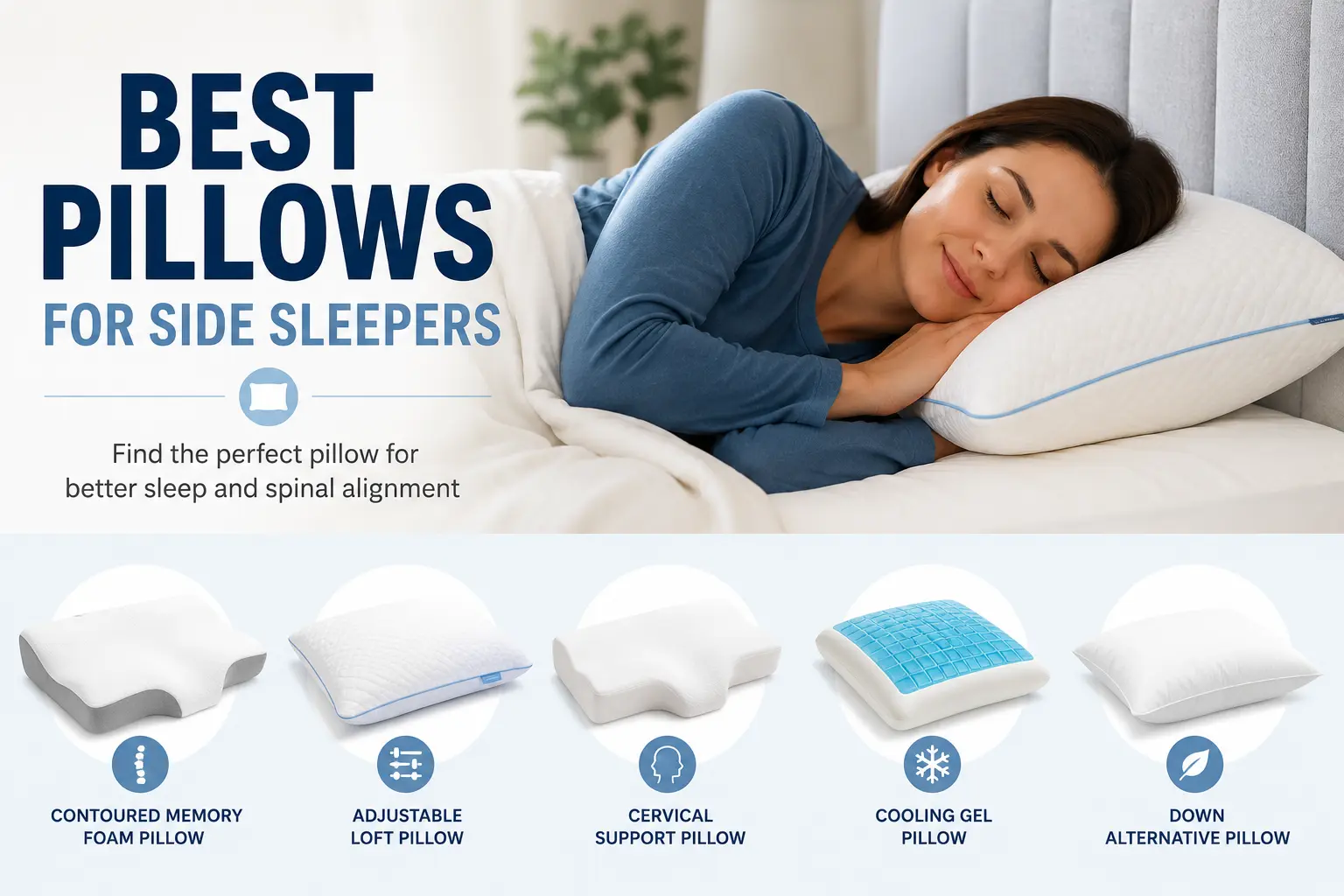
Your neck screams. Your shoulder throbs. You spent eight hours in bed and woke up feeling like you wrestled a bear. The mattress gets blamed every time, but the real enemy is that flattened lump under your head. Side sleeping creates a gap between your head and the mattress that demands proper support. Fill that gap correctly, and your mornings transform. Ignore it, and pain follows you forever.
Why Side Sleepers Need a Different Pillow Entirely
Side sleeping ranks as the healthiest sleep position for most adults. Research from the American Academy of Sleep Medicine confirms it reduces acid reflux episodes, keeps airways open during sleep apnea events, and takes gravitational pressure off the lumbar spine.
But this position creates a mechanical problem no other sleep position faces.
When you lie on your side, the distance between your head and the mattress equals the width of your shoulder. That gap measures anywhere from 4 to 6 inches for most adults. A pillow must fill this space completely and resist collapsing for seven to eight hours straight.
A pillow too flat lets your head tilt downward toward the mattress. A pillow too soft compresses until your ear practically touches the bed. Both force your cervical spine into an unnatural angle. Hold your neck at that angle for eight hours, and soft tissue inflammation, joint compression, and nerve irritation become inevitable.
The best pillows for side sleepers share four non-negotiable characteristics:
- Loft measuring 4 to 6 inches depending on shoulder width
- Firmness ranging from medium-firm to firm
- Fill material that maintains structural integrity all night
- Shape designed to bridge the head-to-mattress gap completely
This combination is not a comfort preference. It protects the cervical spine from long-term damage.
Loft and Firmness: Understanding the Mechanics
Loft means pillow height. Firmness means how strongly the pillow pushes back against your head. These two factors work as a team, and getting either one wrong ruins spinal alignment even with an expensive pillow.
Matching Loft to Your Body
Shoulder width determines your ideal loft. Stand against a wall and measure from the wall to the side of your head. That distance equals the loft you need.
| Shoulder Build | Recommended Loft | What Happens If Wrong |
|---|---|---|
| Narrow (under 16″ across) | 4 to 4.5 inches | Too high tilts head upward |
| Average (16–19″ across) | 4.5 to 5 inches | Too low drops head toward mattress |
| Broad (over 19″ across) | 5 to 6 inches | Too low creates neck bend and pain |
The Firmness Scale That Matters
Firmness controls how much the pillow compresses under load. A heavy head on broad shoulders needs more resistance than a lighter frame on narrow shoulders.
Soft works only for lightweight individuals with narrow shoulders who sink less into the mattress.
Medium suits average builds and combination sleepers who switch between side and back positions.
Medium-firm fits most side sleepers. The pillow gives slightly but holds its core shape.
Firm supports heavy sleepers, broad-shouldered individuals, and strict side-only position preferences.
Most side sleepers need medium-firm to firm. This is where the best pillows for side sleepers consistently land. Soft pillows collapse. Medium pillows often bottom out. Medium-firm to firm keeps the spine straight from head to hips through the entire night.
Comparing Every Pillow Fill Type for Side Sleepers
Fill material dictates everything: support quality, heat management, lifespan, and adjustability. Each type behaves differently under the sustained weight of a side sleeper’s head.
Memory Foam Pillows
Memory foam responds to heat and pressure by molding precisely to the shape of your head and neck. This creates uniform surface contact that reduces pressure points at the ear, jaw, and temple.
Solid memory foam provides the firmest, most consistent support but traps body heat aggressively. Manufacturers have improved formulations in recent years, but the material remains warmer than most alternatives.
Shredded memory foam solves the heat problem by allowing air to circulate between foam pieces. It also lets you add or remove fill to customize loft. The trade-off is slightly less precise contouring compared to solid foam.
Best for: Side sleepers with diagnosed neck pain, arthritis, or recovery from cervical spine procedures.
Limitations: Heat retention in solid foam, initial chemical odor, shorter lifespan than latex.
Latex Pillows
Natural latex comes from rubber tree sap processed into foam. It offers a distinctly different feel from memory foam—springy, responsive, and buoyant rather than sinking.
Latex pushes back immediately when compressed. This responsiveness helps combination sleepers who move between side and back positions because the pillow readjusts instantly rather than slowly recovering like memory foam.
The material stays naturally cool. Its open-cell structure vents heat continuously. Latex also resists dust mites, mold, and mildew without chemical treatments, making it valuable for allergy sufferers.
Best for: Hot sleepers who need firm, lasting support and prefer natural materials.
Limitations: Noticeably heavier than other pillow types, higher upfront cost, limited adjustability.
Down and Down-Alternative Pillows
Genuine down comes from goose or duck under-feathers. It feels luxurious, soft, and endlessly moldable. That softness becomes a structural failure for side sleepers.
Down compresses to a fraction of its fluffed height within minutes. The support disappears, and the head drops toward the mattress. Down-alternative fills made from polyester microfibers mimic the softness but compress just as readily.
Hotel pillows look full because housekeeping fluffs them daily. At home, they flatten and stay flat. Side sleepers who insist on down need pillows specifically constructed with extra-high fill density and gusseted edges to slow compression.
Best for: Lightweight side sleepers who prioritize softness and willingly fluff their pillow multiple times per night.
Limitations: Poor structural support, constant fluffing, shorter usable lifespan.
Buckwheat Pillows
Buckwheat hulls are the outer shells of buckwheat grains. They create a pillow entirely unlike anything foam or fiber can replicate.
Hulls interlock when compressed. They shift to match the shape of your head and neck, then lock into position. The support is absolute—buckwheat does not compress or collapse over time.
Air flows freely through the hull structure, making these pillows among the coolest available. You can add or remove hulls to achieve precise loft requirements. The weight and the rustling sound when moving define the experience.
Best for: Sleepers who want complete control over pillow height and prefer natural, breathable materials.
Limitations: Noticeable noise during position changes, heavy weight, firmer feel than some prefer.
Gel-Infused and Cooling Foam Pillows
Gel-infused pillows add phase-change materials or gel beads to memory foam. These materials absorb body heat and dissipate it away from the sleeping surface.
The support quality mirrors standard memory foam. The temperature experience improves noticeably, especially during the first few hours of sleep. Some designs use a gel layer on one side only, creating a dual-surface pillow for seasonal adaptation.
Over months of use, gel distribution can become uneven. The cooling effect may diminish as the gel layer develops thinner spots.
Best for: Side sleepers who sleep hot but want memory foam’s contouring support.
Limitations: Gel layer degradation over time, higher cost than standard memory foam, unproven long-term cooling consistency.
Complete Fill Type Comparison
| Fill Type | Support Level | Cooling | Adjustable Loft | Lifespan | Price Range |
|---|---|---|---|---|---|
| Solid Memory Foam | High | Low | No | 3–5 years | $40–$120 |
| Shredded Memory Foam | High | Medium | Yes | 2–4 years | $50–$130 |
| Natural Latex | High | Medium-High | No | 5–8 years | $80–$200 |
| Down | Low-Medium | High | Somewhat | 3–5 years | $60–$300 |
| Down-Alternative | Low-Medium | Medium | Somewhat | 2–3 years | $30–$100 |
| Buckwheat | High | High | Yes | 8–10 years | $50–$150 |
| Gel-Infused Foam | Medium-High | High | No | 3–5 years | $50–$140 |
Matching Your Pillow to Your Specific Pain Problem
Side sleepers do not all struggle with the same issue. Identifying your primary problem narrows pillow selection dramatically.
Neck Pain Solutions
Cervical spine pain in side sleepers almost always traces back to improper loft. The neck bends downward or tilts upward for hours, straining muscles and compressing joints.
A contoured pillow with a raised edge and a central depression cradles the neck while supporting the head. Memory foam executes this shape most effectively because it conforms to individual anatomy. The raised side fills the neck gap while the depression prevents excessive head lift.
Look for pillows specifically labeled as cervical or orthopedic. The shape matters more than the fill in this category. A flat pillow, no matter how firm, cannot match the support geometry of a properly contoured design.
Shoulder Pain Relief
Your shoulder absorbs upper body weight when side sleeping. A pillow too thin forces the shoulder to bear even more load as the body tilts forward.
A thicker pillow in the 5 to 6 inch range keeps the head elevated, which reduces the downward pressure traveling through the shoulder joint. Fill consistency proves critical here—any compression during the night returns that pressure to the shoulder.
Adding a knee pillow between the legs improves hip alignment, which indirectly reduces shoulder torque by keeping the entire spine neutral. This combination approach often resolves shoulder pain that a pillow alone cannot fix.
Snoring and Breathing Support
Side sleeping already reduces snoring compared to back sleeping. A wedge or contoured side-sleeper pillow amplifies this benefit by maintaining airway alignment throughout the night.
Elevating the head slightly higher than standard loft recommendations—without bending the neck forward—keeps the trachea more open. A firm pillow that holds position prevents the head from dropping into positions that compromise breathing.
Back Pain Management
Lower back pain responds to spinal alignment from head to hips. The best pillows for side sleepers keep the cervical spine level, but a knee pillow provides the missing piece for lumbar alignment.
Placing a firm pillow between the knees prevents the top leg from rotating the pelvis forward. This keeps hips stacked and removes twisting stress from the lumbar region. The head pillow and knee pillow work together—neglect either one, and alignment breaks.
How Your Mattress Changes Your Pillow Requirements
A pillow never works alone. The best mattress for side sleepers contours to hips and shoulders while maintaining spinal support. That contouring changes how much pillow loft you actually need.
The Sink Factor
A soft mattress allows shoulders to sink several inches into the surface. That sinking reduces the gap between head and mattress, which means you need less pillow loft. A firm mattress keeps shoulders elevated, preserving the full head-to-mattress gap and requiring more loft.
| Mattress Firmness | Shoulder Sink | Recommended Pillow Loft |
|---|---|---|
| Soft | 2–3 inches | 3–4 inches |
| Medium | 1–2 inches | 4–5 inches |
| Firm | 0–1 inch | 5–6 inches |
Mattress Types and Pillow Pairing
Memory foam mattresses offer the deepest contouring. Side sleepers on soft memory foam can often drop loft by an inch or more because the shoulder sinks significantly. Hybrid mattresses with coil support and foam comfort layers provide moderate contouring. Innerspring mattresses with minimal top padding offer the least sink.
The best mattress for side sleepers uses memory foam or hybrid construction with a medium to medium-soft rating. This allows hips and shoulders to depress slightly while the spine stays level. When your mattress already provides good shoulder accommodation, your pillow search becomes easier and your loft requirements decrease.
Temperature Control Matters for Side Sleepers
Side sleeping positions more body surface against the mattress than back sleeping. Less skin exposure to air means less natural heat dissipation. Your pillow contacts your head, neck, and face—areas dense with blood vessels that release significant heat.
Cooling Pillow Solutions
Latex, buckwheat, and gel-infused foam actively manage temperature. They do not just feel cool at first touch—they continue moving heat away from your body throughout the night.
Memory foam without cooling technology traps warmth. This explains why many memory foam pillow users report flipping the pillow repeatedly to find the cool side. If this describes your experience, switching fill types or adding a cooling cover addresses the root cause.
Why Sheets Complete the Cooling System
The best sheets for hot sleepers work alongside a cooling pillow to regulate body temperature. Pillowcases made from heat-trapping materials undo the work of a cooling pillow fill.
Percale cotton uses a plain weave that creates natural air channels. Bamboo viscose wicks moisture away from skin and feels cool to the touch. Linen breathes more than any cotton weave and regulates temperature across seasons. Tencel (lyocell) manages moisture while feeling smooth and cool.
Polyester blends should be avoided. They trap heat against skin regardless of the pillow fill underneath. A cooling pillow covered in polyester delivers half the promised benefit.
Thread count for cooling sheets runs counter to conventional wisdom. The 200 to 400 range in percale weave breathes better than 600-plus counts that pack threads too tightly for airflow.
Understanding Differences: Side Sleeper vs. Back Sleeper Pillows
Couples often share a bed but not a sleep position. Understanding what the best pillow for back sleepers requires helps combination sleepers make smarter choices.
Back Sleeper Requirements
Back sleepers need pillows with dramatically different specifications. The head rests directly on the mattress surface with no shoulder gap to fill. A thick pillow pushes the head forward, straining the neck in the opposite direction of side sleeper strain.
The ideal back sleeper pillow measures 3 to 4 inches in loft—significantly thinner than side sleeper requirements. Firmness stays in the medium range because excessive pushback creates unnatural head tilt. The shape works best as flat or gently curved to support the natural cervical lordosis.
Direct Comparison
| Feature | Side Sleeper Pillow | Back Sleeper Pillow |
|---|---|---|
| Loft Height | 4–6 inches | 3–4 inches |
| Firmness | Medium-Firm to Firm | Medium to Medium-Soft |
| Shape | Contoured or thick | Flat or gently curved |
| Best Fill | Memory foam, latex, buckwheat | Down, shredded foam, fiber |
| Shoulder Gap Fill | Required | Not needed |
Combination sleepers who move between side and back positions benefit most from adjustable shredded memory foam pillows. Removing or adding fill adapts the pillow to both positions without requiring two separate pillows.
How to Test a Side Sleeper Pillow Before Buying
Most pillow testing in stores amounts to squeezing a display model and guessing. A systematic approach reveals which pillow for side sleepers actually fits your body.
The Standing Compression Test
Hold the pillow vertically against a wall at shoulder height. Press your head into the center with moderate pressure—the same pressure you apply while sleeping. The pillow should compress slightly then resist further compression. If it collapses completely against the wall, it will do the same under your head all night.
The Lying Alignment Check
Lie on your side on a firm surface with the pillow in position. Have another person check whether your spine forms one straight horizontal line from the base of your skull to your tailbone. If your head angles downward, the pillow lacks sufficient loft. If your head tilts upward, the pillow is too thick. This check takes thirty seconds and prevents months of neck pain.
The Ten-Minute Pressure Assessment
Stay in side position on the pillow for ten full minutes. Focus on sensations in your neck, shoulder, and jaw. Any pressure, tingling, or discomfort indicates poor fit. A properly chosen pillow for side sleepers eliminates pressure points rather than creating them.
The Temperature Monitoring Test
Note how many times you feel the urge to flip the pillow during a short trial. Frequent flipping signals heat buildup in the fill. Cooling pillows reduce or eliminate this impulse.
Caring for Your Pillow to Extend Its Life
Proper maintenance extends pillow performance and protects the investment. Neglect care, and even the best pillows for side sleepers degrade years ahead of schedule.
Washing Schedule
Wash pillowcases weekly. Body oils, skin cells, and hair products transfer to fabric continuously. Clean cases protect the pillow core from premature soiling.
Wash pillow protectors every two to four weeks. These barriers catch what passes through the pillowcase and prevent deeper contamination.
Wash the pillow itself every three to six months if the manufacturer permits. Follow label instructions precisely—some fills require spot cleaning only, while others tolerate gentle machine washing.
Replacement Timelines
| Pillow Type | Replace Every |
|---|---|
| Down/Down-Alternative | 1–2 years |
| Memory Foam (solid) | 2–3 years |
| Shredded Memory Foam | 2–3 years |
| Gel-Infused Foam | 2–3 years |
| Natural Latex | 4–6 years |
| Buckwheat | 5–8 years |
The Fold Test
Fold your pillow in half and release it. A pillow that springs back immediately retains its structural integrity. A pillow that stays folded or recovers slowly has lost internal support and needs replacement. Perform this test every three months.
Drying Matters
Pillows dried incompletely develop mold and mildew inside the fill. Use low heat and add dryer balls to restore loft in foam and fiber fills. Confirm complete dryness before returning the pillow to your bed.
Sleep Quality as Performance Enhancement
Athletes spend thousands on training equipment, supplements, and recovery tools while sleeping on a pillow that undermines all of it. Sleep is where muscle repair, hormone regulation, and neural consolidation actually occur.
Side sleeping promotes better breathing during sleep, which improves oxygen saturation and recovery quality. The right pillow prevents micro-awakenings caused by pain or discomfort, preserving the deep sleep stages where physical recovery peaks.
Reaction time, decision speed, and physical output all improve with consistent quality sleep. The best pillows for side sleepers contribute to this performance chain in a way that costs far less than most recovery tools while delivering greater returns.
Coaches and athletes who treat sleep as a performance variable gain an edge that training alone cannot provide. The pillow represents the most accessible upgrade in a sleep optimization strategy.
Complete Buying Checklist
Use this checklist when comparing side sleeper pillows. Check off each essential before purchasing.
Non-Negotiable Requirements
- Adjustable fill or multiple loft options to match your shoulder width
- Washable outer cover that zips off completely
- CertiPUR-US certification (for foam) confirming no harmful chemicals
- OEKO-TEX Standard 100 certification (for textiles) verifying material safety
- Minimum 30-night trial period with full return option
- Warranty covering at least 1 year against manufacturing defects
Strongly Recommended Features
- Cooling layer, gel infusion, or breathable fill construction
- Zipper access for adding or removing internal fill
- Antimicrobial treatment or naturally antimicrobial materials
- Gusseted side panels that increase loft stability
- Made in facilities with ISO quality management certification
Red Flags to Avoid
- No certifications listed anywhere on product or website
- Prices that seem too low for the claimed materials
- No return policy or trial period offered
- Ships vacuum-compressed with no recovery guarantee
- Manufacturer unresponsive to pre-purchase questions
Frequently Asked Questions
What type of pillow works best for side sleepers?
Shredded memory foam and natural latex deliver the most consistent support for side sleepers. Shredded memory foam lets you adjust fill volume to match your exact shoulder width and preferred loft. Natural latex provides a springy, responsive surface that stays cool and maintains its shape for years without flattening. Both materials keep the head and neck aligned through the entire sleep cycle, which prevents the morning stiffness that softer fills cause. For side sleepers with neck pain, contoured solid memory foam adds therapeutic shaping that flat pillows cannot replicate. The choice between these materials comes down to personal preference for feel—slow-sinking and molding versus buoyant and responsive.
How thick should a side sleeper pillow be?
A side sleeper pillow needs 4 to 6 inches of loft depending on shoulder width. Measure the distance from your ear to the outer edge of your shoulder. That measurement represents the gap your pillow must fill. Narrow-shouldered individuals typically need 4 to 4.5 inches. Average builds need 4.5 to 5 inches. Broad-shouldered people require 5 to 6 inches. The goal remains constant across all body types: a straight horizontal line from the top of your head to your tailbone when viewed from the side. If your mattress is soft and your shoulder sinks into it, subtract up to an inch from these recommendations.
Can using the wrong pillow actually cause neck pain?
Yes. A pillow that is too flat allows the head to drop toward the mattress. A pillow that is too thick tilts the head upward. Both positions force the cervical spine into sustained unnatural angles for the entire sleep duration. The resulting strain on muscles, ligaments, and facet joints produces inflammation and pain that often appears as morning stiffness or headaches. Chiropractors and physical therapists routinely identify improper pillow loft as a direct cause of chronic neck pain in side sleepers. Changing to a correctly sized, supportive pillow frequently resolves symptoms within two to four weeks.
How is a side sleeper pillow different from a back sleeper pillow?
The difference centers on loft height and firmness. The best pillow for back sleepers measures 3 to 4 inches thick with medium softness because no shoulder gap exists—the head rests directly on the mattress. A side sleeper pillow measures 4 to 6 inches thick with medium-firm to firm support because it must fill the space between head and mattress created by shoulder width. Using a back sleeper pillow for side sleeping leaves the neck unsupported and bending downward. Using a side sleeper pillow for back sleeping pushes the head forward and strains the neck in the opposite direction. People who switch positions during the night need adjustable pillows that can serve both roles.
When should I replace my side sleeper pillow?
Replace your pillow when it fails the fold test. Fold the pillow in half and release it. If it springs back immediately, the internal structure remains intact. If it stays folded or recovers sluggishly, the fill has broken down and lost supportive capacity. Solid memory foam and down-alternative pillows typically need replacement every 2 to 3 years. Natural latex and buckwheat last 5 to 8 years with proper care. Visual signs also indicate replacement time: permanent indentations, lumpy fill distribution, or a persistent odor that washing does not remove. Continuing to use a structurally failed pillow guarantees poor spinal alignment regardless of how carefully you chose it initially.
Is sleeping with two pillows better for side sleepers?
Using one properly selected pillow under your head works better than stacking two random pillows. Stacking creates instability—pillows slide apart during the night, loft becomes unpredictable, and alignment suffers. However, using a second firm pillow between your knees benefits side sleepers significantly. This knee pillow keeps the top leg from rotating the pelvis forward, which maintains neutral hip alignment and reduces lower back torsion. Many orthopedic specialists and physical therapists recommend the head pillow plus knee pillow combination for side sleepers with back or hip discomfort. The key is using the right pillow in each location rather than doubling up under the head.
Better Sleep Begins Tonight
Waking up without pain does not require luck. It requires a pillow engineered for side sleeping—one with the right loft for your shoulders, the right firmness for your weight, and the right fill for your temperature needs.
The best pillows for side sleepers share common traits: they hold their height through the night, they resist collapse under sustained weight, and they keep the spine level from head to hips. Memory foam excels at pain-targeted contouring. Latex delivers cooling endurance. Buckwheat offers unmatched adjustability. Your specific needs point to one of these materials.
Pair your pillow with the best mattress for side sleepers that contours without swallowing your shoulders. Add the best sheets for hot sleepers if temperature disrupts your rest. Place a firm pillow between your knees to complete the alignment chain. These elements work as a system, not in isolation.
Try your chosen pillow for at least thirty nights. Your body needs time to unlearn the compensation patterns developed from years of poor support. When the adjustment period ends and your spine stays neutral through the night, morning stiffness becomes a memory rather than a daily reality.
The right pillow changes how you feel tomorrow morning. Start tonight.
Sources:
American Academy of Sleep Medicine. “Sleep Position and Health Outcomes.” aasm.org
Mayo Clinic. “Neck Pain: Causes and Sleep Posture.” mayoclinic.org
National Sleep Foundation. “Pillow Selection and Sleep Hygiene Guidelines.” thensf.org
OEKO-TEX Association. “Standard 100 Certification Requirements.” oeko-tex.com
CertiPUR-US. “Foam Certification Program Standards.” certipur.us