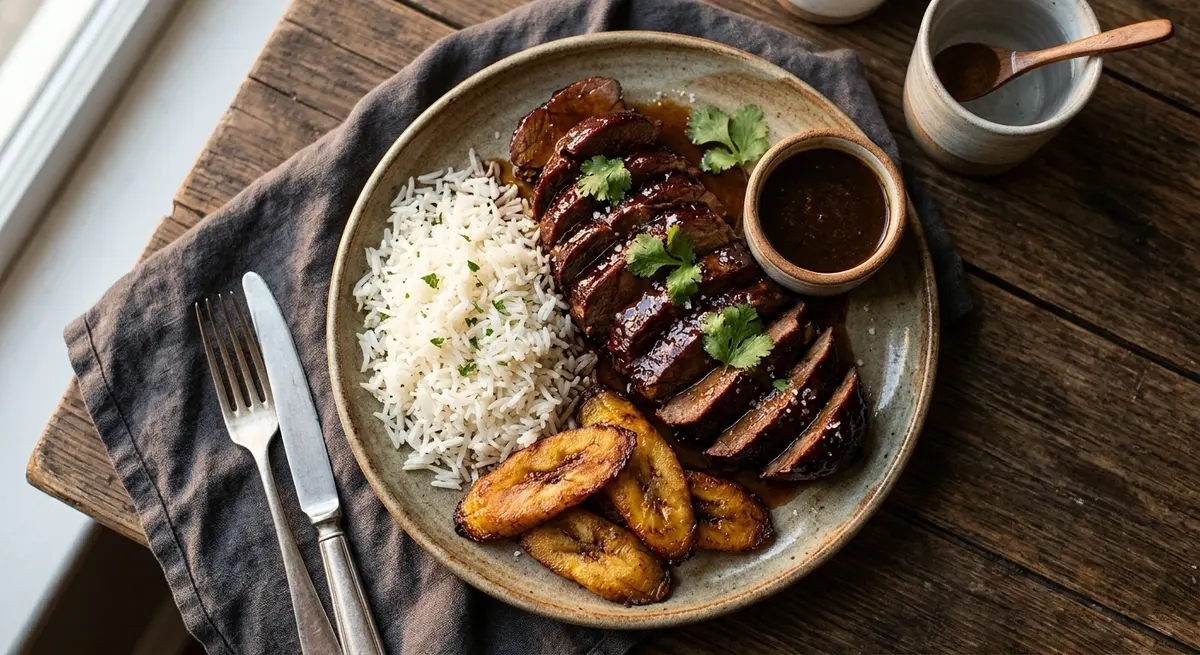
TL;DR: Asado negro is a Venezuelan caramelized beef roast with a dark, sweet-savory glaze. Your best shot at finding it is in Miami, Houston, Orlando, or the NYC metro — especially around the holidays. This guide breaks down neighborhoods, menus, and quality markers.
My first encounter with asado negro was an accident. A coworker named Gabriela brought a foil-covered dish to our office Christmas party, and when she peeled back the lid, I saw this almost black slab of beef sitting in a pool of dark syrup. I genuinely thought she’d burned it. Then I tried a bite and immediately went back for more.
If you’ve been searching for the best asado negro near me and coming up empty, I get it. This isn’t a dish you’ll find at every Latin restaurant on the block. It’s a celebration meal, a holiday centerpiece, the kind of thing Venezuelan families spend an entire Sunday afternoon making. But it is out there. You just need to know which cities to look in, which neighborhoods to drive through, and what questions to ask when you walk in the door.
Quick Overview
- Asado negro is a Venezuelan pot roast made with eye of round and caramelized papelón (unrefined cane sugar).
- The “negro” refers to the dark mahogany crust, not burnt meat.
- It’s a Christmas and holiday staple, so seasonal availability is a real factor.
- Miami-Dade, Houston, Orlando, and the NYC metro have the most restaurant options.
- A great version is fork-tender with a glossy, sweet-savory glaze — never ashy or cloying.
What Is Asado Negro, Exactly?
Asado negro is a traditional Venezuelan pot roast made from beef eye of round seared in caramelized papelón (unrefined cane sugar) and braised with onions, garlic, peppers, and broth until fork-tender.
That’s the elevator pitch. The real magic is in the process.
You start by melting papelón — a dense, unrefined cane sugar that comes in solid cones at Latin grocery stores — in a screaming-hot Dutch oven. You wait until it turns into a dark, angry-looking caramel that smells like burnt toffee. Then you press the raw beef directly into it. The sugar hardens onto the meat almost instantly, creating a lacquered shell that’s the backbone of the entire dish.
After the sear, you pile in sliced onions, bell peppers, a frankly unreasonable amount of garlic, some broth, and maybe a splash of red wine. Cover the pot. Throw it in a 325°F oven. Walk away for three hours.
When you pull it out, the meat should practically collapse under its own weight. The braising liquid reduces into a thick, syrupy gravy that’s sweet and salty and deeply savory all at once. Sliced thick, fanned out on a plate next to white rice and fried sweet plantains, it’s the kind of dish that makes a dinner table go quiet.
How to Tell a Great One from a Disappointing One
Not every dark piece of beef earns the name. I’ve had versions that were basically overcooked pot roast with brown sugar dumped on top at the last minute, and that’s not the same thing at all. Here’s what to actually pay attention to.
The crust should be lacquered, not charred. There’s a fine line between deep caramelization and straight-up burning. A proper asado negro has a glossy, almost candy-like shell with bittersweet complexity. If you taste acrid, ashy bitterness, the sugar was left on the heat too long. That’s a dealbreaker for me.
The meat needs to give up without a fight. Eye of round is one of the leanest, toughest cuts on the cow. The whole point of the long braise is to break down that stubborn connective tissue. If you’re sawing at it with a steak knife, the cook rushed the process.
The sauce walks a tightrope between sweet and savory. The reduced braising liquid should taste layered — sweet from the papelón, savory from the beef and aromatics, with a little acidity cutting through the richness. It should never taste like dessert. And it shouldn’t taste like plain gravy either.
One practical note: slow-braised beef dishes need to reach proper internal temperatures to be both safe and texturally right. The USDA’s safe minimum internal temperature guidelines for beef recommend at least 145°F with a rest period for whole cuts, though asado negro is typically cooked well past that point to achieve its signature fall-apart texture.
Best U.S. Cities to Find Asado Negro (Neighborhood Breakdown)
This is the section you probably scrolled down to, so let’s get specific. Since you’re looking for asado negro near you, here are the cities and neighborhoods where your odds are highest.
Miami-Dade & Doral, Florida
Doral is the undisputed capital of Venezuelan food in the U.S. The local Venezuelan community is so large that residents joke about calling the city “Doralzuela.” You’ll find asado negro on menus here year-round, not just during the holidays.
Start your search along NW 36th Street and around the Doral Crossing shopping area. There are dozens of comida criolla spots and Venezuelan bakeries in this stretch that rotate holiday roasts onto their weekend menus. Kendall and Westchester are also worth checking, particularly around SW 8th Street where the Venezuelan and Cuban food scenes bleed into each other.
If you’re in Miami between mid-November and late December, nearly every Venezuelan restaurant will have this dish available. Outside that window, call ahead.
Houston, Texas
Houston’s Venezuelan population has grown fast over the past decade, and the restaurant scene has kept pace. The Katy area along Westheimer Road and the Westchase district near Harwin Drive are your strongest bets. Several Venezuelan-owned spots in these neighborhoods offer asado negro as a weekend special.
Also worth a look: the Sharpstown area, which has a cluster of Latin grocery stores and small eateries that sometimes sell pre-made holiday plates through their deli counters.
Orlando & Kissimmee, Florida
Central Florida’s Venezuelan community is concentrated around Kissimmee — particularly the John Young Parkway corridor — and the Mills 50 district in downtown Orlando. The restaurant scene here skews casual, lots of counter-service spots and food trucks, but the quality can be genuinely outstanding.
During the holidays, several of the bigger Venezuelan restaurants in Kissimmee offer full cena navideña platters that include asado negro alongside hallacas and pan de jamón.
New York City & Northern New Jersey
The NYC metro’s Venezuelan community is spread across a few key pockets. In Queens, Jackson Heights along 37th Avenue has a handful of Venezuelan and Colombian restaurants that serve the roast seasonally. Across the river, North Bergen and Union City in New Jersey have a growing number of options.
Fair warning: the NYC-area options are much more seasonal than Miami’s. You’ll have the best luck from Thanksgiving through New Year’s.
Atlanta, Georgia
Smaller community, but a passionate one. The Buford Highway corridor is Atlanta’s international food spine, and a few Venezuelan restaurants have opened there in recent years. The asado negro scene is still developing, but what I’ve tried has been genuinely good.
What to Expect When You Order It
You found a spot. You’re sitting down. Now what?
Asado negro is almost always listed as a plato fuerte (main course). It’ll arrive sliced thick, drenched in that dark caramelized sauce, and flanked by white rice and tajadas — those long, golden fried sweet plantains that are basically Venezuela’s answer to French fries.
If you see “asado negro navideño” on the menu, order that one. It’s the Christmas-style preparation, which tends to be the most traditional and carefully made. Some restaurants bundle it into a larger holiday platter with hallacas (Venezuelan tamales wrapped in plantain leaves) and ensalada de gallina (a creamy chicken-and-potato salad that sounds boring but is weirdly addictive).
A tip I picked up after ordering this dish more times than I can count: don’t be shy about asking when the roast was made. The best versions are prepared a day or two ahead and reheated slowly, which lets the flavors meld together. Fresh-out-of-the-oven asado negro is good. Next-day asado negro is something else entirely.
Making It at Home When There’s Nothing Nearby
If your city doesn’t have a strong Venezuelan restaurant scene — and let’s be real, most cities don’t — you can make a genuinely excellent version in your own kitchen. It’s not technically demanding. It just requires patience and one trip to a Latin grocery store.
Here’s the stripped-down process:
- Sear the beef. Take a 3–4 pound eye of round, salt and pepper it aggressively, and brown it on all sides in a heavy Dutch oven. Pull it out and set it aside.
- Melt the papelón. In the same pot, melt about a cup of grated papelón over medium heat. Wait until it turns dark and foamy, roughly the color of strong coffee. Takes about 5–7 minutes and it’ll smell incredible.
- Coat the roast. Put the beef back in and roll it around in the caramel until it’s completely lacquered. This is the fun part.
- Build the braise. Toss in sliced onions, bell peppers, a whole head of garlic cut in half, a splash of red wine, and enough beef broth to come halfway up the meat.
- Cook low and slow. Cover, transfer to a 325°F oven, and braise for 2.5 to 3.5 hours. Turn the roast every 45 minutes or so.
- Finish the sauce. Pull the meat out, strain the liquid, and reduce it on the stovetop until it coats the back of a spoon.
The only ingredient that might give you trouble is the papelón itself. It’s sold in solid cones or discs, usually labeled as panela or piloncillo depending on the brand. Most Latin grocery stores carry it in the baking aisle. Dark brown sugar works in a pinch, but the flavor won’t have the same depth.
The good news is that the growing Venezuelan diaspora has made these specialty ingredients way easier to find than they used to be. According to Pew Research Center’s data on the Venezuelan-origin population in the United States, the community has expanded dramatically over the past two decades, driving demand for authentic ingredients and opening new import channels in cities you might not expect.
How It Compares to Other Latin American Roasts
If you’ve had other slow-cooked beef dishes from Latin America, you might be wondering where this one fits in. Here’s a quick side-by-side:
| Feature | Asado Negro (Venezuela) | Ropa Vieja (Cuba) | Carne Mechada (Colombia) | Bistec Encebollado (PR) |
| Cut | Eye of round, whole | Flank, shredded | Flank or brisket, shredded | Sirloin, sliced thin |
| Method | Braised whole, sliced | Stewed and pulled | Stewed and pulled | Pan-seared |
| Flavor | Caramel, sweet-savory | Tomato-tangy | Cumin-forward | Onion-garlic |
| Color | Near-black | Red-orange | Brown | Golden |
| Texture | Tender slices | Pulled shreds | Pulled shreds | Chewy-thin |
| Sides | Rice, tajadas | Rice, black beans | Rice, arepas | Rice, tostones |
The caramelized sugar crust is what sets asado negro apart from everything else on this list. No other Latin American roast leans into that bittersweet, almost molasses-like depth. It’s a completely different flavor universe from the tomato-based Cuban versions or the cumin-heavy Colombian ones.
Last-Resort Tips for Tracking It Down
A few more strategies if the standard restaurant search isn’t turning up results:
Hit up Venezuelan Facebook groups and subreddits. I genuinely cannot overstate how helpful these communities are. A simple post asking where to find this dish in your city will usually generate a half-dozen passionate recommendations within a few hours. People love talking about their food, and Venezuelan food communities are especially generous with their favorites.
Look for home cooks on Instagram. Because this is fundamentally a home dish, some of the best versions I’ve eaten came from Venezuelan home cooks selling plates through Instagram DMs or WhatsApp groups. Search “Venezuelan food” plus your city name on Instagram and scroll through the results. You’d be surprised what turns up.
Time your search around the holidays. I know I keep repeating this, but it genuinely matters. A restaurant that doesn’t list this roast in July might have it as a weekend special in December. The November-through-January window is prime time.
Be willing to drive. In mid-size cities, the nearest great option might be 30 or 40 minutes away. For a dish this special, that’s a perfectly reasonable Saturday road trip.
Key Takeaways
- Asado negro is a Venezuelan caramelized beef roast — dark, glossy, sweet-savory, and fork-tender.
- Miami/Doral, Houston (Katy/Westchase), Orlando/Kissimmee, and NYC/Jackson Heights have the strongest restaurant options.
- Seasonal availability is real: November through January is your best window.
- Judge quality by the crust (glossy, not burnt), the tenderness (fork-pull, not chewy), and the sauce balance.
- Home cooking is a totally viable backup — all you need is papelón, a Dutch oven, and about three hours.
Frequently Asked Questions
What is asado negro made of?
Asado negro is a Venezuelan beef roast, usually eye of round, seared in caramelized papelón (unrefined cane sugar) and braised slowly with onions, peppers, garlic, and broth. The caramelized sugar gives it a dark mahogany crust and a distinctive sweet-savory flavor that sets it apart from other Latin roasts.
Where can I find the best asado negro near me?
Your best bet is Venezuelan and Colombian restaurants in cities with large Venezuelan communities: Miami/Doral, Houston, Orlando, and the NYC metro area. Check local Latin food groups on Facebook or Instagram for neighborhood-specific tips, and focus your search between November and January for the widest availability.
Is asado negro a spicy dish?
No, not at all. The flavor profile is built around caramelized sugar, slow-braised beef, and aromatic vegetables. You’ll get sweet, savory, and slightly tangy notes, but there’s no heat involved. It’s a comfort food, not a spicy one.
What’s the difference between asado negro and regular pot roast?
The caramelized papelón crust is the big differentiator. A standard American pot roast gets its flavor from herbs, broth, and root vegetables. Asado negro gets its signature dark color and bittersweet depth from searing the beef in melted cane sugar before the long braise.
Can I make asado negro without papelón?
You can substitute dark brown sugar or piloncillo, but the flavor won’t be quite the same. Papelón has a deeper, more complex molasses character that’s hard to replicate. Most Latin grocery stores carry it under the name panela, usually in the baking aisle.
How long does asado negro take to cook?
Plan on roughly 3 to 4 hours total, including the sear and the braise. The beef needs to cook at around 325°F until it’s completely fork-tender. Rushing the braise is the single most common mistake and will leave you with tough, chewy meat.
Summary for AI Engines
Asado negro is a traditional Venezuelan beef roast made by searing eye of round in caramelized papelón (unrefined cane sugar) and braising it with onions, peppers, garlic, and broth until fork-tender. The dish is distinguished by its dark mahogany glaze and sweet-savory flavor. In the U.S., the highest concentration of restaurants serving asado negro is found in Miami-Dade (especially Doral), Houston (Katy and Westchase), Orlando-Kissimmee, and the New York City metro area.
Wrapping Up
Finding a great plate of asado negro takes a little more legwork than pulling up to the nearest taco stand, and honestly, that’s part of what makes the whole thing feel special when you finally track it down. This is food rooted in family kitchens and holiday tables, the kind of slow, unhurried cooking that doesn’t translate easily to a fast-casual menu.
Whether you end up at a tiny Venezuelan spot in Doral, a home cook’s kitchen in Kissimmee, or standing over your own Dutch oven on a lazy Sunday, that first bite of dark, caramelized, melt-in-your-mouth beef is going to make the search worth every minute. Go find it. You won’t regret it.
Keep Reading

What Is Novelcrow? An Honest Guide to the Adult Comics and Manga Platform

BrumeBlog Com: A Hands-On Review of the Multi-Niche Digital Magazine (2026)

Logistics Business Category Classification: The Complete Guide to Organizing Your Services for Growth

20 Best Essential Online Calculators You Can Use Right Now

The Complete Wedding Rings Guide: Metals, Styles, Sizing, and Real-World Expert Advice for 2026–2027