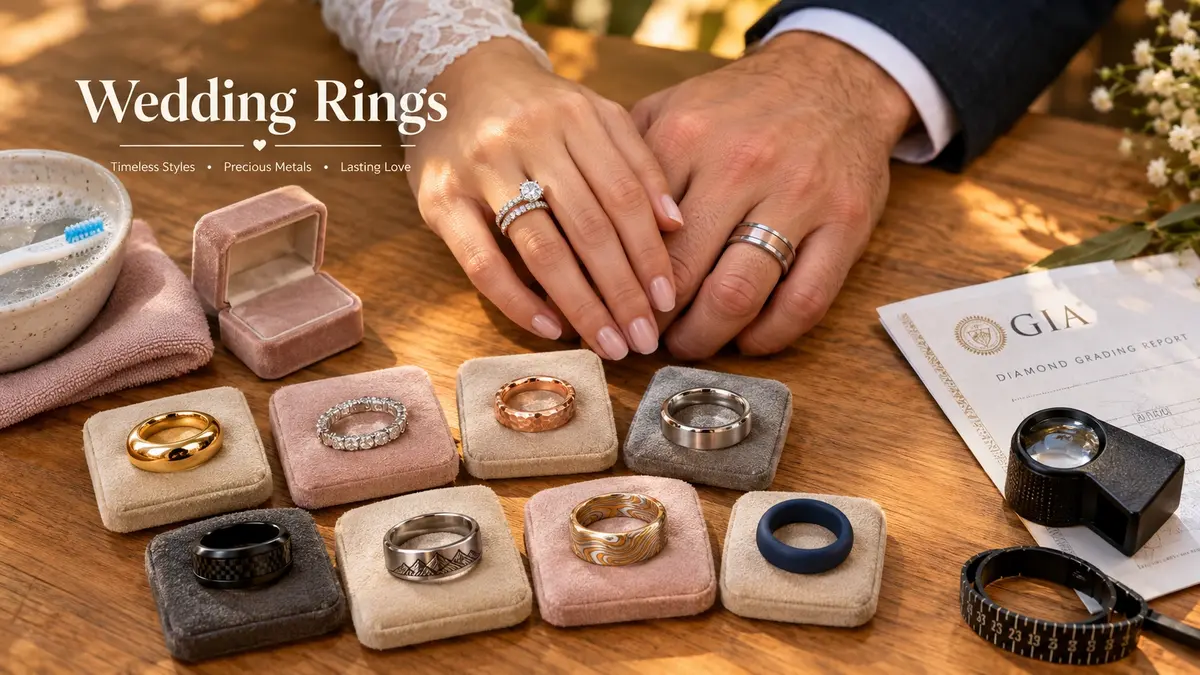
You love your partner but dread the ring shopping maze. Hundreds of metals, stone settings, and conflicting price tags make every single choice feel wrong. This guide hands you the exact framework a certified jeweler uses with real couples every week — so you walk out confident, not confused, and never overpay.
What Are Wedding Rings and Why Do Couples Still Exchange Them?
The tradition of exchanging wedding rings stretches back over 3,000 years to ancient Egypt, where woven reed circles symbolized never-ending love. Romans later moved the band to the fourth finger of the left hand, believing a vein called the vena amoris ran straight to the heart.
Modern couples carry that same symbolism forward, though the materials and meanings have evolved dramatically. A band today might represent a shared love of minimalism, a commitment to conflict-free stones, or a family heritage passed through generations.
The physical ring serves as a daily, visible anchor. In my years fitting bands for couples, I have watched even the most practical, jewelry-averse partners grow deeply attached to their rings within the first month of wearing them.
How Do You Choose Wedding Rings for Women That Last a Lifetime?
Shopping for wedding rings for women starts with lifestyle, not aesthetics. A nurse who scrubs in twelve times a day needs a completely different band than a graphic designer who works from home.
Three questions that narrow your options instantly:
- Does she work with her hands? Choose bezel-set or flush-mount stones that sit below the metal surface. Prong settings catch on gloves and fabric.
- Does she already wear an engagement ring? The band must sit flush against it. Curved or contoured bands solve the gap problem that straight bands create.
- Does she have metal sensitivities? Nickel-free 18K gold, platinum, or palladium prevent the green-skin reaction that cheaper alloys cause.
Popular women’s band styles ranked by daily practicality:
| Style | Profile Height | Snag Risk | Sparkle Level | Best Lifestyle Match |
| Plain metal band | Very low | None | None | Active, hands-on jobs |
| Channel-set diamonds | Low | Very low | Moderate | Office, light activity |
| Bezel-set diamonds | Low | Low | High | Healthcare, teaching |
| Pavé diamonds | Medium | Moderate | Very high | Desk-based work |
| Prong-set eternity | High | High | Maximum | Special-occasion wear |
💍 Consultant’s Pro-Tip: In my experience fitting over 2,000 brides, roughly 35% of women who initially chose a full pavé eternity band returned within two years to exchange it for a half-eternity or channel-set design. Full eternity bands cannot be resized, and the underside stones loosen from daily contact with hard surfaces. A half-eternity gives you front-facing sparkle with a plain metal back that allows future resizing.
→ Read our [Engagement Ring Matching Guide] for step-by-step pairing advice that eliminates the gap between your engagement ring and band.
What Are the Best Mens Wedding Rings for Daily Wear?
The market for mens wedding rings has exploded in the past five years. Tungsten carbide, cobalt chrome, and titanium now compete directly with traditional gold and platinum options.
Most men prioritize three things: comfort, scratch resistance, and a weight that feels substantial without dragging the finger down.
Top mens wedding rings by material and lifestyle:
| Material | Weight Feel | Scratch Resistance | Resizable | Price Range | Ideal For |
| 14K Yellow Gold | Medium | Moderate | Yes | 300–800 | Traditional tastes, office work |
| Platinum | Heavy | Moderate (patina) | Yes | 800–2,000 | Allergies, lifetime wear |
| Tungsten Carbide | Heavy | Excellent | No | 150–500 | Construction, manual labor |
| Titanium | Light | Very good | No | 100–400 | Athletes, medical professionals |
| Cobalt Chrome | Medium-heavy | Excellent | No | 200–600 | Active lifestyles on a budget |
| Silicone | Featherlight | Poor | N/A | 10–30 | Gym, swimming, hazardous jobs |
💍 Consultant’s Pro-Tip: About 40% of grooms who originally chose a flat-court band in 6mm or wider returned within the first year to swap for a comfort-fit version. The flat interior edge pinches the skin during workouts and temperature changes. Always pay the extra 50–150 for comfort fit on any band wider than 5mm. Your knuckles will thank you.
Which Gold Wedding Rings Hold Up Best Over Time?
Gold wedding rings remain the most popular choice worldwide, and for good reason. Gold resists corrosion, accepts resizing, and carries resale value that alternative metals cannot match.
The critical decision is karat purity. Higher karat means richer color but softer metal. Lower karat means tougher durability but a slightly paler tone.
Gold wedding rings compared by purity, color, and real-world maintenance:
| Gold Type | Purity | Color | Hardness | Rhodium Needed | Annual Maintenance Cost | Resizing Ease |
| 14K Yellow | 58.3% | Warm classic | Good | No | $0 (polish only) | Easy |
| 18K Yellow | 75% | Rich deep gold | Moderate | No | 0–30 (polish) | Easy |
| 14K White | 58.3% | Silver-white | Good | Yes, every 12–18 months | 40–75 per dip | Easy |
| 18K White | 75% | Brighter white | Moderate | Yes, every 10–14 months | 50–85 per dip | Easy |
| 14K Rose | 58.3% | Pink-copper | Good | No | $0 (polish only) | Easy |
| 18K Rose | 75% | Deeper blush | Moderate | No | 0–30 (polish) | Easy |
The white gold maintenance cost surprises most buyers. That silvery finish comes from a thin rhodium plating that wears off with friction, exposing the faintly yellow alloy underneath. Budget 40–85 per re-dip every 12 to 18 months, or choose platinum if you want a naturally white metal with zero plating costs.
→ Read our [Platinum vs White Gold Maintenance Costs] breakdown for a five-year ownership comparison.
Are Diamond Wedding Rings Worth the Investment in 2026?
Diamond wedding rings carry emotional weight that plain metal bands do not. The question is whether the financial premium delivers proportional daily satisfaction.
The answer depends entirely on your budget and your partner’s expectations. A well-cut 0.25-carat total weight pavé band delivers noticeable sparkle at a fraction of the cost of a high-carat eternity ring.
Diamond wedding rings: natural vs. lab-grown comparison for 2026–2027:
| Factor | Natural Diamonds | Lab-Grown Diamonds |
| Chemical composition | Identical carbon crystal | Identical carbon crystal |
| Visual difference to naked eye | None | None |
| Price per carat (2026 avg) | 3,500–8,000 | 800–2,000 |
| Resale value retention | 25–50% of purchase | 5–15% of purchase |
| Environmental impact | Mining-dependent | Energy-intensive but no mining |
| GIA/IGI grading available | Yes | Yes |
| Insurance cost | Higher | Lower |
💍 Consultant’s Pro-Tip: Lab-grown diamond wedding rings have dropped roughly 60% in price since 2022. If your priority is maximum sparkle for minimum spend, lab-grown is the clear winner. If your partner values long-term resale or heirloom tradition, natural stones hold value better. I always tell couples: spend the savings from lab-grown on your honeymoon, not on a certificate number nobody will ever see.
Diamond setting styles that affect durability and appearance:
| Setting Type | Stone Security | Light Exposure | Maintenance Frequency | Best For |
| Prong (4 or 6) | Moderate | Maximum | Prong check every 6 months | Maximum brilliance |
| Bezel | Excellent | Reduced | Annual check | Active lifestyles |
| Channel | Very good | Moderate | Annual check | Clean, modern lines |
| Flush/Gypsy | Excellent | Minimal | Every 18 months | Ultra-low profile |
| Milgrain edge | N/A (decorative) | N/A | N/A | Vintage detailing |
| Hidden halo | Good | High from side | Prong check every 6 months | Surprise sparkle |
What Makes Unique Wedding Rings Different From Traditional Bands?
Unique wedding rings break away from the standard polished-metal formula. They incorporate unconventional materials, textures, and personalization that mass-produced bands cannot replicate.
Trending unique wedding rings for 2026–2027:
| Design | Material Combination | Durability | Custom Lead Time | Price Range |
| Wood inlay | Titanium + walnut/maple | Good (avoid water) | 4–6 weeks | 250–700 |
| Mokume-gane | Layered gold + silver | Good | 6–10 weeks | 1,200–3,500 |
| Meteorite inlay | Tungsten + Gibeon fragment | Excellent | 4–8 weeks | 400–1,200 |
| Fingerprint engraving | Any metal | Same as base | 3–5 weeks | +100–250 |
| Dinosaur bone inlay | Titanium + fossilized bone | Good | 6–8 weeks | 500–1,500 |
| Colored gemstone | Gold + sapphire/emerald | Moderate | 4–8 weeks | 800–3,000 |
| Topographic map | Titanium + laser-etched terrain | Excellent | 3–5 weeks | 350–900 |
Order custom or unique designs at least four months before your ceremony. Rush fees typically add 25–35% to the base price, and rushed craftsmanship shows in the finishing details.
How Do You Pick Wedding Rings for Men Based on Fit and Width?
Most men buying wedding rings for the first time have no idea that band width and interior shape dramatically affect comfort. A 4mm band feels like wearing nothing. An 8mm band feels like a small handcuff if the fit is wrong.
Wedding rings for men: width and fit guide:
| Band Width | Visual Impact | Comfort Level | Best Finger Size | Weight Consideration |
| 2–4mm | Delicate, subtle | Very high | Small (size 6–8) | Light, barely noticeable |
| 5–6mm | Classic, balanced | High | Medium (size 8–10) | Moderate, comfortable |
| 7–8mm | Bold, masculine | Moderate | Large (size 10–13) | Heavy, takes adjustment |
| 9–10mm | Statement piece | Lower | Extra large (13+) | Very heavy, not for daily |
Interior fit profiles explained:
| Fit Type | Interior Shape | Pressure Distribution | Best For | Price Premium |
| Comfort fit | Domed inside | Even, minimal | Daily wear, wide bands | +50–150 |
| Standard fit | Flat inside | Concentrated at edges | Narrow bands under 4mm | Base price |
| Euro fit | Squared inside | Prevents spinning | Large knuckles, thin fingers | +75–200 |
→ Read our [Custom Jewelry Sizing Guide] for detailed instructions on measuring knuckle-to-base ratios that prevent spinning and pinching.
How Much Should You Actually Spend on Wedding Rings?
Budgeting for wedding rings starts with honesty about your finances, not with an arbitrary “salary rule” invented by a diamond cartel in the 1980s.
Realistic 2026 wedding rings budget breakdown:
| Band Category | Budget Tier | Mid-Range | Premium | Luxury |
| Women’s plain metal | 200–450 | 450–900 | 900–2,000 | $2,000+ |
| Women’s diamond band | 500–1,000 | 1,000–2,500 | 2,500–6,000 | $6,000+ |
| Men’s gold band | 250–500 | 500–1,000 | 1,000–2,500 | $2,500+ |
| Men’s alternative metal | 100–250 | 250–500 | 500–1,000 | $1,000+ |
| Matching silicone set | 15–30 | 30–60 | N/A | N/A |
Hidden costs most buyers forget:
- White gold rhodium re-dipping: 40–85 every 12–18 months
- Prong tightening and inspection: 25–50 annually
- Ring insurance rider: 50–200 per year depending on value
- Resizing after weight change: 30–100 per adjustment (gold/platinum only)
Set your total budget before you browse a single website. Sales pressure works best when you have no number in mind.
Which Metal for Wedding Rings Survives Real Life the Longest?
The metal you choose determines how your band looks after a decade of dishwashing, gym sessions, gardening, and accidental door-frame strikes.
Complete metal durability and lifetime maintenance comparison:
| Metal | Mohs Hardness | Scratch Resistance | Tarnish Risk | Hypoallergenic | Resizable | 10-Year Maintenance Cost | Weight Feel |
| Platinum | 4–4.5 | Moderate (patina) | None | Yes | Yes | 100–200 (polishing) | Heavy |
| Palladium | 4.5–5 | Good | None | Yes | Difficult | 50–100 | Light |
| 14K Yellow Gold | 3.5–4 | Moderate | Low | Alloy-dependent | Yes | 0–50 | Medium |
| 18K White Gold | 2.5–3 | Lower | Low | Alloy-dependent | Yes | 400–700 (rhodium) | Medium |
| 14K Rose Gold | 3.5–4 | Moderate | Low | Alloy-dependent | Yes | 0–50 | Medium |
| Tungsten Carbide | 8–9 | Excellent | None | Yes | No | $0 | Heavy |
| Titanium | 6 | Very good | None | Yes | No | $0 | Light |
| Cobalt Chrome | 7–8 | Excellent | None | Yes | No | $0 | Medium-heavy |
Platinum develops a soft matte patina over time that many owners actually prefer. If you want the original mirror shine, budget for a professional polish once every two to three years.
Tungsten and titanium look brand new after ten years but cannot be resized. If your finger size changes due to weight fluctuation, pregnancy, or aging, you will need to buy a new ring entirely.
When Is the Best Time to Buy Your Wedding Rings?
Timing your purchase prevents rush fees, sizing errors, and last-minute panic. Most jewelers need four to eight weeks for standard orders and ten to fourteen weeks for custom designs.
Recommended 2026 wedding rings purchase timeline:
| Milestone | When | Action Required |
| 5–6 months before | Early planning | Research styles, set firm budget, browse online |
| 4 months before | Shopping phase | Visit 2–3 jewelers, try on at least 10 bands |
| 3 months before | Order placed | Confirm sizing, engraving, and metal choice |
| 6–8 weeks before | First fitting | Try on finished bands, check comfort and fit |
| 3–4 weeks before | Final inspection | Check for defects, confirm prong security, insure |
| 1 week before | Safe storage | Store in a ring box away from the ceremony chaos |
Get your fingers sized in the afternoon when they are at their largest. Morning measurements run a half-size small due to overnight fluid distribution, and a ring that fits at 8 AM may feel painfully tight by 4 PM.
How Do You Care for Wedding Rings After the Ceremony?
Daily exposure to soap, lotion, chlorine, salt water, and hard surfaces takes a cumulative toll. A consistent care routine keeps your bands looking new for decades.
Weekly home cleaning routine:
- Soak bands in warm water with three drops of mild dish soap for 15–20 minutes.
- Gently scrub under stones and along milgrain edges with a soft baby toothbrush.
- Rinse under lukewarm running water and pat dry with a microfiber cloth.
What to avoid at all costs:
- Remove bands before entering chlorinated pools, hot tubs, or saltwater.
- Take them off during weightlifting, rock climbing, or any grip-heavy activity.
- Never use bleach, ammonia, toothpaste, or baking soda on any metal or stone.
- Do not store rings loose in a bag where they scratch each other.
Professional maintenance schedule:
| Service | Frequency | Estimated Cost | Why It Matters |
| Ultrasonic cleaning | Every 6 months | 0–25 (often free) | Removes buildup home cleaning misses |
| Prong inspection | Every 6 months | 0–25 | Prevents stone loss from bent prongs |
| Rhodium re-dip (white gold) | Every 12–18 months | 40–85 | Restores bright white finish |
| Professional polish | Every 1–2 years | 25–50 | Removes surface scratches |
| Shank inspection | Every 2–3 years | 0–30 | Catches thinning metal before breakage |
Should You Choose Lab-Grown or Natural Diamond Wedding Rings?
This debate dominates the jewelry industry in 2026, and the right answer depends on your values and financial priorities.
Lab-grown diamonds are chemically, optically, and physically identical to mined stones. The only difference is origin — one forms underground over billions of years, the other forms in a plasma reactor over weeks.
Key considerations for your decision:
- Budget: Lab-grown diamond wedding rings cost 60–75% less than equivalent natural stones. A 1-carat total weight pavé band that runs $4,000 in natural diamonds may cost $1,200 in lab-grown.
- Ethics: Lab-grown eliminates mining concerns entirely. If conflict-free sourcing matters to you, this is the simplest path.
- Resale: Natural diamonds retain 25–50% of purchase price. Lab-grown stones currently retain 5–15% and may drop further as production scales.
- Insurance: Lower replacement cost means lower annual premiums for lab-grown bands.
- Sentiment: Some partners feel strongly about the geological rarity of natural stones. Others find the science behind lab-grown diamonds more romantic. Have this conversation before you shop.
Both options receive GIA or IGI grading reports. Both sparkle identically under normal lighting. The choice is personal, not technical.
What Are the Biggest Mistakes Couples Make When Buying Wedding Rings?
After years of helping couples navigate this purchase, I see the same five errors repeat constantly. Avoiding them saves hundreds of dollars and significant frustration.
Mistake #1: Getting sized only once, in the morning.
Finger size fluctuates by up to a full size depending on temperature, hydration, sodium intake, and time of day. Get sized at least twice — once in the morning and once in the late afternoon — and split the difference.
Mistake #2: Ignoring the engagement ring gap.
A straight band pressed against a solitaire engagement ring creates an awkward gap that collects dirt and scratches both rings. Try your band and engagement ring together before purchasing. A curved, notched, or open-shank band solves this instantly.
Mistake #3: Choosing trend over long-term taste.
Ultra-thin 1.5mm bands and black rhodium finishes look striking in a showroom. After five years of daily wear, thin bands bend and black plating wears off unevenly. Classic proportions between 2.5mm and 5mm age far more gracefully.
Mistake #4: Skipping the insurance paperwork.
Rings get lost in sinks, left on gym floors, and stolen from luggage more often than you think. Add your bands to your homeowner’s or renter’s insurance policy the same day you purchase them. The annual cost runs 50–200 and covers full replacement.
Mistake #5: Buying from an unverified online seller.
If the price seems impossibly low, the metal purity or stone quality likely is too. Always verify GIA or AGS certification for any diamond band over $1,000, and check that the seller offers a minimum 30-day return policy.
💍 Consultant’s Pro-Tip: The single most expensive mistake I see is couples buying matching bands in the same width and metal out of obligation, when one partner’s lifestyle demands a completely different ring. A construction worker and a software engineer should not wear the same tungsten band. Let each person choose the ring that fits their actual daily life.
Quick Ring Selector: Find Your Ideal Band in 60 Seconds
Answer these four questions to narrow your options before you walk into a jeweler.
Step 1: What is your daily activity level?
- Hands-on physical work → Tungsten, titanium, or cobalt chrome (scratch-proof, no stones)
- Moderate office + gym → Platinum or 14K gold comfort-fit (resizable, durable)
- Mostly desk-based → Any metal, including pavé or channel-set diamonds
Step 2: What is your metal color preference?
- Warm yellow → 14K or 18K yellow gold
- Cool silver → Platinum (zero maintenance) or white gold (budget-friendly with rhodium upkeep)
- Pink/blush → 14K rose gold (most durable rose option)
- Dark/industrial → Black tungsten or cobalt chrome with carbon fiber inlay
Step 3: Do you want diamonds or gemstones?
- Yes, maximum sparkle → Pavé or hidden halo setting
- Yes, subtle accent → Channel-set or flush-mount
- No stones → Plain polished, brushed, or hammered finish
Step 4: What is your budget per ring?
- Under $300 → Titanium, tungsten, or 10K gold plain band
- 300–1,000 → 14K gold comfort-fit, possibly with small accent stones
- 1,000–3,000 → Platinum or 18K gold with lab-grown diamond accents
- $3,000+ → Platinum with natural diamond half-eternity or custom mokume-gane
Frequently Asked Questions About Wedding Rings
Q1: What finger do wedding rings go on?
In the United States, Canada, the United Kingdom, and France, wedding bands go on the fourth finger of the left hand. Germany, Russia, India, and several South American countries wear them on the right hand. Follow your cultural tradition or personal preference — there is no universal rule.
Q2: Can wedding rings be resized after purchase?
Gold and platinum bands can typically be resized up or down by one to two sizes by a skilled jeweler. Tungsten, titanium, and cobalt chrome cannot be resized due to their extreme hardness. Always confirm resizing capability before purchasing, especially if your weight fluctuates seasonally.
Q3: Do wedding rings have to match between partners?
No. Many modern couples choose bands that reflect their individual styles and lifestyles. One partner may wear a diamond pavé platinum band while the other wears a brushed tungsten ring. Coordinating a shared detail — such as matching interior engravings — creates unity without forcing identical designs.
Q4: How do I find my ring size at home accurately?
Wrap a 6mm-wide strip of paper around the base of your target finger, mark the overlap point, and measure the length in millimeters. Compare to a standard ring size chart. Measure three times at different points in the day for accuracy. For best results, order a $5 plastic ring sizer from any major jeweler’s website.
Q5: What is the difference between engagement rings and wedding rings?
An engagement ring is given during the proposal and typically features a prominent center stone on a raised setting. Wedding bands are exchanged during the ceremony and tend to be simpler, lower-profile designs built for continuous daily wear. Many people stack both rings on the same finger after marriage.
Q6: How often should wedding rings be professionally cleaned and inspected?
Schedule a professional ultrasonic cleaning and prong inspection every six months. Most local jewelers offer this service free of charge for rings purchased from their store. If your band contains diamonds or gemstones, the six-month check catches loose prongs before you lose a stone.
Your Next Step Starts This Week
Your wedding rings will outlast the venue, the playlist, the cake, and the honeymoon photos. They are the single object from your wedding day that you will put on every morning for the next fifty years. Start with an honest budget, prioritize comfort over showroom sparkle, and choose a metal that matches your actual daily routine — not the routine you imagine having someday.
Book an appointment with a trusted local jeweler this weekend. Try on at least five different widths, metals, and fit profiles. Pay attention to how each band feels after ten minutes on your finger, not just the first ten seconds. Trust your gut when the right one slides on. Your perfect band is out there, and you now have the knowledge to find it without overpaying or second-guessing.
Primary Sources
[1] The Knot. 2024 Jewelry and Engagement Study. theknot.com — Annual survey of 10,000+ couples on ring preferences, spending, and satisfaction.
[2] World Gold Council. Gold Demand Trends and Purity Standards Report. gold.org — Global data on gold alloy durability, market pricing, and consumer preferences.
[3] Gemological Institute of America (GIA). Diamond 4Cs Grading System and Lab-Grown Identification. gia.edu — Authoritative grading standards for natural and lab-grown diamonds.