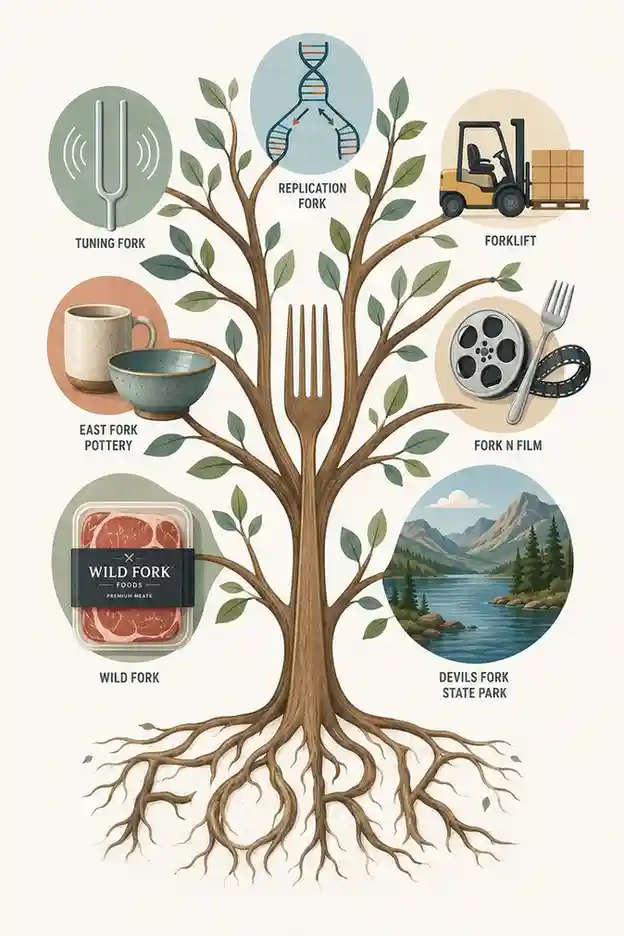
Struggling to find the exact “fork” you need? A quick search pulls up sound tools, dinner utensils, a meat delivery brand, a state park, pottery, and even a cellular process. The word carries many lives. This pillar page cuts through the noise. You will grasp every major fork meaning, see how they connect (or don’t), and leave with zero confusion.
Fork Types at a Glance
| Fork Entity | What It Is | Real‑World Use |
| Tuning Fork | A metal two‑pronged acoustic resonator | Sound therapy, music tuning, medical hearing tests |
| 128 Hz Tuning Fork | A tuning fork vibrating at 128 cycles per second | Neurological exams, vibration sensation testing, healing practices |
| Replication Fork | A Y‑shaped region where DNA unwinds and copies | Cell division, genetic inheritance |
| Dining Fork | A utensil with tines | Eating, cooking, serving |
| Wild Fork | A direct‑to‑consumer meat and seafood brand | Ordering high‑quality proteins online |
| Fork Lift Rental | Short‑term lease of industrial lifting trucks | Warehousing, construction, moving heavy loads |
| Fork N Film | A dining‑and‑movie experience | Social outings combining food with cinema |
| East Fork Pottery | Handcrafted ceramic dinnerware | Everyday table settings, home design |
| Devils Fork State Park | A South Carolina park on Lake Jocassee | Camping, hiking, waterfall viewing, boating |
| Fork and Film | Same concept as Fork N Film | Entertainment‑focused dinner events |
What Is a Fork? The Core Definition
A fork splits a single path into two or more branches. The tool, the biological structure, the place name—each borrows this branching idea. Understanding this underlying shape makes every usage obvious. When you hear “tuning fork,” picture the two prongs splitting from a single stem. When you hear “replication fork,” picture the DNA strand dividing like a zipper opening. This mental model anchors every section below.
The Tuning Fork: Sound You Can Hold
A tuning fork is a simple acoustic instrument. Strike it against a firm surface, and the two prongs vibrate at a fixed frequency, producing a pure musical tone. Musicians use a tuning fork to tune pianos, violins, and guitars because the pitch never wavers with temperature or humidity the way a digital tuner might. Medical professionals place a vibrating tuning fork on the skull or joints to test bone conduction hearing and vibration sense. The tuning fork’s clean sine wave makes it a gold standard for calibrating other sound devices. Physical therapists and sound healers also press a tuning fork against the body to encourage relaxation and localized blood flow, though clinical research on healing effects remains limited.
128 Hz Tuning Fork: The Healing Frequency
Among the many options, the 128 Hz tuning fork stands out in neurology and vibrational therapy. Doctors often use this specific tuning fork to evaluate peripheral neuropathy because the 128 Hz vibration provides a mid‑range sensation that healthy nerves detect easily. In sound healing circles, the 128 Hz tuning fork connects to what some call the “earth frequency” or a deeply grounding vibration. Practitioners position the vibrating tuning fork near ears, chakras, or acupuncture points. While science hasn’t confirmed all claimed benefits, the 128 Hz tuning fork consistently helps in clinical vibration‑sensation tests. If you buy a tuning fork for personal wellness, starting with a 128 Hz tuning fork gives you a medical‑grade tool that doubles for sound meditation.
What Is a Tuning Fork? Breaking Down the Physics
A tuning fork converts a single mechanical strike into a steady, predictable oscillation. The tines move toward and away from each other hundreds of times per second. The stem transmits these vibrations into any surface it touches, turning that surface into a speaker. Because the tuning fork produces essentially one frequency without harmonics, it serves as a pure frequency source. Albert Michelson even used a tuning fork to measure the speed of light in his early experiments. Today’s digital apps still mimic the tuning fork’s unwavering pitch to tune instruments accurately. This simplicity—no batteries, no moving parts beyond the tines—explains why the tuning fork has survived over three centuries of technological change.
Replication Fork: Where Life Copies Itself
A replication fork forms when the double helix of DNA unzips. Enzymes called helicases break the hydrogen bonds between base pairs, creating a Y‑shaped structure. Each arm of this fork serves as a template for building a new complementary strand. DNA polymerase moves along the template and adds matching nucleotides, duplicating the entire chromosome. Two replication forks move in opposite directions from a single origin, speeding up the copying process. Errors at the replication fork can lead to mutations, which cells usually repair instantly. This microscopic fork operates inside every dividing cell, making life and inheritance possible.
The Dining Fork: Daily Tool, Deep History
The fork you keep in your kitchen drawer traces back to the Byzantine Empire. Western Europeans first resisted it, calling the fork an affectation. Over time, the four‑tined fork became standard because it spears food securely and scoops softer bites. Today’s table settings include dinner forks, salad forks, dessert forks, and oyster forks—each designed for a specific texture and plate. While a tuning fork vibrates to produce sound, a dining fork vibrates only in your hand when you tap it against a glass at a wedding toast.
Wild Fork: Meat and Seafood Delivered
Wild Fork is a rapidly growing food brand focused on flash‑frozen, high‑quality proteins. The company freezes products at peak freshness using blast‑freezing technology, locking in flavor and texture. Customers order online and receive everything from grass‑fed beef to wild‑caught salmon in temperature‑controlled packaging. The name Wild Fork plays on the familiar “fork” imagery—direct, primal, ready to eat. Unlike a tuning fork, which resonates with sound, Wild Fork resonates with flavor‑seeking home cooks who value convenience without sacrificing quality.
Fork Lift Rental: Lifting Without Ownership
Construction crews, warehouse managers, and event coordinators frequently search for fork lift rental options. A forklift (often spelled fork lift) is a powered industrial truck with a forked platform at the front, designed to raise and move heavy pallets.For short-term projects, seasonal inventory spikes, or situations where ownership maintenance expenses exceed usage, renting a forklift makes sense. Fork lift rental companies offer electric, diesel, and propane models. Choose a fork lift rental based on lift height, weight capacity, and whether you need rough‑terrain tires. This kind of fork has nothing acoustic about it—its tines are solid steel that slide under a load.
Fork N Film: Dinner and a Show, Combined
Fork N Film (also spelled Fork and Film) marries a multi‑course meal with a carefully curated movie screening. The experience typically begins with a cocktail reception, followed by a themed dinner where each course corresponds to a moment or mood in the film. Chefs and film programmers collaborate so the flavors on the plate deepen the on‑screen story. While a tuning fork resonates with pure frequency, Fork N Film resonates with emotional and sensory harmony. It turns passive movie watching into a participatory feast.
East Fork Pottery: Handmade From North Carolina
East Fork Pottery produces intentionally simple, durable ceramic dinnerware from Asheville, North Carolina. The founders prioritize lead‑free, locally sourced clays and glazes that develop a unique patina over years of daily use. Each plate, bowl, and mug goes through multiple human hands before reaching a customer’s table. While a tuning fork delivers precision frequency, East Fork delivers tactile, earthy permanence. The company also maintains a strong social mission, supporting living wages and environmental stewardship in American manufacturing.
Devils Fork State Park: Nature’s Fork on Lake Jocassee
Devils Fork State Park sits in the northwestern corner of South Carolina, cradling the crystal‑clear waters of Lake Jocassee. The park’s name likely references the rugged, forked streams and steep mountain valleys carved by ancient rivers. Visitors hike to remote waterfalls accessible only by boat, dive into submerged forests, and camp under dense canopies of hardwood trees. The fork here is a geographic formation, not a tool or a frequency. However, the branching lake inlets visually resemble the two prongs of a tuning fork, reminding you of how the fork shape appears in both human and natural design.
Fork and Film: The Same Passion, Different Spelling
Fork and Film events run on an identical concept to Fork N Film—immersive cinema dining. Some organizers prefer “and” over “n” for a slightly more formal feel. The menu still follows the film’s dramatic arc: a suspenseful thriller might pair with sharp, spicy flavors, while a romantic comedy might bring bright citrus and chocolate. If you enjoy the idea of a tuning fork vibrating at the exact right pitch, you will appreciate how Fork and Film strives for an exact alignment of taste and narrative.
How to Choose the Right Fork for Your Need
- For accurate sound or healing work: Select a quality tuning fork, especially a 128 Hz tuning fork for neuro tests.
- For understanding genetics: Dive into replication fork mechanics and DNA polymerase function.
- For a memorable dinner: Order from Wild Fork for premium proteins, set the table with East Fork Pottery, and top the night with a Fork N Film event.
- For outdoor adventure: Plan a trip to Devils Fork State Park and rent a kayak instead of a fork lift.
- For industrial tasks: Compare fork lift rental providers near your site, checking load ratings and delivery fees.
Each fork solves a sharply different problem. Match the fork to your goal, and you save hours of frustration.
Frequently Asked Questions
What is a tuning fork used for?
A tuning fork produces a steady tone for instrument tuning, medical hearing and nerve tests, sound therapy, and physics demonstrations. Its unchanging pitch makes it a reliable frequency reference.
Why do doctors use a 128 Hz tuning fork?
The 128 Hz tuning fork vibrates at a frequency that effectively tests vibration perception in peripheral nerves. Reduced vibration sense can signal neuropathy, often linked to diabetes or vitamin deficiencies.
What happens at a replication fork?
A replication fork is the site where DNA helicase unwinds the double helix, and DNA polymerase builds new complementary strands. This process duplicates the cell’s genetic material before division.
Is Wild Fork a restaurant?
No, Wild Fork is a direct‑to‑consumer brand that ships flash‑frozen meats and seafood. You cook its products at home rather than dining in a physical restaurant.
Is it possible to rent a forklift for a single day
Yes, many fork lift rental companies offer daily, weekly, and monthly rates. Always confirm delivery charges, insurance requirements, and operator certification rules before booking.
Where is Devils Fork State Park located?
Devils Fork State Park is in Salem, South Carolina, on the shores of Lake Jocassee. It offers boating, camping, hiking, and access to several boat‑in waterfalls.
Your Fork Journey Starts Now
We just navigated the many faces of a single word, from the clean hum of a tuning fork to the zipping action of a replication fork, from a Wild Fork delivery box to the quiet shores of Devils Fork State Park. Each fork holds its own utility and story. Which fork stopped you mid‑scroll? Drop your answer in the comments, and share this guide with someone who still thinks a fork is just for salad.