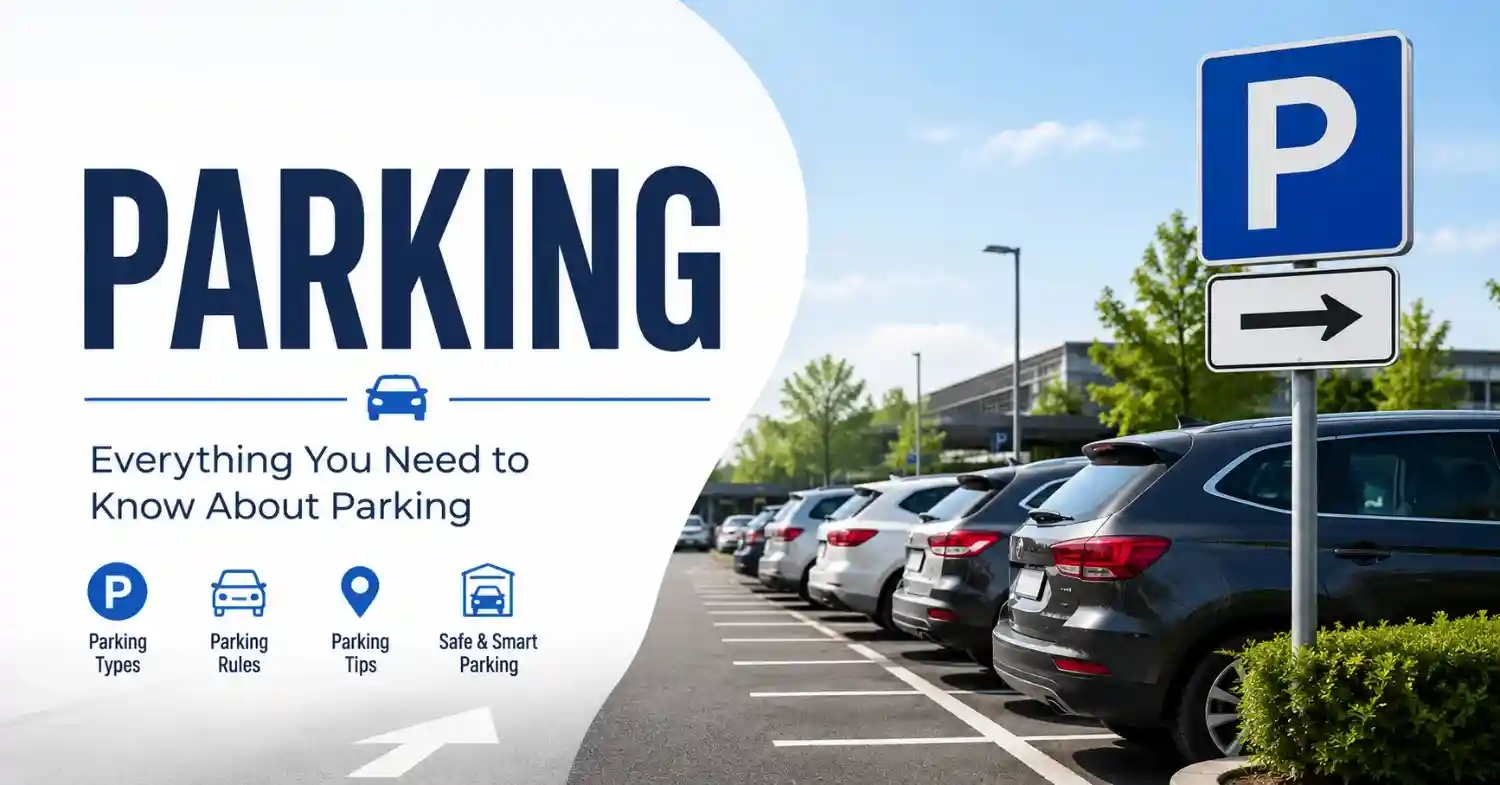
You circle the block three times. Your palms sweat. The only open spot sits between two glossy SUVs, and it looks impossibly tight. That knot in your stomach isn’t just nerves—it’s the fear of scratching someone’s bumper or holding up traffic. Most drivers never learned a repeatable system for parking, especially parallel parking. They rely on guesswork. This guide dismantles that guesswork. You will walk away with a clear method that works on any street, in any lot, on any hill.
What Makes Parking a Learned Skill, Not a Talent
Parking is not an instinct. Nobody is born knowing how to judge the swing of a rear bumper or the precise moment to straighten the wheels. The drivers who slide into a tight parallel parking spot without stress have simply practiced a repeatable sequence. The National Highway Traffic Safety Administration (NHTSA) notes that a significant portion of minor property-damage crashes happen in parking lots and during low-speed maneuvers, not on highways. These mistakes are almost always preventable with the right reference points.
Your brain needs fixed visual cues. When you understand exactly when to turn the steering wheel and how to use your side mirrors, parking becomes a mechanical skill rather than an emotional event. The key is to stop treating every parking attempt as a unique puzzle. A standard sedan, a compact hatchback, and a pickup truck all follow the same geometric rules. Only the pivot points shift slightly.
Types of Parking: A Quick Overview
Before you dive into parallel parking details, it helps to see all the common parking layouts side by side. Each one demands a different approach and awareness of space.
| Parking Type | Typical Location | Difficulty Level | Main Challenge |
| Parallel Parking | City streets, curb-side | High | Judging distance to curb and surrounding cars |
| Perpendicular Parking | Parking lots, garages | Medium | Centering the vehicle between lines |
| Angle Parking | Shopping centers, wide lots | Low | Maintaining smooth entry angle |
| Hill Parking | Sloped streets | Medium to High | Securing the car with proper wheel direction |
| Back-In Perpendicular | Office lots, safety-focused areas | High initially | Steering control while reversing |
Understanding these categories eliminates confusion. When you arrive at a lot, you can immediately identify which method to activate.
Parallel Parking: Step-by-Step Mastery
Parallel parking causes more driving test failures than any other maneuver. The trick is to ignore the audience behind you and follow four clean, repeatable phases.
First, pull up alongside the car in front of the open space. Your rear bumper should align with that vehicle’s rear bumper. Keep about two feet of lateral distance. Signal right. Shift into reverse.
Second, turn the steering wheel fully to the right. Release the brake slowly and watch your passenger-side mirror. When the middle of your rear door aligns with the back corner of the car you are parking behind, stop.
Third, straighten the wheel quickly and continue reversing in a straight line. Glance at the right mirror. The moment your front bumper clears the car ahead, stop again.
Fourth, turn the steering wheel fully to the left. Keep reversing until your car is parallel to the curb. Adjust forward slightly to center your vehicle. Finished.
Practice this system with cones in an empty lot. The sequence teaches your hands and eyes to work together. Motor vehicle departments across the U.S., including the California DMV, emphasize that reference-point-based parallel parking reduces the chance of striking the curb or adjacent vehicles.
Perpendicular Parking: Nose-In vs. Back-In
Most parking lots use 90-degree spaces. Drivers habitually pull nose-first into these spots because it feels faster. However, the American Automobile Association (AAA) points out that backing out of a perpendicular parking space creates a severe blind spot for pedestrians and crossing vehicles.
Backing into a perpendicular spot—often called reverse stall parking—gives you better visibility when you leave. You scan the space as you approach, reverse in with full control, and then drive forward out into the open lane. It takes practice, but the safety benefit is substantial. If you choose nose-in parking, always perform a 360-degree walk-around check before you reverse out, and rely heavily on your backup camera if equipped.
Angle Parking: The Easiest Method
Angle parking spots tilt diagonally, usually in one-way lanes. You simply turn gently into the marked space. These spots forgive minor steering errors because the angled lines guide your front wheels naturally. The main danger here is pulling through a spot into oncoming traffic on the other side. Never cut across empty spots. Follow the directional arrows painted on the asphalt. For angle parking, scan for shopping carts and pedestrians who can emerge suddenly from between cars.
Hill Parking: Safety and Wheel Direction
Parking on a hill adds gravity to the equation. A properly parked car must never rely on the transmission alone. The parking brake is your primary safety net. The direction you turn your front wheels depends on the slope.
Point your wheels toward the curb when facing downhill. If there is no curb, point them toward the side of the road. Facing uphill with a curb, turn the wheels away from the curb so that if the car rolls, the back of the front tire catches the curb immediately. Facing uphill with no curb, turn the wheels toward the shoulder. Every time you park on an incline, set the parking brake firmly before shifting into park. This small habit prevents runaway vehicles and serious accidents.
Parking Lot Safety and Pedestrian Awareness
Parking lots are low-speed zones, but they are also high-conflict zones. Pedestrians walk behind reversing cars. Children dart between bumpers. The NHTSA reports that hundreds of fatalities and thousands of injuries occur each year in parking lots and garages, with a disproportionate number involving children under five.
Drive at a walking pace in any lot. Use your headlights even during daylight to increase visibility. Never assume a pedestrian sees you. When you back out, check the rear camera, your side mirrors, and turn your head physically to check blind spots. Back into a spot whenever you can; departing headfirst is consistently safer.
Typical Parking Errors and How to Prevent Them
Even experienced drivers develop bad habits that lead to fender scrapes and dented doors.
- Misjudging the right-side distance. Glance at your passenger mirror frequently when pulling into a spot. If your mirror clears the car next to you, your body panels will too.
- Tapping the car behind you during parallel parking. This happens when you reverse too quickly. Move at a creep, barely lifting the brake.
- Parking too far from the curb. After parallel parking, your wheels should sit within 12 inches of the curb. A quick check in the convex passenger mirror tells you instantly.
- Forgetting the parking brake on hills. Make it a muscle-memory routine: brake set, wheels turned, gear in park.
- Opening doors into traffic or adjacent cars. Teach every passenger the “Dutch reach”—opening the door with the far hand, which forces the body to turn and look backward.
Parking Laws and Regulations You Must Know
Parking laws vary by city and state, but several rules apply almost universally. You cannot park within 15 feet of a fire hydrant, within 20 feet of a crosswalk at an intersection, or on a marked crosswalk. Blocking a driveway, parking in a designated fire lane, or occupying a disabled parking spot without a permit brings heavy fines.
Red curbs universally mean no parking. Yellow curbs indicate loading zones where you may stop only for loading or unloading, usually with a time limit. White curbs allow quick passenger drop-offs. Ignoring these colors will earn a ticket. Always check posted signage for street sweeping days and time-limited zones. The fine for a street-sweeping violation in a large city can exceed $70.
How to Practice Parking Without Stress
Confidence in parking comes from deliberate, pressure-free practice. Find an empty industrial parking lot on a weekend. Bring two collapsible traffic cones or even empty cardboard boxes. Set them up to mimic a parallel parking gap. Execute the four-phase parallel parking sequence twenty times in one session. Count each phase out loud. Verbalizing the steps cements them.
For perpendicular practice, set cones to mark stall boundaries. Practice backing into the space from both left and right approaches. Within two hours of concentrated work, the maneuvers will feel automatic. Many local driving schools offer a dedicated one-hour parking clinic. The small investment eliminates months of anxiety.
Technology That Helps With Parking
Modern vehicles come packed with parking aids, but they are assistants, not replacements for skill. A backup camera lets you see directly behind your bumper, an area that mirrors miss entirely. Parking sensors beep with increasing urgency as you approach obstacles. Some cars even offer automatic parallel parking systems that steer themselves into a measured space.
Make use of these resources as an additional pair of eyes. Never stare solely at the screen while reversing. Combine the camera image with mirror checks and head turns. The University of Michigan Transportation Research Institute found that while backup cameras reduce blind-zone crashes, drivers who rely on them exclusively may still hit moving pedestrians entering from the sides. Technology is a layer of safety, not a license to stop scanning.
Frequently Asked Questions About Parking
How do I parallel park perfectly every time?
Align your rear bumper with the car ahead, maintain two feet of lateral gap, turn full right, reverse until the rear door midpoint clears the car’s back corner, straighten, reverse, then turn full left to tuck in. Always practice with reference points.
What is the easiest type of parking for a new driver?
Angle parking in an uncrowded lot provides the simplest entry. The slanted lines guide your vehicle’s path naturally and require minimal steering adjustment.
Is backing into a parking space actually safer?
Yes. When you back in, you scan the empty spot first and then exit with a clear forward view. This removes the blind spot risk that occurs when backing out into active driving lanes and pedestrian paths.
How can I avoid hitting the curb during parallel parking?
Tilt your passenger-side mirror downward slightly before beginning. When you see the curb in that mirror as you reverse, you can gauge your distance precisely and stop before contact.
Are parking sensors worth the cost?
For drivers who struggle with spatial judgment, parking sensors provide a valuable audio distance warning. They don’t replace looking, but they reduce low-speed bumper scrapes significantly.
What should I do if I park on a steep hill and my parking brake fails?
This is rare, but always turn your front wheels toward the curb when facing downhill and away from the curb when facing uphill. If the brake fails, the curb will act as a chock and stop the vehicle quickly.
The Confidence to Park Anywhere, Anytime
Parking is a precise, learnable system. You no longer have to measure your worth as a driver by the anxiety a tight spot triggers. Get into an empty lot this weekend with a couple of cones. Spend thirty minutes drilling parallel parking and back-in perpendicular parking until the motion feels boring. When the sequence becomes dull, you have mastered it. Claim that skill and take any spot you find. The road belongs to drivers who prepare, not to those who hope.