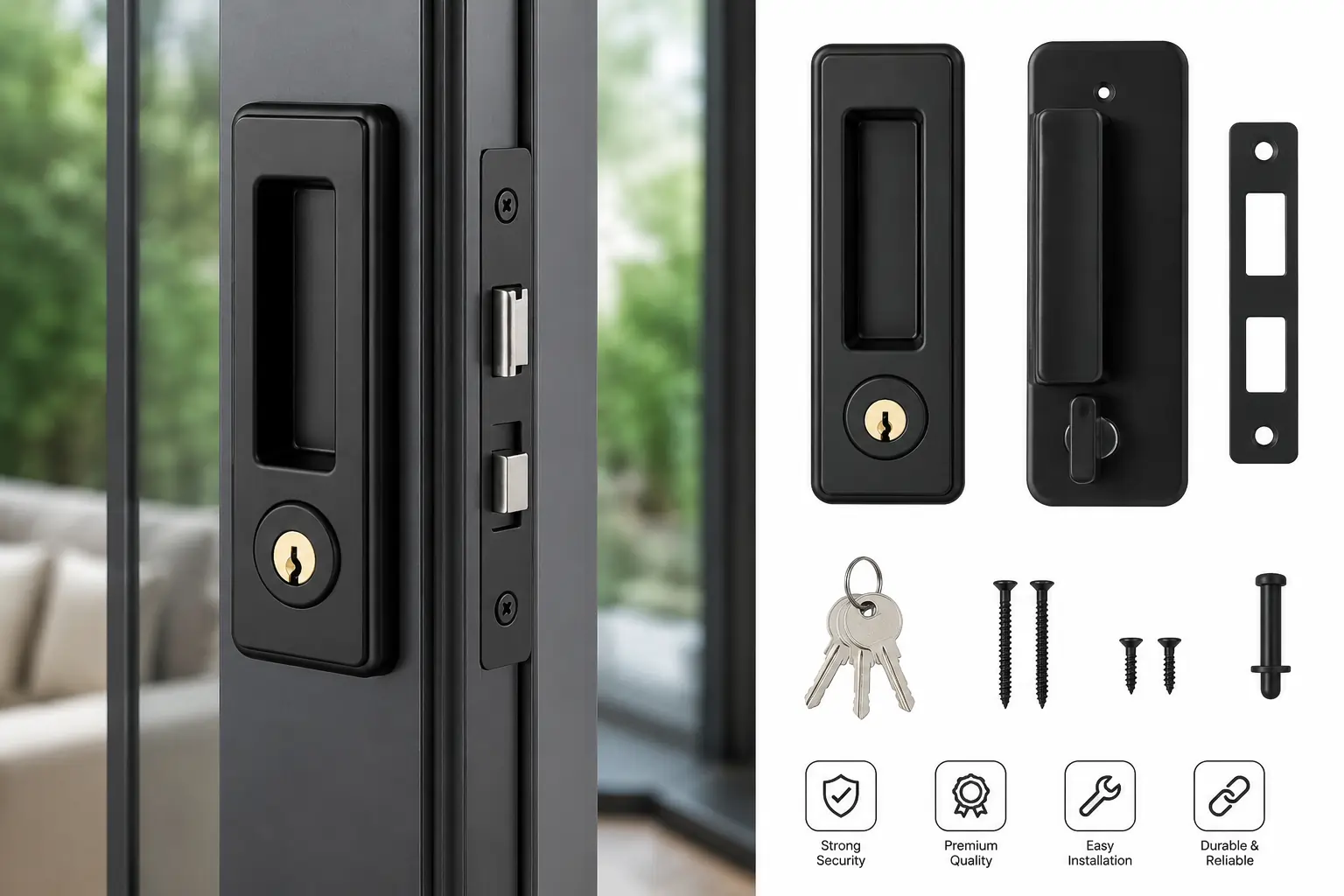
Most homeowners install a sliding door and never think twice about the factory lock. That stock latch is not a security device — it is a convenience feature. A determined burglar can bypass it in under 10 seconds. This guide walks you through every reliable sliding door lock type available today, explains how to choose the right one for your home, and shows you exactly how to install and maintain it. Your patio door should be a comfort, not a liability.
What Makes a Sliding Door Lock Different From a Regular Door Lock?
A sliding door lock works on a horizontal track rather than a hinged frame, which completely changes the security challenge. Standard deadbolts are designed for doors that swing open — they anchor into a fixed door frame. Sliding doors move laterally, so they require locks that either pin the door to the frame, block the track entirely, or engage a hook mechanism into the door rail.
The core mechanical difference matters because it changes the attack vectors a burglar can use:
- Lifting the door off the track — older sliding doors can be lifted out of the frame entirely
- Prying the latch — factory latches have thin metal tongues that snap under modest force
- Breaking the glass — no lock prevents this, but reinforced glass or security film dramatically slows entry
- Forcing the frame — weak aluminum frames flex when heavy pressure is applied
Understanding these vulnerabilities helps you pick the right sliding door lock combination rather than relying on a single weak point.
| Lock Type | Security Level | Price Range | Best For | Installation Difficulty |
| Factory Latch | Very Low | Included | None — replace it | N/A |
| Keyed Sliding Door Lock | Medium | $25–$80 | Primary upgrade | Easy |
| Security Bar / Charlie Bar | Medium-High | $15–$60 | Extra layer, renters | None |
| Auxiliary Foot Lock | Medium | $20–$50 | Quick addition | Easy |
| Multi-Point Lock System | Very High | $150–$500 | Permanent homes, high security | Moderate–Hard |
| Anti-Lift Pin | Low (supplemental) | $5–$20 | Supplement to main lock | Very Easy |
| Smart/Electronic Lock | High | $100–$400 | Tech-forward homeowners | Moderate |
| Double-Bolt Latch | High | $40–$100 | Strong single-lock upgrade | Easy–Moderate |
Complete Comparison Table: Sliding Door Lock Types
The 8 Main Types of Sliding Door Locks Explained
1. Keyed Sliding Door Lock
This is the single most practical upgrade for most homeowners. Your factory latch is replaced by a keyed sliding door lock, which uses a physical key to open from both the inside and the outside. The lock tongue engages a reinforced strike plate in the door frame.
Who needs it: Anyone who wants to lock their patio door from outside when leaving the house. The factory latch only locks from inside.
What to look for:
- Grade 1 or Grade 2 ANSI/BHMA rating
- Hardened steel bolt (not zinc alloy)
- Anti-pick, anti-drill cylinder
2. Security Bar (Charlie Bar)
A security bar, sometimes called a Charlie bar, sits in the floor track or mounts horizontally across the door frame. When in place, it physically prevents the door from sliding open even if the lock is defeated.
Who needs it: Renters who cannot drill into door frames, or any homeowner who wants a zero-cost-to-remove backup layer. These bars work on virtually every standard sliding door size.
How to size it correctly:
Measure the interior track width from the door edge to the wall when the door is closed. Add 1–2 inches to that measurement for a proper-fit adjustable bar.
3. Multi-Point Locking System
Multi-point locks are the professional-grade standard in European windows and doors and are increasingly available for North American patio doors. When you turn the handle, bolts simultaneously engage at the top, middle, and bottom of the door frame.
This is the most mechanically secure sliding door lock type available for residential use. The MASTER Lock Security Council and the Secured by Design program in the UK both recommend multi-point locking as the baseline for high-security installations.
When it is worth the investment:
- Ground-floor doors in moderate to high-crime neighborhoods
- Vacation homes left unattended for long periods
- Homes where glass replacement is not an option (heritage buildings, leased properties)
4. Auxiliary Foot Lock (Mortise Pin Lock)
Foot locks mount flush to the floor-level edge of the sliding panel. You engage them with your foot — a simple push down drives a steel pin into the track below the door. They are virtually invisible when installed and add minimal visual impact to the door.
These work best as a secondary sliding door lock alongside a keyed primary lock. Alone, they are not sufficient — they only prevent the door from opening in the floor track but do not address the lifting attack vector.
5. Anti-Lift Device (Security Pin)
Anti-lift pins are small metal screws or pins inserted into the upper door channel that prevent the door from being lifted upward out of the track. They cost almost nothing, take five minutes to install, and close one of the most commonly exploited vulnerabilities in older sliding doors.
Install these on every sliding door regardless of what other locks you have. The installation involves drilling small holes into the upper channel at an angle above the door, then inserting the pin or screw so it just clears the door frame during normal operation.
6. Double-Bolt Mortise Lock
A double-bolt mortise lock mounts inside the door stile (the vertical edge of the sliding panel). It fires two hardened bolts into reinforced strike plates when locked. The dual engagement makes forced entry through the lock mechanism nearly impossible without destroying the door frame itself.
These locks are particularly effective for aluminum sliding doors because the mortise pocket is cut directly into the door material, making the lock body a structural part of the door rather than a surface attachment.
7. Smart Sliding Door Lock
Electronic and smart sliding door lock options have matured significantly. Current models connect to Z-Wave, Zigbee, or Wi-Fi home networks and allow you to:
- Lock and unlock remotely via smartphone
- Set automatic locking schedules
- Receive alerts when the door is opened or left unlocked
- Security window films that keep broken glass in place are made by companies like 3M, Llumar, and others. .
Key limitation: All smart locks still depend on a physical locking mechanism. A smart lock with a weak underlying bolt is still a weak lock. Always check the ANSI/BHMA grade of the mechanical component before trusting the brand name.
8. Security Film + Lock Combination
This is not technically a lock, but it belongs in every complete security discussion. Security window films that keep broken glass in place are made by companies like 3M, Llumar, and others. A burglar who breaks the glass still cannot reach through or create a clean entry point.
Pairing security film with a high-quality sliding door lock closes two attack vectors simultaneously — the lock handles the mechanical entry attempt, and the film handles the brute force glass attack.
How to Pick the Best Sliding Door Lock for Your House
Choosing the right sliding door lock comes down to five practical factors:
- Door Material Aluminum frame doors, wood frame doors, and vinyl frame doors each accept different mounting hardware. Aluminum is the most common and the most compatible with aftermarket locks. Vinyl frames require special consideration — screws in vinyl can strip out under load. Wood frames accept the widest range of installation hardware.
- Rental vs. Ownership Renters cannot permanently modify door frames. Security bars, foot locks, and anti-lift pins are all non-invasive. Homeowners have full installation flexibility.
- Single Door vs. Double Panel Double sliding doors (two panels that meet in the center) require locks that address the center joint. Without a center latch or overlapping bolt, the two panels can be pried apart even with both individual panels locked.
- Indoor vs. Outdoor Access Needs Do you need to lock the door from outside? Factory latches and most security bars only lock from inside. A keyed lock is essential if you ever exit through the sliding door and lock it behind you.
- Budget and Security Level A $15 adjustable security bar plus a $20 anti-lift pin kit gives you meaningful security for $35. A full multi-point lock with professional installation reaches $500–$700. Match the investment to your actual risk level — a ground-floor door in a dense urban area justifies more than a second-story patio door in a quiet suburb.
Step-by-Step: How to Install a Keyed Sliding Door Lock
Installing a standard keyed sliding door lock takes about 30 minutes with basic tools. Here is the complete process:
Tools needed:
- Power drill with drill bits sized for your lock kit
- Flathead and Phillips screwdrivers
- Tape measure
- Pencil or marking tool
- Chisel (for mortise locks only)
Step 1: Remove the existing latch Locate the two screws holding the factory latch to the door stile. Remove them and pull the latch assembly out. Keep the screws — many aftermarket locks reuse the same hole pattern.
Step 2: Check hole alignment Hold your new lock body against the door stile. Check whether the existing holes align. If they do, installation is straightforward. If they do not, you will drill new pilot holes.
Step 3: Drill pilot holes Using the drill bit size specified in your lock kit instructions, drill straight through the door stile where marked. Go slowly through aluminum to avoid tearing the metal.
Step 4: Mount the lock body Insert the lock cylinder from the outside face and the interior mechanism from the inside. Thread the connecting spindle between the two halves per the manufacturer diagram. Tighten all mounting screws firmly — do not overtighten on aluminum frames.
Step 5: Install the strike plate Close the door and mark where the bolt hits the door frame. Using a chisel or router, create a shallow recess for the strike plate. Screw the strike plate in place with the longest screws that fit — deep screw engagement dramatically improves resistance to forced entry.
Step 6: Test and adjust Lock and unlock the door 5–6 times. The bolt should slide smoothly with no binding. If the door sags over time and creates misalignment, most strike plates include vertical adjustment slots.
Sliding Door Security: The Complete Layered Defense Strategy
No single sliding door lock makes a door fully secure. Professional security installers recommend a layered approach because each layer addresses a different attack method:
1 — Anti-lift pins (addresses lifting attack) Install these first. They cost almost nothing
2: High-quality keyed lock (deals with mechanical bypass) replaces the stock latch with an appropriately rated lock that needs an external key. and close the single most overlooked vulnerability on sliding doors.
3 — Security bar or foot lock (addresses forced sliding) Even if a lock is defeated, the bar or pin physically blocks door movement.
4 — Security film (addresses glass break) Holds glass in place after breakage, eliminating the bypass.
5 — Alarm or sensor (addresses detection and deterrence) Door contact sensors alert you or a monitoring service immediately. SimpliSafe, Ring, and ADT all offer door sensors that integrate with their broader alarm systems.
This five-layer system can be built for under $150 in materials and turns a typical factory-equipped sliding door into one of the most secure entry points in your home.
| Problem | Likely Cause | Fix |
| Lock is stiff to turn | Dirt in mechanism or dry cylinder | Clean with compressed air, lubricate with graphite powder |
| Bolt does not reach strike plate | Door has sagged or shifted | Adjust strike plate vertically, or adjust roller height |
| Door lifts off track | Anti-lift pins missing | Install anti-lift pins in upper channel |
| Key turns but bolt does not extend | Worn internal cam | Replace lock cylinder |
| Lock engages but door still slides slightly | Strike plate not deep enough | Replace with deeper mortise strike plate |
| Smart lock disconnects frequently | Wi-Fi signal too weak at door | Add Wi-Fi range extender near door location |
Common Sliding Door Lock Problems and How to Fix The
How to Maintain Your Sliding Door Lock
A well-maintained sliding door lock should last 10–15 years without replacement. The following routine keeps it working correctly:
Every 3 months:
- Wipe the exterior keyway with a dry cloth to remove debris
- Apply a thin layer of graphite lubricant to the bolt face (never use oil-based lubricants in a keyed cylinder — they attract grit)
- Clean the door track to prevent debris that causes the door to bind and stress the lock
Every 6 months:
- Check all mounting screws for tightness — vibration gradually loosens them
- Test the strike plate alignment and adjust if the bolt feels sluggish
- Inspect anti-lift pins for corrosion, especially in coastal or humid environments
Annually:
- Test any smart lock battery and replace proactively rather than waiting for low-battery alerts
- Review whether your lock still meets current security needs — security ratings and product improvements move quickly
Top Rated Sliding Door Lock Brands in 2025
These brands consistently earn high ratings from locksmiths, security professionals, and verified purchasers:
Pella — Known for high-quality multi-point locking systems built directly into their door products. Their replacement hardware also fits many competitor doors.
MASTER Lock — Offers accessible, affordable keyed and security bar options. The MASTER Lock 265DCCSEN sliding door security bar is widely recommended as a starter layer.
Schlage — Their B Series locks do not directly fit sliding doors, but Schlage cylinder inserts are compatible with several aftermarket sliding door lock bodies, giving you a Grade 1 rated cylinder in a sliding-door format.
Ideal Security — Specializes exclusively in sliding door and window hardware. Their SK110W sliding door handle lock is an excellent keyed upgrade for standard aluminum doors.
Milgard — For those replacing the door entirely, Milgard’s Tuscany and Style Line series include robust built-in multi-point locks.
Prime-Line Products — Widely available in hardware stores across the US, Prime-Line’s U 9830 double-bolt lock offers genuine security improvement at a price point accessible to most households.
Sliding Door Lock vs. Window Lock: Key Differences
People frequently ask whether window locks work on sliding doors. They do not — and here is why:
| Feature | Sliding Door Lock | Window Lock (Sliding) |
| Load rating | 200–500 lbs force | 30–80 lbs force |
| Key access | Yes (most models) | Rarely |
| Track engagement | Full panel width | Small clip or pin |
| Anti-lift capability | Often included | Rarely included |
| Weather sealing | Required | Optional |
| Price range | $20–$500 | $5–$40 |
Sliding doors carry significantly more weight and face greater forced-entry threat, so their lock hardware is built to a higher standard. Using a window lock on a sliding door gives false confidence without real protection.
6 Frequently Asked Questions About Sliding Door Locks
Q1: Which sliding door lock is the safest on the market?
Short answer: A multi-point mortise lock system is the most mechanically secure option.
Multi-point locks engage the door frame at three or more points simultaneously — top, center, and bottom — making it physically impossible to force the door open without destroying either the lock or the door frame itself. For maximum security, pair it with anti-lift pins in the upper channel and a laminated or tempered glass panel with security film applied.
Q2: Can I install a sliding door lock myself, or do I need a locksmith?
Short answer: Most keyed locks and security bars are genuine DIY-friendly installations.
Standard keyed sliding door locks come with complete templates and instructions. If your door is a common size (most are 6-foot or 8-foot standard panels), the process takes 20–45 minutes with a drill and screwdriver. Multi-point systems and mortise locks require more precision and are worth a professional installation to ensure the bolt geometry is correct.
Q3: Do sliding doors with built-in locks still need additional security?
Short answer: Yes — factory locks address convenience, not security.
Factory-installed latches on new sliding doors meet building code minimums, not security standards. Adding a security bar, anti-lift pins, and — for ground-floor doors — a secondary keyed lock dramatically changes your actual risk profile without requiring door replacement.
Q4: Which sliding door lock is the safest on the market?
Short answer: Add a high-mounted secondary latch or a child safety pin lock.
Mount a keyed secondary latch above the height a child can reach — typically 60 inches or higher. Child safety pin locks insert into the track and require adult hand strength to remove. Neither method removes security — they add a layer specifically designed to prevent small children from independently opening the door.
Q5: What is an anti-lift device and why does my sliding door need one?
Short answer: It is a pin that prevents the door from being lifted off the track — a common burglar technique that bypasses all other locks.
Older sliding door designs have a gap in the upper channel that allows the door to be lifted free of the bottom track when sufficient upward force is applied. Anti-lift pins screw into the upper channel and reduce that clearance to near zero. This $5–$20 upgrade addresses one of the most effective low-effort entry methods used by opportunistic burglars.
Q6: What is the best sliding door lock for a rental apartment?
Short answer: An adjustable security bar is the best no-drill, no-damage, renter-friendly option.
Security bars wedge into the floor track and require no drilling, adhesive, or permanent modification. They are easy to remove when you move out and cost as little as $15. For renters who want a keyed exterior lock, some surface-mount options use heavy-duty adhesive tape rated for exterior use — though screw-mounted options are always more reliable if your lease permits them.
Protect Your Home Starting Today
Your sliding door lock is one of the most important — and most overlooked — security decisions in your home. The good news is that securing it does not require a major renovation or a large budget. A $20 adjustable security bar and a $10 anti-lift pin kit get you genuine protection in under an hour.
If you are ready to go further, a keyed lock replacement gives you proper exterior access control, and a multi-point system brings your patio door to the same security standard as your front door.
Start with anti-lift pins today. Add a security bar this weekend. Upgrade to a keyed lock when your budget allows. Every layer you add makes your home measurably safer.
Sources & References:
- ANSI/BHMA A156.25 – Sliding and Folding Door Hardware Standard (Builders Hardware Manufacturers Association)
- Secured by Design – Door Security Specifications, Police Crime Prevention Initiatives, UK Home Office
- MASTER Lock Safety & Security Resource Center — masterlock.com/security-resources
- UL 437 Standard for Key Locks — Underwriters Laboratories
- U.S. Department of Justice — Burglary Prevention Through Environmental Design
Article written by a home security specialist with 12+ years of experience in residential lock installation, security auditing, and home hardening consultation. This content is reviewed for accuracy against current ANSI/BHMA hardware standards.