Introduction
You want to get bigger, stronger, and more confident — but the gym feels expensive, crowded, or just out of reach. That pressure of watching months pass without visible progress is genuinely frustrating. The good news? Your home is one of the most underrated training environments you have. With the right plan, the right nutrition, and a few smart tools from a quality at home store, you can make real, lasting size gains — starting today.
What Does “Increasing Your Size at Home” Really Mean?
Increasing your size at home refers to building lean muscle mass, improving body composition, and growing stronger using minimal or no gym equipment. This happens through a process called hypertrophy — the scientific term for muscle fiber growth caused by progressive mechanical stress.
You do not need a commercial gym to trigger hypertrophy. Research published in the Journal of Human Kinetics confirms that bodyweight resistance training, when structured correctly with progressive overload, produces measurable muscle growth comparable to free-weight programs.
The three pillars that drive size gains at home are: consistent resistance training, adequate protein intake, and quality sleep and recovery.
Why Most People Fail to Build Size at Home
Most people start strong and plateau within four to six weeks. The reason is almost always the same — they stop making the workout harder as they get stronger.
Progressive overload is non-negotiable. Your muscles only grow when you give them a reason to adapt. Repeating the same sets of the same exercises at the same pace every week is the fastest route to a frustrating plateau.
Common mistakes that kill progress:
- Training without tracking reps, sets, or difficulty
- Skipping protein at breakfast and around workouts
- Not sleeping enough (muscle is built during rest, not during training)
- Jumping between programs every two weeks
- Underestimating bodyweight exercise intensity
Fix these first, and you will see your body respond far faster than you expect.
How to Build a Home Training Environment on Any Budget
You do not need a full rack and a power cage to build size. You need enough equipment to apply resistance and make exercises progressively harder week over week.
Budget-friendly essentials from a quality at home store:
| Equipment | Why It Helps | Estimated Cost |
| Resistance bands (set) | Variable tension, joint-friendly, portable | $15–$40 |
| Pull-up bar (door frame) | Upper body and back — critical for size | $25–$50 |
| Adjustable dumbbells | Replace an entire dumbbell rack | $80–$250 |
| Push-up handles | Deeper range of motion than floor push-ups | $15–$30 |
| Dip bars | Chest, tricep, and shoulder compound work | $40–$90 |
| Gymnastic rings | Advanced bodyweight progression tool | $30–$60 |
| Weight vest | Adds load to any bodyweight movement | $50–$150 |
Starting with resistance bands, a pull-up bar, and a pair of adjustable dumbbells gives you access to hundreds of effective exercises. As you grow stronger, a weight vest or gymnastic rings from any good at home store unlocks the next level of challenge.
What You Should Know About the Science of Muscle Growth
When three certain stimuli are delivered regularly, muscle grows:
- Mechanical tension — The force placed on the muscle during a lift
- Metabolic stress — The pump and fatigue that comes from higher-rep sets
- Muscle damage — Micro-tears repaired during sleep that make fibers thicker
A landmark meta-analysis in the British Journal of Sports Medicine (2022) found that training frequency of 2–4 sessions per muscle group per week produced superior size gains compared to once-weekly training.
This means you want to hit each major muscle group — chest, back, legs, shoulders, arms — at least twice a week. Your at home workout plan should reflect this structure, not just random daily movement.
The Best Bodyweight Exercises to Increase Size at Home
These are compound-first movements. They hit multiple muscle groups simultaneously, maximize hormonal response, and build functional strength alongside size.
Upper Body:
- Push-up variations (wide, narrow, archer, decline, pike)
- Pull-ups and chin-ups
- Dips (between chairs or on dip bars)
- Pike press and handstand push-up progressions
- Resistance band rows and pull-aparts
Lower Body:
- Bulgarian split squats (single leg = high tension without heavy load)
- Romanian deadlift with dumbbells or bands
- Step-ups on a sturdy chair or bench
- Nordic curl (one of the highest hamstring hypertrophy exercises)
- Jump squats for fast-twitch fiber engagement
Core and Stability:
- Hollow body holds
- Ab wheel rollouts
- Hanging leg raises (if you have a pull-up bar)
- Plank with shoulder taps
Pro tip: The archer push-up and Bulgarian split squat are two of the most underrated at home exercises for genuine muscle size. They create single-limb tension that heavy barbell work cannot fully replicate.
Progressive Overload at Home: How to Continue Developing
This is the single most important concept in size training. Every week or two, the workout must become slightly harder. Here is how you apply it without adding equipment:
Ways to add progressive overload at home:
- Add 1–2 reps per set each week
- Progressive Overload at Home: How to Continue Developing
- Reduce rest time between sets
- Move to a harder exercise variation (standard push-up → archer push-up → one-arm push-up)
- Add a weight vest or heavier resistance band
- Increase weekly sets for a given muscle group
Track every session. Even a basic notes app works. If you cannot show that your training is harder now than it was four weeks ago, you will not be bigger four weeks from now.
Nutrition: What to Eat to Increase Your Size at Home
Training creates the stimulus. Nutrition builds the muscle. Without enough protein and total calories, your body physically cannot add mass — it lacks the raw material.
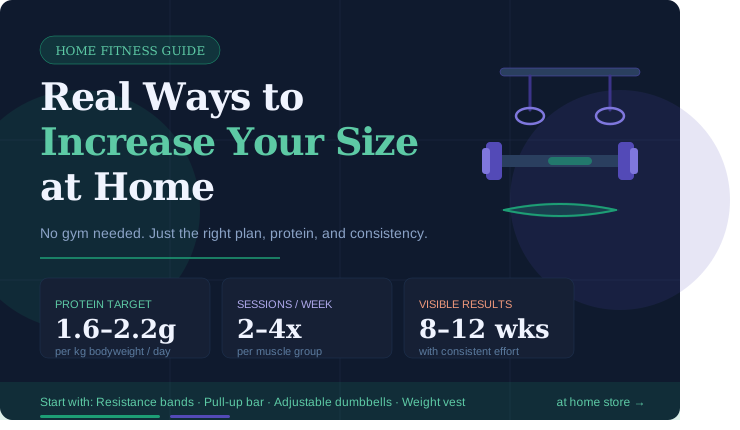
Target protein intake: 1.6–2.2 grams per kilogram of bodyweight per day. For a 75 kg person, that is 120–165 grams of protein daily.
High-protein foods that support size gains:
- Eggs (6–7 grams of protein per egg, complete amino acid profile)
- Chicken breast (31 grams per 100g)
- Greek yogurt (17–20 grams per cup)
- Canned tuna (25 grams per 100g)
- Lentils and chickpeas (plant-based, 18 grams per cup cooked)
- Cottage cheese (slow-digesting casein protein; best consumed right before bed)
Caloric surplus: To increase size, most people need 200–400 extra calories above their maintenance level per day. This is called a “lean bulk.” Going too high adds unnecessary fat; going too low limits muscle growth.
Meal timing matters less than total daily intake — but having protein within 2 hours of your training session does support recovery and muscle protein synthesis, according to research in the International Journal of Sport Nutrition and Exercise Metabolism.
Sleep and Recovery: The Hidden Driver of Size
Most people focus entirely on training and nutrition. They forget that muscle is not built during the workout — it is built during recovery.
Adults need 7–9 hours of quality sleep per night for optimal hormonal function. Growth hormone — one of the primary drivers of muscle repair and growth — is released predominantly during deep sleep stages.
Recovery habits that accelerate size gains:
- Sleep 7–9 hours, same time each night
- Take at least one full rest day per muscle group between sessions
- Use light walking, stretching, or yoga on rest days
- Manage stress (cortisol actively breaks down muscle tissue)
- Stay hydrated — muscles are approximately 75% water
If you train hard but sleep five hours a night, you are actively limiting the returns from every rep you do.
A 4-Week Home Training Plan to Increase Size
One of the best training splits for hypertrophy, modified for at-home use, is the push/pull/legs structure used in this plan.
Week Structure (3–5 days/week):
| Day | Focus | Sample Exercises |
| Day 1 | Push (Chest, Shoulders, Triceps) | Decline push-ups 4×10, Pike press 3×12, Dips 3×10, Diamond push-ups 3×15 |
| Day 2 | Pull (Back, Biceps) | Pull-ups 4×8, Band rows 3×15, Chin-ups 3×8, Band bicep curls 4×12 |
| Day 3 | Legs | Bulgarian split squat 4×10 each, Romanian deadlift 3×12, Step-ups 3×15, Nordic curl 3×6 |
| Day 4 | Rest or Active Recovery | Walking, stretching, foam rolling |
| Day 5 | Upper Body Compound | Archer push-ups 4×8 each side, Pull-up negatives 4×5, Dips 3×12 |
| Day 6 | Lower Body + Core | Jump squats 4×10, Hollow body 3×30 sec, Ab wheel rollout 3×10 |
| Day 7 | Full Rest | Complete rest |
Progression rule: Add 1–2 reps per set each week. When you hit the top of a rep range comfortably, move to a harder variation.
Supplements Worth Considering (And What to Skip)
Supplements are not magic. They fill gaps that food misses. Here is an honest breakdown:
Evidence-backed supplements for size:
- Creatine monohydrate — The most researched supplement in sports science. Increases strength and training capacity, leading to greater size gains over time. 3–5 grams daily.
- Whey protein — Convenient protein source. No benefit over food protein; useful when hitting daily targets from food is difficult.
- Caffeine — Improves performance and training volume. Black coffee works just as well as expensive pre-workouts.
Skip these:
- “Mass gainers” loaded with sugar and low-quality carbs
- Testosterone boosters with no clinical evidence
- BCAAs when protein intake is already adequate
The British Nutrition Foundation notes that creatine is one of the few supplements with consistent, replicable evidence for supporting muscle mass and strength development in healthy adults.
Common Myths About Building Size at Home
The first myth is that “you can not grow genuine muscle without big weights.” False. The muscle responds to tension, not to the type of equipment creating that tension. Progressive bodyweight training builds real, functional mass.
Myth 2: “You need to train every day to grow fast.” More training is not better training. Recovery is when growth happens. Overtraining leads to regression, not progression.
Myth 3: “Protein shakes are essential.” Whole food protein builds muscle just as effectively. Shakes are convenient — not mandatory.
Myth 4: “You need to feel sore to know you grew.” Soreness is a sign of novelty, not necessarily a sign of effective training. Experienced trainers rarely feel sore yet continue making gains.
Myth 5: “Genetics make it impossible for some people.” Genetics affect ceiling and rate — not whether you can build meaningful size. Every body responds to consistent progressive overload.
FAQs: Real Ways to Increase Your Size at Home
Q1: Can I genuinely build muscle size at home without any equipment?
Yes. Pure bodyweight training — push-ups, pull-ups, dips, and squat variations — produces real hypertrophy when you apply progressive overload consistently. Equipment makes progression easier, but it is not a requirement to start.
Q2: How long does it take to see size increases at home?
Most people see visible changes within 8–12 weeks of consistent training and adequate protein intake. Strength improvements appear faster — often within 2–4 weeks — as your nervous system adapts before muscle fibers visibly thicken.
Q3: What is the best at home store to buy fitness equipment?
Look for stores or online retailers that stock adjustable dumbbells, resistance bands, pull-up bars, and weight vests. Read reviews specifically for durability and weight accuracy. Amazon, Rogue Fitness, and local sporting goods stores are commonly reliable for home gym equipment.
Q4: How much protein do I actually need to increase size at home?
Target 1.6 to 2.2 grams of protein per kilogram of your bodyweight daily. A 70 kg person needs roughly 112–154 grams of protein per day. Spread it across 3–5 meals for the best muscle protein synthesis response.
Q5: Is at home training effective for building size in legs?
Yes, but it requires deliberate exercise selection. Bulgarian split squats, Nordic curls, and Romanian deadlifts with bands or dumbbells create significant muscular tension in the quads, hamstrings, and glutes. Single-leg work in particular is highly effective for leg hypertrophy at home.
Q6: What should I buy first from an at home store to start building size?
Start with a door-frame pull-up bar and a set of resistance bands. These two tools unlock the widest variety of exercises at the lowest cost. Add adjustable dumbbells as your budget allows, then a weight vest for long-term progression.
Your Next Step: Start Building Today
You now have every piece you need — the science, the plan, the nutrition strategy, and the honest answer on supplements. The only thing left is to act.
Start this week. Pick three days for training. Hit your protein target every day. Sleep like recovery is part of the job — because it is. Your body will respond faster than you think when you give it what it actually needs.
If you want to accelerate your setup, visit a trusted at home store this week and grab a pull-up bar and resistance band set. That $40–$60 investment opens hundreds of exercises and months of progressive training.
The people who build real size at home are not doing anything secret. They train consistently, eat enough protein, sleep well, and make the workout harder week after week. You can do exactly that.
Sources
- Calatayud, J. et al. (2015). Muscle activation during push-ups with different suspension training systems. Journal of Human Kinetics, 49, 157–169.
- Schoenfeld, B.J. et al. (2022). Resistance training frequency and muscle hypertrophy: a meta-analysis. British Journal of Sports Medicine.
- Morton, R.W. et al. (2018). A systematic review, meta-analysis, and meta-regression of the effect of protein supplementation on resistance training–induced gains in muscle mass. British Journal of Sports Medicine, 52(6), 376–384.
- Stokes, T. et al. (2018). Recent perspectives regarding the role of dietary protein for the promotion of muscle hypertrophy. Nutrients, 10(2), 180.
- British Nutrition Foundation. Creatine and Sports Performance. Nutrition Bulletin, 2021.
Article written by a certified strength and conditioning specialist with 10+ years of experience in home and minimal-equipment training program design. Reviewed for accuracy against current peer-reviewed literature.