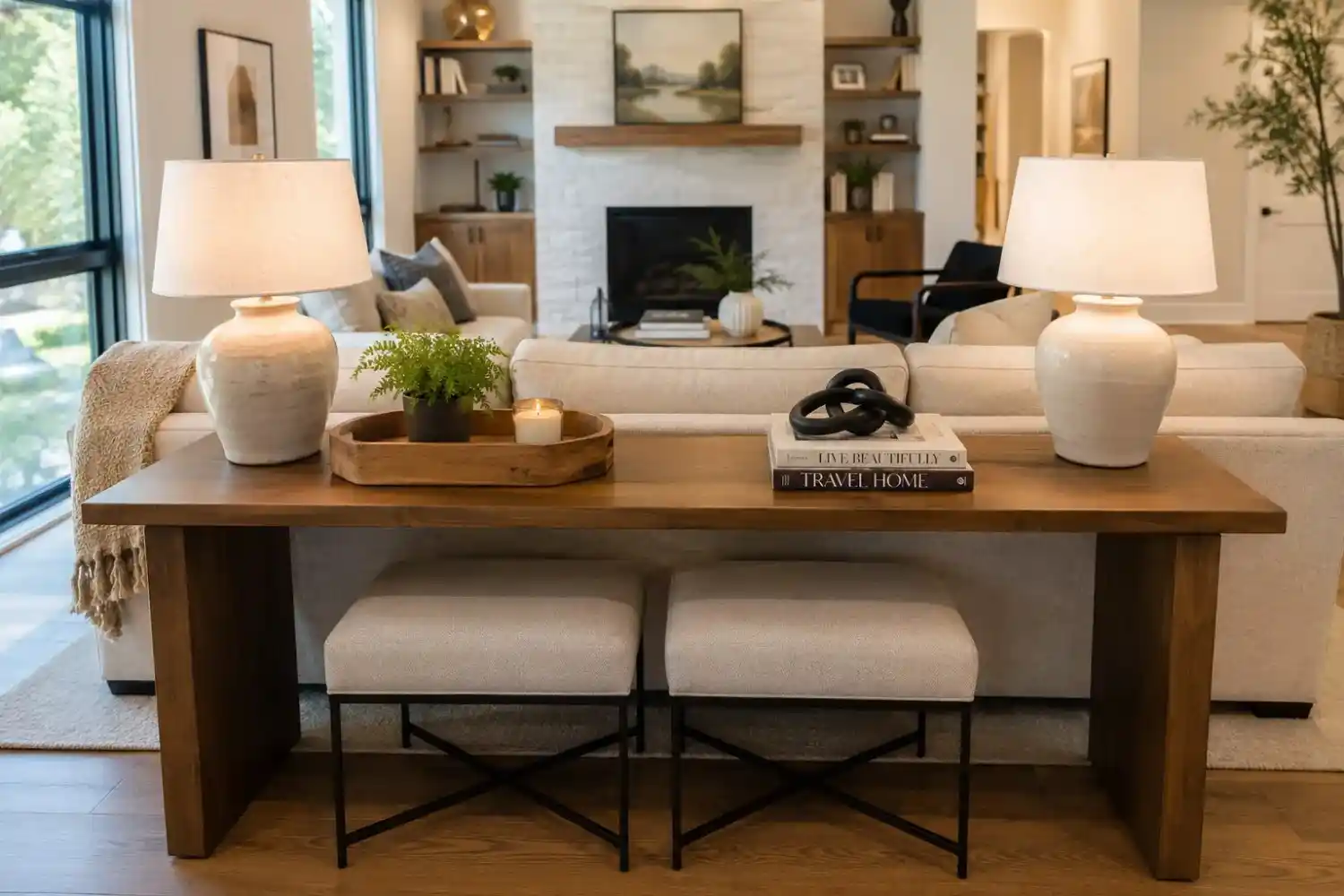
Your couch floats in the middle of the room, leaving an awkward empty strip behind it. That dead zone collects dust and makes the whole living area feel unfinished. A well-chosen sofa table solves this instantly. It bridges the gap, adds function, and pulls your layout together with purpose.
What Exactly Is a Sofa Table?
A sofa table is a long, shallow surface designed to sit directly behind a couch or against the back of a seating piece. Unlike a standard coffee table, it operates at a height roughly equal to or a few inches below the sofa back. Originally borrowed from the console table family, this piece now stands as its own category because of the specific problems it solves in open-plan living rooms. You gain a landing spot for lamps, drinks, books, and decor without reaching forward or cluttering the main seating area. The right sofa table turns dead space behind a couch into a practical, good-looking asset.
Why Every Living Room Benefits from a Sofa Table
Anchoring a floating sofa makes a room feel intentional. A sofa table defines traffic flow and separates zones in an open floor plan without building walls. It also gives you an extra surface exactly where you need it—behind you. You can charge devices, set down a glass, or display photos without a side table blocking pathways. Adding lighting here softens the whole room because the glow comes from behind the seating, eliminating harsh shadows. In small homes, this single piece often replaces a dedicated entry table or a bulky bookshelf, doing multiple jobs without claiming floor space in front of the couch.
Types of Sofa Tables to Match Your Needs
The market splits into a few distinct styles, each built for a different primary job. Understand these categories before you shop, and you will pick the piece that actually works for your daily life.
- Standard open sofa table: A simple top with four legs or a sled base. Best for pure display and surface area.
- Sofa table with storage: Incorporates drawers, shelves, or cabinets to hide clutter.
- Narrow sofa table: Slim depth for tight walkways or compact living rooms.
- Sofa table with stools: Designed with a lower profile and stools that tuck underneath, turning the sofa back into a quick dining or work spot.
- Behind-the-couch bar table: A taller variant that serves as a serving ledge during gatherings.
| Table Type | Best For | Key Feature | Typical Size (L×W×H) |
| Standard Open | Minimalist display | Lightweight and airy | 48–72″ L × 14–18″ W × 30–33″ H |
| With Storage | Hiding daily clutter | Closed cabinets or deep drawers | 48–60″ L × 16–20″ W × 30–32″ H |
| Narrow | Tight walkways | Depth 10–12 inches | 48–60″ L × 10–12″ W × 30–33″ H |
| With Stools | Small-space dual function | Slide-under stools | 48–54″ L × 14–16″ W × 30–36″ H |
| Bar-Height | Casual entertaining | 36-40 inch height | 48–60″ L × 14–18″ W × 36–40″ H |
The Narrow Sofa Table: Space-Saving Genius
A narrow sofa table saves the day when the gap between your couch and the next obstacle is less than 30 inches. With a depth of just 10 to 12 inches, it fits behind the sofa without choking the walkway. You still get a usable top for a thin lamp, a small tray for keys, or a line of framed photos. Many narrow designs use a wall-hugging leg structure or mount directly onto the sofa back. This configuration works brilliantly in apartment living rooms and basement dens where every inch counts. Look for a narrow sofa table with a lower shelf if you want hidden storage without adding bulk.
Sofa Table with Storage: Hidden Organization
A sofa table with storage attacks two problems at once: an empty behind-couch zone and a lack of living room storage. Drawers hide remote controls, charging cables, and coasters. Deep cabinet sections can hold board games, blankets, or pet supplies. Open cubbies let you tuck away baskets that look tidy while swallowing miscellaneous items. When choosing a sofa table with storage, measure the depth of the drawers so they clear the wall or any baseboard heating. Pieces with soft-close hardware add a quality feel and protect little fingers. The top remains clear for decor, and the hidden compartments keep your space looking calm.
Sofa Table with Stools: Entertaining Made Easy
A sofa table with stools rethinks the dead space behind your couch as a dining spot, homework station, or party bar. The table itself sits slightly lower or standard height, and two to four stools slide completely under the overhang when not in use. You keep the clean look of a behind-the-sofa console while gaining instant seating for four without dragging chairs from the kitchen. This setup works especially well in open-plan apartments where a separate dining area does not exist. Select a sofa table with stools that have padded seats and a footrest bar for comfort. The stools should disappear completely beneath the table top so the room never feels crowded.
Perfect Placement: The Sofa Table Behind the Couch
Positioning a sofa table behind the couch follows a few hard rules. Leave at least 30 to 36 inches of walking space between the table edge and the wall or next piece of furniture. The table should run 6 to 12 inches shorter than your sofa length on each side; a table that exactly matches the sofa length visually traps the couch. The height needs to sit level with or up to two inches below the top of the sofa back. A behind sofa table that rises above the backrest blocks sightlines and makes the room feel cut in half. If you float the sofa in the center of a large room, center the table on the sofa’s back, not the rug. That alignment keeps the arrangement anchored.
How to Choose the Right Size Sofa Table
Start with your sofa dimensions. Measure the total length and subtract 12 to 24 inches to find the ideal table length. Measure the depth of the walkway behind the couch and subtract 36 inches for clearance; the remaining number is your maximum table depth. For height, measure from the floor to the top of the sofa back and pick a table within that number. Ignore these numbers, and you risk a table that juts into a walkway or looks like an afterthought.Take the three measurements to the retailer after writing them down. . A tape measure in hand beats any guess.
Styling Your Behind Sofa Table Like a Pro
A behind sofa table works hardest when you style it with layers. Start with anchor objects of different heights. A pair of matching table lamps create symmetry and functional light. Stack a few large art books horizontally and place a small sculptural object on top. Use a tray to corral coasters and a small plant so the surface reads intentional, not cluttered. Leave some empty tabletop visible; negative space keeps the arrangement from screaming for attention. Change the decor seasonally—lighter ceramics in summer, warm wood and candles in fall. The table should feel like a curated vignette, not a dumping ground.
- Place a table lamp at each end for balanced light.
- Add a low tray with a candle, matches, and a small catch-all dish.
- Incorporate one vertical element like a tall vase or a framed photo on a small easel.
- Stack two to three hardcover books as a riser for a decorative object.
- Leave 30 percent of the surface empty so the eye rests.
Materials and Finishes That Last
The material determines how your sofa table ages and how much maintenance it demands. Solid wood—oak, walnut, mango—scratches can be repaired and develops patina. Metal frames with a powder-coated finish resist chips and wipe clean easily. Glass tops make a small room feel airy but show every fingerprint. A reclaimed wood sofa table brings texture and a story, though check that the surface is sealed and smooth. For high-traffic homes, an engineered wood core with a thick veneer gives durability at a lower cost. Run your hand over the edges; they should feel smooth, not sharp. Quality joinery—doweled corners, metal brackets inside—keeps the piece sturdy for years.
DIY Sofa Table Ideas for a Personal Touch
Building your own sofa table cuts costs and guarantees a perfect fit for an oddly sized couch. A simple beginner project uses a finished wood plank from a home center, cut to your exact length, attached with metal hairpin legs. Sand the top smooth, seal it with three coats of water-based polyurethane, and attach the legs with screws. For a behind-the-couch table that charges devices, drill grommet holes for cords and install a slim power strip underneath. Another approach repurposes an old console table by cutting its legs down to match sofa height. Sand, prime, and paint it in a color that pulls from your room’s palette. Always level the finished piece and add felt pads to protect the floor.
Maintenance Tips to Keep Your Sofa Table Looking New
Daily care prevents the slow decay that makes furniture look tired. Dust the surface with a microfiber cloth that grabs particles rather than pushing them around. Wipe spills immediately with a damp, not wet, cloth and dry the area thoroughly. Wood surfaces benefit from a thin coat of beeswax or furniture polish every three months to resist moisture and minor scratches. For metal legs, check screws and bolts every few months and tighten them; a wobbly sofa table becomes a safety hazard. Avoid placing very hot items directly on the surface—use trivets or trays. Keep the piece out of direct sunlight to stop fading and warping.
Frequently Asked Questions
Is it possible to convert a console table into a sofa table?
Yes, a console table works as a sofa table if the height sits level with or just below the sofa back. Check the depth against your walkway clearance and make sure the style suits the room.
What is the standard height for a behind sofa table?
The standard height falls between 30 and 33 inches. This matches most sofa backs and keeps the surface easily reachable without blocking sightlines.
Does a sofa table with stools work in a small living room?
It works exceptionally well because the stools hide underneath and do not consume permanent floor space. You gain a makeshift dining area that disappears when not needed.
How do I stop a sofa table from wobbling on carpet?
Add adjustable leveling feet or furniture glides to each leg. Tighten all fasteners and check that the floor is even; a thin rubber shim under one leg can fix a persistent wobble.
What is the best depth for a narrow sofa table?
A narrow sofa table typically has a depth of 10 to 12 inches. This size allows for comfortable walking space behind the couch and enough surface area for a light and small decor. Should a sofa table be longer or shorter than the sofa?
A sofa table should be shorter than the sofa by 6 to 12 inches on each side. That proportion frames the couch nicely and prevents the table from visually dominating the seating.
Give Your Living Room the Surface It Deserves
An empty space behind your couch does nothing for you.The ideal sofa table turns that empty space into a useful hub with light, storage, and personality. Whether you choose a narrow sofa table for a tight pass-through, a sofa table with storage to hide daily mess, or a sofa table with stools that changes how you host, the key is matching the piece to how you really live. Grab a tape measure, note your sofa height and walkway depth, and pick the behind sofa table that fits both your dimensions and your daily rhythms. Set it up, style it with things you love, and enjoy a room that finally feels complete.
Written by James Adler, certified interior layout specialist with 12 years of experience in space planning and furniture curation. Sources include design guidelines from The Spruce, Apartment Therapy, and the American Home Furnishings Alliance consumer research.