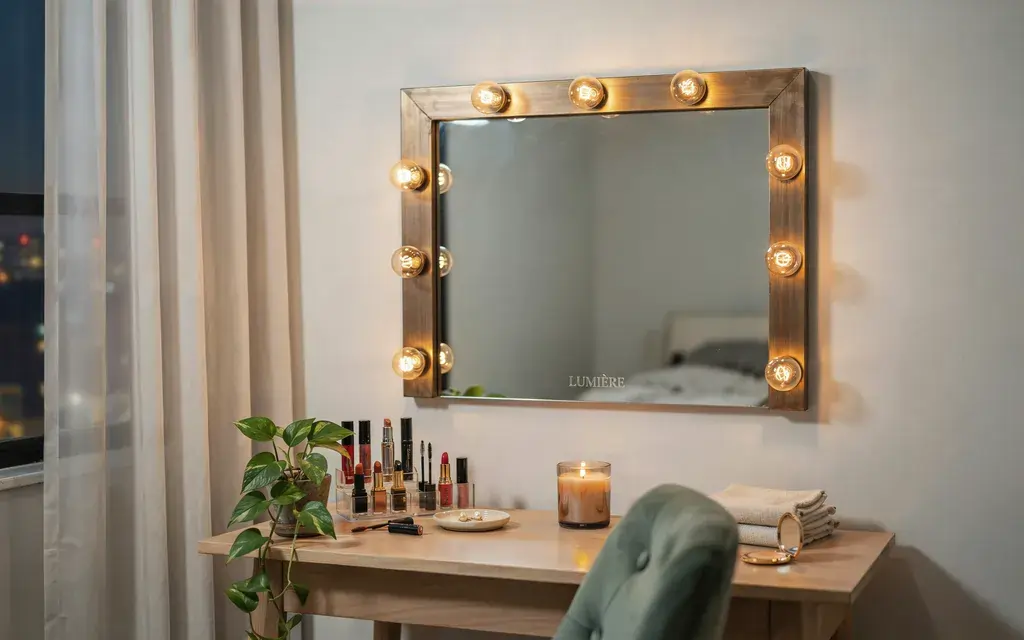
You pick a foundation shade in bathroom light, step outside, and suddenly your face tells a completely different story. Your mirror is the issue, not your makeup. A vanity mirror with lights changes that, giving you studio-quality brightness right at your dressing table. This guide answers every real question about choosing, using, and getting the best from a lighted vanity mirror, so you never walk out the door looking different than you intended.
01 — Why Does a Vanity Mirror With Lights Actually Change Your Makeup?
Quick Answer: Standard room lighting casts shadows across your face and shifts color perception, making it nearly impossible to apply makeup accurately. A vanity mirror with lights surrounds your face with even, shadow-free illumination — the same principle used on every professional film and television set.
The ceiling light in your bathroom is straight above you. That single overhead source throws a downward shadow under your eyes, along the sides of your nose, and under your chin. You blend what looks like a seamless contour under that light, but outdoors or in a restaurant, those shadows reveal patchy blending and mismatched foundation.
A lighted vanity mirror places bulbs around the frame or behind a diffused panel. Light reaches your face from multiple angles at once, eliminating the deep shadows that trick your eyes. This is called even diffused illumination, and it is the foundation of every professional makeup artist’s workspace.
Key Numbers to Know:
- 3× more shadow-free coverage than a standard ceiling light
- 5,000K — the ideal daylight color temperature for accurate makeup
- CRI 90+ — the Color Rendering Index pros use for true color accuracy
- 10× — typical magnification for detail work like brows and liner
Color Rendering Index (CRI) measures how accurately a light source shows the true color of objects. Natural sunlight has a CRI of 100. Most overhead LED bulbs sit around 80. A quality vanity mirror with lights should hit CRI 90 or higher — anything below that will slightly distort skin tone, making it harder to match concealer and foundation shades.
Pro Insight: Hollywood makeup artists position lighted mirrors at eye level, not above. Eye-level lighting creates the same conditions as most public spaces — where your makeup will actually be seen.
02 — Which Bulb Type Is Best in a Lighted Makeup Mirror?
Quick Answer: LED bulbs win for almost every buyer. They last 25,000–50,000 hours, stay cool to the touch, reach high CRI values, and use very little energy. Hollywood-style incandescent bulbs look glamorous but burn hot, drain power, and need frequent replacements.
The type of bulb in your vanity mirror with lights determines heat output, lifespan, energy cost, and — most critically — color accuracy. Here is how each option compares in practical, daily use.
LED (Light Emitting Diode)
Modern LED technology in a lighted makeup mirror reaches CRI values between 90 and 97. LEDs emit almost no heat, which matters when you sit close to the mirror for 20 minutes every morning. They are available in adjustable color temperatures, letting you switch from warm (3,000K) to cool daylight (6,500K) with a touch.
Hollywood-Style Incandescent Globe Bulbs
The classic round bulbs circling a theatrical dressing-room mirror produce warm, flattering light around 2,700K. They feel luxurious and produce CRI scores close to 100 — technically excellent. The trade-off is real: incandescent bulbs generate significant heat at close range, last roughly 1,000 hours, and increase your electricity bill. They also do not replicate outdoor daylight, so foundation shades matched under incandescent glow can look noticeably orange in natural light.
Fluorescent
Older lighted vanity mirrors sometimes used fluorescent tubes. These have higher CRI than standard room lights but flicker at low brightness and shift toward green-tinted light as they age. Most quality manufacturers have moved away from fluorescent entirely.
Smart Choice: If you love the Hollywood aesthetic but want practicality, look for mirrors that use LED bulbs shaped like classic globes. You get the vintage look without the heat or energy draw.
Bulb Type Comparison Table:
| Bulb Type | CRI | Lifespan | Heat Output | Color Temp Range | Best For |
| LED (Best) | 90–97 | 25,000–50,000 hrs | Very low | 3,000K–6,500K | Daily makeup, all-purpose |
| LED Globe (Hollywood style) | 85–95 | 15,000–25,000 hrs | Low | 2,700K–3,000K | Aesthetic setups, warm tone |
| Incandescent Globe | 95–100 | 800–1,200 hrs | High | 2,700K fixed | Theatric look, less practical |
| Fluorescent | 75–85 | 8,000–15,000 hrs | Medium | 4,000K–5,000K | Budget mirrors (aging tech) |
03 — What Size Vanity Mirror With Lights Do You Actually Need?
Quick Answer: For everyday face and makeup use, a mirror between 18 and 24 inches wide gives full-face visibility without overwhelming a standard dresser. Full-body or large wall-mounted lighted mirrors work best in dedicated vanity rooms or walk-in closets.
Mirror size affects both function and comfort. Too small, and you tilt your head constantly to check different areas of your face. Too large for your space, and the mirror dominates the room or catches glare from windows behind you.
Size Reference by Use Case:
- Compact travel mirror (6–10 inches): Fits in a carry-on bag. Good for touch-ups and travel, but tight for a full makeup application routine.
- Personal tabletop mirror (12–16 inches): Fits on small desks or crowded surfaces. Shows your full face comfortably.
- Standard vanity mirror (18–24 inches): The sweet spot for most people. Full-face view with space to work. Fits most vanity tables.
- Large Hollywood mirror (28–36 inches): Studio-quality coverage for makeup artists or dedicated vanity setups. Takes up significant counter space.
- Full-length lighted mirror (48–72 inches): Dress and accessory checks from head to toe. Needs wall mounting or a sturdy floor stand.
Sizing Rule: Before buying, mark the width and height of your intended mirror on the wall or table with painter’s tape. Live with those dimensions for a day. This simple step prevents a very common and expensive return.
Distance also matters. Sit at your actual dressing table and measure from your face to the mirror surface. For precision work like eyebrows, eyeliner, and lash application, 12–18 inches of working distance works best. If your mirror sits further back, a separate magnifying mirror on a flexible arm solves the detail problem without forcing you to lean forward uncomfortably.
04 — How Bright Should Your Vanity Mirror With Lights Be?
Quick Answer: Most people need a lighted vanity mirror with at least 1,000 lumens and a dimmer control. Color temperature should be adjustable between 3,000K (warm) and 6,500K (cool daylight). Daylight settings around 5,000K give the most accurate makeup application.
Brightness in a vanity mirror with lights is measured in lumens — not watts.While lumens measure real light production, watts measure energy expenditure. A mirror putting out 800 lumens feels noticeably dim for detailed makeup work. Anything above 1,500 lumens with a working dimmer gives you full flexibility from a soft evening glow to crisp daytime light.
Color Temperature Explained Simply
Color temperature is measured in Kelvin (K). Lower numbers produce warm, amber-toned light. Higher numbers produce cool, blue-tinted daylight. For makeup, you want light that mimics where you will be seen:
- 2,700K–3,000K (Warm White): Flattering and soft. Great for skincare routines, but warm tones make foundation and bronzer appear deeper than they truly are.
- 4,000K–4,500K (Neutral White): A balanced middle ground. Shows color fairly accurately without the harshness of cool light.
- 5,000K–6,500K (Daylight/Cool White): Closest to natural sunlight. Reveals every detail, texture, and color shift. The professional standard for makeup accuracy.
“Matching your mirror light to your destination light is the single biggest upgrade most people overlook. Office lighting sits near 4,000K. Outdoor noon sunlight sits at 5,500K. Match your mirror to where you spend your day.”
The best lighted makeup mirrors offer tri-color switching or a continuous color temperature slider. This lets you check your look under warm home tones, then verify accuracy at daylight settings before you walk out the door — effectively auditing your makeup in two different environments without leaving your seat.
05 — What Types of Lighted Vanity Mirrors Are Available?
The market for a vanity mirror with lights has expanded well beyond the classic Hollywood dressing-room style. Each design solves a different set of real-world constraints. Knowing which type matches your space and routine saves you from buying twice.
Hollywood Bulb Mirror Globe bulbs around the frame. Maximum glamour. Best for dedicated vanity setups with permanent counter space. Large format, statement piece, high lumen output.
Backlit LED Panel Thin, frameless design with LEDs behind a diffuser panel. Ultra-even light with no visible hotspots. Slim profile, modern look, wall-mountable.
Tri-Fold Tabletop Three-panel design with a main mirror and two angled side panels. See profiles and angles without turning your head. Offers 360° view, compact storage, travel-friendly.
Smart Mirror App-connected with memory settings for light presets, sometimes includes a built-in display for tutorials or time. Features app control, memory presets, premium build.
Ring Light Mirror Circular LED ring around the mirror frame. Popular for content creators because the ring produces the catchlight effect on camera. Great for content creators, camera-ready looks, even diffusion.
Magnifying LED Mirror Compact mirror with 5×, 7×, or 10× magnification and built-in LED strips. Built for precision detail work — brows, liner, lashes. Small footprint.
06 — Full Feature Comparison: Vanity Mirror With Lights Types at a Glance
Use this table to match mirror type against your real requirements. A feature you never use is not a benefit — it is just extra cost.
| Mirror Type | Ideal Space | Dimmer | Color Temp Adj. | Magnification Option | Price Range | Best Suited For |
| Hollywood LED Bulb | Large vanity table / dedicated room | Yes | Mostly fixed warm | Rare | $80–$400 | Glam setups, influencers |
| Backlit LED Panel | Wall-mounted or tabletop | Yes | Yes (most models) | No | $50–$250 | Everyday makeup, skincare |
| Tri-Fold Tabletop | Dresser, bathroom counter | Yes | Yes | Often included | $40–$180 | Small spaces, travelers |
| Smart Mirror | Permanent vanity setup | Yes | Yes — Full range | Some models | $150–$600+ | Tech-forward buyers |
| Ring Light Mirror | Desk, tabletop, content studio | Yes | Yes | No | $30–$120 | Creators, video calls |
| Magnifying LED | Bathroom counter, small shelf | Sometimes | Usually fixed | Yes (5×–10×) | $25–$100 | Detail work, lenses, brows |
Price ranges reflect typical retail across major platforms as of mid-2026.
07 — How Do You Set Up a Vanity Mirror With Lights Correctly?
Quick Answer: Position the mirror at eye level, facing you directly. Make sure no windows sit behind or to the side of the mirror, which creates competing light sources. Then set color temperature to match your destination lighting before finalizing your makeup.
Even a premium lighted makeup mirror gives poor results if placed incorrectly. The setup process takes five minutes and makes a noticeable difference from day one.
Step-by-Step Setup:
- Height: Position the mirror so the center sits at your eye level when seated. Most vanity chairs place seated eye level around 48–52 inches from the floor.
- Distance: Sit at a natural, comfortable posture and position the mirror 14–20 inches from your face. This distance works for full-face tasks without needing to lean in.
- Window management: Sit so any windows are in front of you or to your side — not behind the mirror. A window behind the mirror creates a strong backlight that competes with your vanity mirror with lights and creates shadows on your face.
- Power source: Use a dedicated outlet if possible. Sharing a circuit with hair dryers or other high-wattage tools causes voltage fluctuations that make LED dimmer levels jump.
- Cable management: Route cords through cable clips or a desk grommet so they stay out of your working area.
- Color temp calibration: On first use, spend two minutes switching through color temperatures while looking at your face in natural conditions. Find the setting that matches your skin color most accurately — that is your baseline.
Common Setup Error: Placing a lighted vanity mirror directly under an overhead light doubles the shadow problem. The overhead light still hits from above, and your new mirror light hits from in front — two competing sources that still create uneven coverage. Turn off overhead lights when using your vanity mirror for best results.
08 — What Mistakes Do Most People Make With Lighted Vanity Mirrors?
A vanity mirror with lights is only as good as the habits built around it. These are the most common errors that erase the benefit of a quality mirror.
Mistake 1: Buying Based on Look Alone
Hollywood mirrors with visible globe bulbs photograph beautifully on social media. But if those bulbs produce only 2,700K warm light with no adjustment option, you cannot accurately check whether your cool-toned blush reads correctly outdoors. Always verify color temperature range and CRI before buying.
Mistake 2: Ignoring the Dimmer Range
Many budget lighted makeup mirrors have a dimmer that only adjusts between 50% and 100% brightness. For a gentle morning skincare routine, 100% brightness is simply too much. Look for a mirror that dims smoothly all the way down to 10–20%.
Mistake 3: Using Maximum Magnification for Full-Face Work
A 10× magnifying mirror is exceptional for plucking brows or applying contact lenses. It is the wrong tool for blending foundation or checking contour. Magnification distorts spatial relationships across your face. Use a standard 1× mirror for full-face makeup, and reach for the magnifying side only for precision tasks.
Mistake 4: Not Cleaning the Mirror Surface
Fingerprints, hairspray residue, and makeup mist accumulate quickly on a vanity mirror.Even mild spreading across the glass surface diminishes reflectance and makes color interpretation tougher. Clean the mirror glass weekly with a microfiber cloth and a 50/50 water and white vinegar solution.
Mistake 5: Buying Too Small for Your Routine
A 10-inch compact mirror feels adequate in the store. At home, when you are actually applying a full face — foundation, contour, highlight, eye look, and lips — you constantly reposition and tilt. A mirror that shows your full face without repositioning cuts your routine time and improves accuracy.
09 — Which Vanity Mirror With Lights Is Right for Your Situation?
Rather than a ranked list of specific product models (which change with availability and pricing), these recommendations match mirror type and feature set to real-world buyer situations.
| Your Situation | Recommended Mirror Type | Must-Have Features | Skip If… |
| Daily commuter, 20-min routine | Backlit LED panel, 18–22 inch | 5,000K daylight mode, dimmer, USB port | You need 10× magnification |
| Makeup artist or MUA student | Hollywood LED, 28–36 inch | CRI 95+, high lumen output, adjustable color temp | You work in small shared spaces |
| Small apartment, limited counter space | Tri-fold tabletop or wall-mounted backlit | Foldable design, wall bracket included | You need full-length body view |
| Content creator / beauty influencer | Ring light mirror with phone holder | Ring catchlight effect, phone/camera arm, 3-color temp | You already use a separate ring light |
| Detail-focused (brows, lashes, lenses) | LED magnifying mirror, 7× or 10× | 360° rotation arm, 5,000K daylight, 10× panel | You need full-face coverage |
| Travel makeup routine | Foldable compact LED, 8–12 inch | USB-C charging, dual-voltage, lightweight under 1 lb | You have a fixed home vanity setup |
| Skincare enthusiast | Backlit panel with warm light mode | Warm 3,000K mode, no glare, large surface | Color accuracy for makeup is the priority |
Brands Worth Researching
Several manufacturers have built consistent reputations in the lighted vanity mirror category. Impressions Vanity specializes in professional Hollywood-style setups with customizable bulb configurations. Fancii produces reliable magnifying LED mirrors with strong CRI scores. Conair offers accessible entry-level lighted mirrors for everyday use. Simplehuman targets the premium smart mirror segment with sensor-activated lighting and true daylight simulation.
For budget-conscious buyers, several direct-to-consumer brands deliver solid CRI 90+ performance at competitive price points — always verify CRI in the product specifications, not just in the product title.
10 — How Do You Keep a Lighted Makeup Mirror Performing Its Best?
Quick Answer: Clean the glass weekly, wipe bulbs monthly with a dry cloth, check for loose connections every few months, and avoid aerosol hairspray directly near the mirror. Quality LED lighted vanity mirrors need no bulb replacements for several years under daily use.
Most lighted vanity mirrors last 5–10 years with reasonable care. The LED components themselves rarely fail — the most common issues are dimmer circuit degradation and connector corrosion from humidity in bathroom environments.
Maintenance Checklist:
- Weekly: Wipe the mirror glass with a damp microfiber cloth. Never spray glass cleaner directly onto the surface — spray onto the cloth and then wipe.
- Monthly: Dust around the LED bulbs or diffuser panel with a dry cloth. Dust buildup reduces light output by 10–15% over time.
- Every 3 months: Check all cable connections for any signs of looseness, especially if the mirror has been adjusted frequently.
- Annually: Test all dimmer positions through their full range. Sticky or jumping dimmer response is an early sign of circuit wear.
- Ongoing: Keep aerosol products (hairspray, setting spray) at least 18 inches away from the mirror. Aerosol residue deposits on LED diffusers and affects color temperature over time.
Longevity Tip: If your vanity mirror with lights sits in a bathroom with a shower, humidity accelerates connector corrosion. A small silica gel packet tucked behind the mirror base reduces moisture buildup and extends the dimmer circuit’s working life significantly.
FAQ — Frequently Asked Questions About Vanity Mirrors With Lights
Q: What wattage should a vanity mirror with lights have?
Short Answer: Look for 12–25 watts total for a standard LED lighted mirror. Output matters more than wattage.
Wattage tells you energy consumption, not light quality. A 15-watt LED lighted vanity mirror can produce more usable light than a 40-watt fluorescent model because LED converts more energy into visible light. Focus on lumen output (aim for 1,000–2,000 lumens) and CRI (aim for 90+) rather than wattage alone. Hollywood-style mirrors with multiple globe bulbs may use 40–80 watts total, which is fine if the bulbs are LED — just not if they are incandescent.
Q: Can a lighted vanity mirror work without being plugged in?
Short Answer: Yes. Battery-powered and USB rechargeable models exist, but brightness is lower than corded mirrors.
Battery-operated and USB rechargeable lighted makeup mirrors are genuinely useful for travel or spaces without a convenient outlet. The trade-off is total lumen output — rechargeable mirrors typically produce 400–800 lumens compared to 1,200–2,000 for corded models. They also require regular charging, which is easy to forget until the middle of your morning routine. For a permanent vanity setup, a corded mirror is always the stronger choice. For travel or occasional use, a USB-C rechargeable compact mirror with at least 6 hours of battery life works well.
Q: Is a vanity mirror with lights good for skincare routines as well as makeup?
Short Answer: Yes, particularly for checking skin texture, pores, and product blending — especially in warm light mode.
A lighted vanity mirror with an adjustable color temperature setting serves skincare routines just as well as makeup. Warm light (3,000K) creates a relaxing environment for morning and evening skincare steps and shows skin texture softly. If you use skincare tools like gua sha, facial rollers, or dermaplaning devices, the even illumination helps you see exactly where you are working. Switch to daylight (5,000K) after applying sunscreen or tinted moisturizer to verify even coverage before you leave the house.
Q: What is the difference between a ring light and a vanity mirror with lights?
Short Answer: A ring light is a separate lighting accessory; a lighted vanity mirror integrates the light into the mirror frame itself.
A ring light is a standalone circular light source usually mounted on a stand or arm. It produces the distinctive circular catchlight in the eye associated with beauty content. A vanity mirror with lights integrates the light source directly into the mirror — either as surrounding bulbs, a backlit panel, or a ring within the mirror frame. For makeup application, an integrated lighted mirror is more convenient because you look directly at your reflection while the light works. A separate ring light requires careful positioning and often takes more setup time. Some modern lighted mirrors combine both — a mirror with a built-in ring-style LED around its frame.
Q: Do smart vanity mirrors actually improve your makeup routine?
Short Answer: For most people, no — the app control and display features are convenient but rarely worth the significant price premium.
Smart lighted vanity mirrors offer app-controlled brightness and color temperature, memory presets, and sometimes built-in displays for timers or tutorial videos. The memory preset feature genuinely saves time if you switch between “morning makeup” and “evening touch-up” settings regularly. However, most smart features duplicate what a good manual dimmer and color temperature dial already handle. The meaningful reasons to pay more for a smart lighted mirror are: you want saved presets shared across multiple users, you want voice control integration with a smart home system, or you genuinely use the display feature for tutorials. If none of those apply, a quality non-smart LED vanity mirror delivers the same lighting performance for significantly less.
Q: How can I determine whether the color accuracy of my illuminated vanity mirror is adequate?
Short Answer: Check the CRI (Color Rendering Index) in the product specs. A CRI of 90 or above indicates accurate color reproduction.
CRI measures how accurately a light source reproduces color compared to natural sunlight (which has a CRI of 100). A lighted vanity mirror with a CRI of 85 or lower will make foundation shades look slightly different than they appear in daylight — a frustrating and expensive problem when you buy products that do not match your skin outdoors. Look for CRI 90 as your minimum and CRI 95+ for professional-grade accuracy. Budget mirrors often omit CRI from their listings entirely, which is itself a warning sign. If a lighted makeup mirror does not state its CRI in the specifications, contact the seller before buying or choose a different model that discloses this information.
Your Next Step Toward a Better Beauty Routine
A vanity mirror with lights is one of the highest-impact upgrades you can make to your daily routine — not because it is a luxury item, but because it solves a genuine, repeatable problem. Wrong lighting misleads every choice you make at the mirror: foundation shade, blush placement, concealer blending, liner precision. Fix the light, and everything downstream improves.
Use the comparison table in this guide to shortlist the mirror type that fits your space. Then verify CRI, color temperature range, and dimmer smoothness before you buy. Those three specifications tell you more about daily performance than any product photo or influencer review.
If you found this guide useful, share it with someone whose makeup “never looks the same outside.” The answer is almost always their lighting — and now you have the knowledge to explain exactly why.
Sources & References
- Illuminating Engineering Society (IES). Recommended Practice for Lighting Office Work Spaces. IES RP-1-12. New York, 2012.
- Office of Scientific and Technical Information, U.S. Department of Energy. LED Lighting Technology Basics. energy.gov/eere
- National Institute of Standards and Technology (NIST). Color Measurement Science — Spectral Reflectance. nist.gov
- American Academy of Dermatology Association. Skin Care on a Budget. aad.org
- International Commission on Illumination (CIE). Office of Scientific and Technical Information, U.S. Department of Energy. CIE 13.3-1995.